 Lynden Siding
 Custer's Exterior Climate: Three Problems at Once
Custer sits close enough to Birch Bay and the Strait of Georgia that homes here catch a mix of weather most inland Whatcom County properties don't deal with. There's the salt-tinged air moving in off the water, the steady, low-intensity rain that defines this whole corner of Washington, and the long stretch of wet, shaded months that let moss take hold on anything that stays damp. None of these three is dramatic on its own. Together, over years, they're what actually wears out a house's exterior.
We work throughout Lynden and the surrounding Whatcom County communities, and Custer homes tend to show a specific pattern: siding that looks fine from the street but is failing at the seams, roofs with moss lines running down from the ridge, and window trim that's soft to the touch before the glass itself ever becomes a problem. Understanding why that pattern shows up here is the first step to building an exterior that actually holds up.
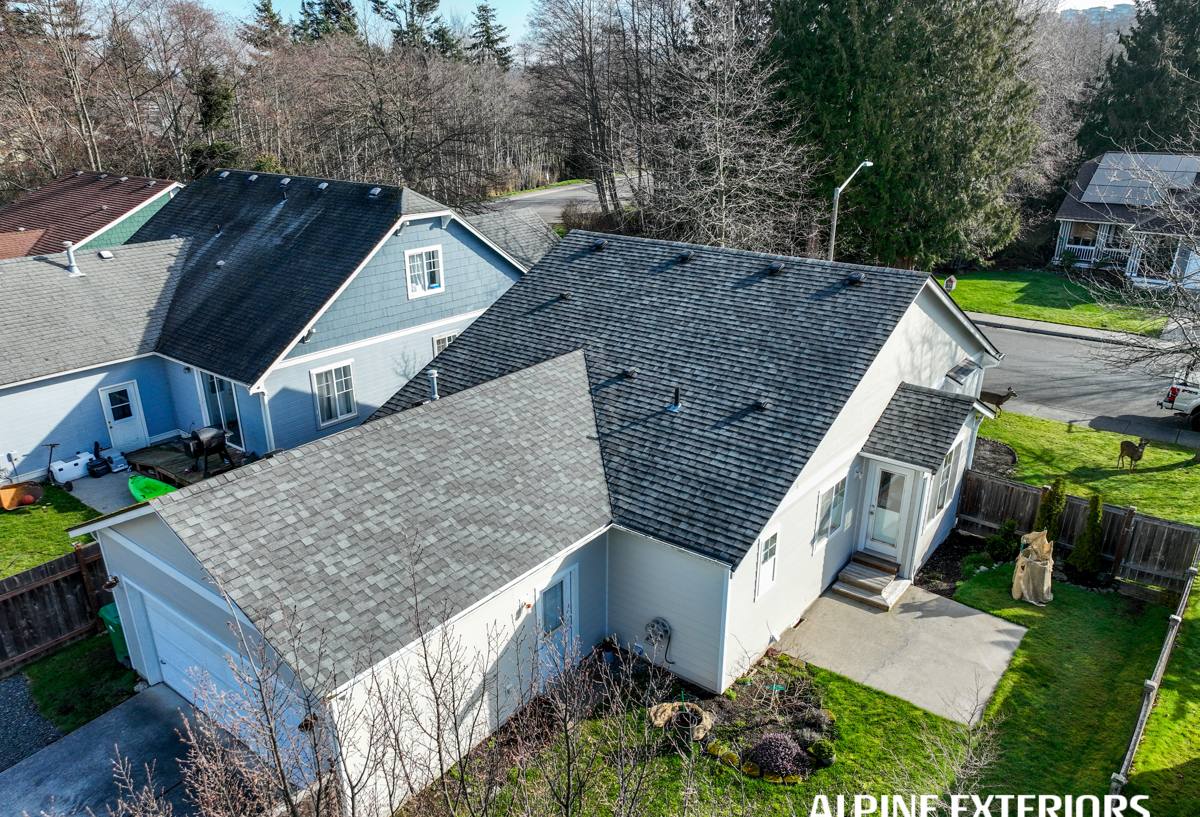
What Salt Air Actually Does to a House
Salt-laden air doesn't have to come from right on the beach to matter. Wind carries fine salt particulate well inland, and in a low-lying, breezy area like Custer it settles on every exterior surface — siding, trim, fasteners, and roofing metal alike. Over time this accelerates corrosion in exposed metal fasteners and flashing, and it can leave a chalky residue on painted or coated surfaces that traps moisture against the substrate underneath.
Where It Shows Up First
The earliest signs are usually small: rust bleeding through paint around nail heads, corrosion on hose bibs and light fixtures, or a dull, gritty film on siding that used to look clean after a rinse. On siding that isn't built to handle repeated wet-dry salt cycling, that surface breakdown eventually opens the door to moisture getting behind the material — which is where real damage starts.
Rain and Moss: The Slower, Bigger Threat
Whatcom County's rain isn't usually the heavy downpour kind — it's the persistent, misty, all-day kind that keeps exterior surfaces damp for long stretches without ever fully drying between events. Add tree cover and north-facing walls that don't get much direct sun, and you've got ideal conditions for moss and algae to establish themselves on roofing, siding, and even deck boards.
Why Moss Is More Than Cosmetic
Moss holds moisture against whatever it's growing on. On a roof, that means shingles and the sheathing beneath them stay wetter longer, shortening the life of the roofing system. On siding, moss and algae growth at butt joints, behind trim, and along the bottom courses signals that water is sitting there rather than shedding — and any siding product with joints that aren't properly sealed or flashed will eventually let that moisture find its way into the wall assembly.
Why We Only Install James Hardie Fiber Cement
We made a deliberate call as a company: we install James Hardie fiber cement siding, and we don't install LP SmartSide, vinyl, Cemplank, Allura, primed spruce, or cedar. That's not a marketing position — it's a standard we hold ourselves to because of what we've seen happen to exteriors in exactly this kind of climate.
What the Other Products Get Right
Vinyl is inexpensive and low-maintenance in mild climates. Cedar has genuine natural appeal and a long tradition in the Pacific Northwest. Engineered wood products like LP SmartSide are lighter and easier to handle on site than fiber cement. None of that is in dispute.
Where the Trade-Offs Show Up in Custer's Climate
The problem is what happens over ten, fifteen, twenty years of salt air and near-constant moisture exposure. Cedar and primed spruce are organic wood products — they need consistent repainting or staining to stay protected, and any lapse in that maintenance schedule lets moisture in, which invites rot and the kind of moss and mildew growth this area encourages. Engineered wood siding is bonded wood strand product; if its factory-sealed edges and surface are compromised — through impact, poor installation, or just age — moisture intrusion can spread through the substrate in a way that's hard to catch early. Vinyl can handle rain fine, but it expands and contracts significantly with temperature swings, its seams and caulked joints are the weak point for wind-driven rain, and it doesn't offer meaningful protection where salt exposure and impact resistance both matter.
Fiber cement is cement, sand, and cellulose fiber — it's non-combustible, it doesn't rot, and it doesn't feed the kind of organic growth that wood-based products can. That's the specific reason it holds up better against the salt-rain-moss combination that defines Custer's exterior climate.
| Factor | James Hardie Fiber Cement | Vinyl | Cedar / Primed Spruce | LP SmartSide |
|---|---|---|---|---|
| Moisture/rot resistance | Does not rot; engineered for moisture | Won't rot but seams can leak | Vulnerable without upkeep | Vulnerable if seal is broken |
| Salt air performance | Factory finish resists chalking/fade | Can chalk and become brittle over time | Finish breaks down faster near salt exposure | Coating wear is a known concern |
| Maintenance | Occasional wash; no repainting needed | Low, but seams/caulk need checks | Repaint/restain every few years | Periodic coating maintenance |
| Fire resistance | Non-combustible | Melts/deforms under heat | Combustible | Combustible |
| Typical warranty | Long-term, transferable | Varies by manufacturer | Manufacturer paint warranty only | Manufacturer-specific |
How Hardie's Product Lines Are Built for This
James Hardie engineers its siding by climate zone, and the HZ5 formulation used in our region is built specifically for areas with significant moisture exposure. The ColorPlus factory finish is baked on under controlled conditions, which gives it far more consistent coverage and UV/salt resistance than field-applied paint ever achieves — and it comes with its own finish warranty separate from the product warranty on the siding itself.
Why That Matters Near the Water
A factory finish that resists chalking and fading holds up better against the fine salt residue that settles on Custer homes than a site-painted surface does. And because the substrate itself is fiber cement rather than organic wood, moss and algae that do take hold on the surface aren't feeding off the material the way they can with wood-based sidings — they're just sitting on top of it, which makes routine cleaning far more effective.
It's Not Just Siding — The Whole Exterior Has to Work Together
We handle siding, roofing, windows, and decks, and in a climate like Custer's those systems aren't independent. A roof holding onto moss too long sheds extra runoff and debris straight down the wall behind it. Window flashing that's been compromised by years of wet-dry cycling can leak into the wall cavity long before it shows up as a stain on the siding. Deck ledger boards and fasteners face the same salt-air corrosion siding fasteners do.
Why We Look at the Full Envelope
When we're on a Custer property for a siding estimate, we're also looking at roof condition, window flashing, and deck structure, because a new siding job installed against a roof that's dumping moss and debris onto it, or windows that are already leaking behind the trim, won't perform the way it should. Fixing one system while ignoring an obviously failing neighbor system just moves the problem.
What Correct Installation Looks Like Here
Fiber cement siding performs the way it's engineered to only when it's installed to Hardie's specifications — this is a product that's sensitive to installation quality in ways that matter more in a climate like this one.
The Details That Matter Most in Custer
- Proper clearance between the bottom of the siding and grade, decking, or roofing to avoid capillary moisture wicking
- Correct fastener type and spacing to resist the additional stress of salt-air corrosion over time
- Properly lapped and sealed flashing at every window, door, and penetration
- Factory-cut and painted edges kept intact, with field cuts sealed per manufacturer instruction
- Ventilation gap and weather-resistive barrier detailing that lets any incidental moisture dry out rather than sit
Skipping any one of these doesn't usually cause an immediate problem — it shows up three, five, or ten years later as exactly the kind of moss, staining, or soft trim we see on older Custer homes that were sided by crews unfamiliar with the specifics of this climate and this product.
Cost Factors for a Custer Siding Project
Every home is different, but the main variables that move a project's scope and cost are consistent enough to plan around.
| Factor | Why It Affects Scope |
|---|---|
| Existing siding condition | Rot or hidden moisture damage found during tear-off adds sheathing repair |
| Home size and wall complexity | More corners, gables, and trim detail means more labor and cut waste |
| Siding profile and finish | Lap width, shingle-style panels, and trim/color choices vary in material cost |
| Flashing and window trim needs | Older window flashing often needs upgrading during a re-side |
| Access and site conditions | Tree cover, slope, and staging space affect labor time |
Maintaining Your Exterior Once It's Done
Fiber cement is genuinely low-maintenance, but "low" isn't "none" — especially in a climate that keeps pushing moss and salt residue at your house year-round.
- Rinse siding and trim once or twice a year to clear salt residue and light surface grime
- Keep gutters clear so overflow doesn't run down the wall and feed moss growth at the top courses
- Trim back tree limbs and shrubs that keep siding shaded and damp longer than the rest of the house
- Check caulking at trim and penetrations every year or two and re-caulk where it's cracked or pulled away
- Have your roof checked for moss buildup — a roof shedding moss debris onto siding below undoes a lot of the benefit of a clean re-side
Why a Local Crew Matters in Custer
A crew that works Whatcom County regularly knows which walls on a Custer property take the worst weathering, how much clearance really matters given local moisture patterns, and what the salt-air fastener and flashing details need to look like in practice — not just on a spec sheet. That local familiarity is part of why the installation details above get done right the first time, rather than becoming a callback five years down the road.
If you're seeing moss buildup, chalky or failing siding, or just want an honest look at what your home's exterior needs, we're happy to come out and take a look. There's no pressure and no obligation — just a straightforward assessment and a free estimate using the form below.