 Lynden Siding
 Laurel's Climate Is Harder on Siding Than It Looks
Laurel sits in the same weather pattern that shapes all of rural Whatcom County: wet winters, damp shoulder seasons, and a marine air influence that carries salt and moisture further inland than most homeowners expect. It's easy to assume that because Laurel isn't right on the water, siding here gets an easier ride than homes closer to Birch Bay or Semiahmoo. In practice, the difference is smaller than people think. Moist Pacific air moves through the lowlands, settles against tree lines and outbuildings common to this area, and keeps exterior surfaces damp for long stretches at a time.
That combination of salt-tinged air, driving rain that comes in sideways during winter storms, and a moss season that can run from October through April is exactly the kind of environment that separates siding products that hold up from siding products that need constant attention. We've built our whole business around installing one product system that's engineered for this: James Hardie fiber cement. We don't install vinyl, LP SmartSide, cedar, primed spruce, Cemplank, or Allura, and we're upfront about why.
What Driving Rain Actually Does to a Wall System
Wind-driven rain doesn't just wet the surface of siding — it pushes water sideways and upward into laps, seams, and fastener penetrations. On a house with good overhangs and correctly installed siding, that water sheds. On a house with tight eaves, exposed trim joints, or siding that wasn't lapped and flashed to spec, water finds its way behind the cladding. Once moisture gets behind siding in a climate that doesn't dry out quickly, it stays there — and that's when rot, mold, and structural damage start, often invisibly, until paint starts failing or a wall feels soft.
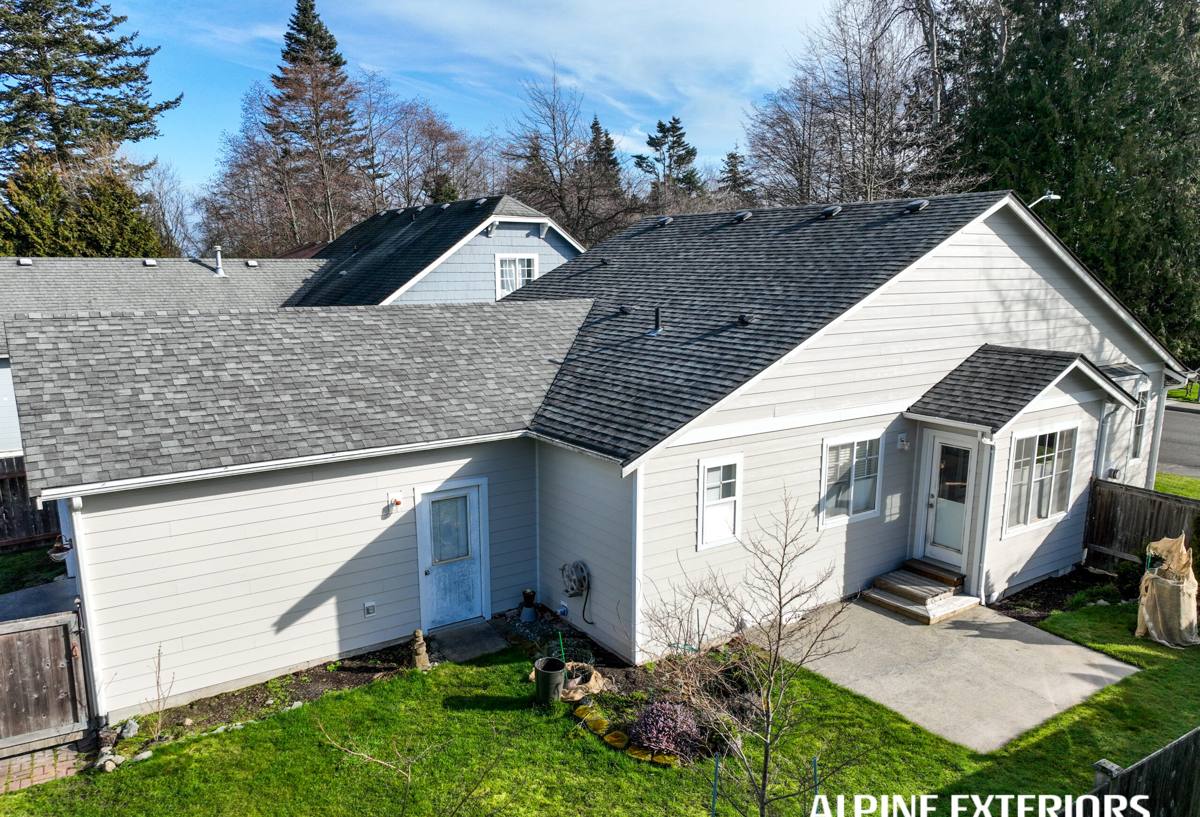
Why Moss and Organic Growth Are a Bigger Deal Here Than People Realize
Whatcom County's tree cover, shade patterns, and near-constant winter humidity create ideal conditions for moss, algae, and lichen to colonize exterior surfaces. Homes tucked near tree lines or with north-facing walls that don't get much sun exposure are especially prone. This isn't just a cosmetic issue:
- Moss holds moisture against the siding surface far longer than open air would allow
- Organic growth in seams and laps can trap water against fasteners and trim
- Wood-based products (cedar, primed spruce, and to a lesser extent OSB-core products like LP SmartSide) can absorb that trapped moisture and begin to swell, delaminate, or rot at the exposed points
- Vinyl doesn't rot, but moss and algae still stain it, and the material itself can warp or become brittle over time from UV and temperature cycling
Fiber cement doesn't give moss and algae the organic material to feed on, and it doesn't absorb water the way wood-based products do. That doesn't mean a Laurel home never sees moss on its siding — spores land on anything — but the substrate underneath isn't compromised by that growth the way wood fiber can be.
Why We Only Install James Hardie
We get asked fairly often why we don't offer vinyl or LP SmartSide as a lower-cost option. The honest answer is that we've seen how each of these products performs over a full lifecycle in exactly this climate, and we'd rather turn down work than install something we don't believe will hold up on a Laurel home for the next 30-plus years.
Vinyl Siding
Vinyl is inexpensive and low-maintenance in the sense that it doesn't need repainting. But it's a thin, flexible material that expands and contracts significantly with temperature swings, which over time opens gaps at seams and corners — exactly where wind-driven rain wants to get in. It also isn't fire-rated the way fiber cement is, and it tends to look and feel like what it is: plastic cladding, not a long-term architectural material.
LP SmartSide and Other Wood-Based Composites
LP SmartSide is an engineered wood product with a resin-treated strand core. It's a genuine improvement over old-school OSB siding, and it holds paint well when properly maintained. The trade-off is that it's still wood at its core — if the factory-sealed edges get compromised (a common installation and re-caulking sensitivity point), moisture can get into the substrate and cause swelling or delamination. In a climate with Laurel's moss season and driving rain, that's a maintenance burden we're not willing to take on.
Cedar and Primed Spruce
Real wood siding has a warmth and character that's hard to replicate, and we understand the appeal. But it demands the most maintenance of any option — regular refinishing, vigilant caulking, and active moss and mildew management — or it will degrade fast in this environment. For homeowners who want that look without the upkeep, Hardie's woodgrain-textured ColorPlus panels are the closer answer.
Cemplank and Allura
These are other fiber cement manufacturers, and the base material — cement, sand, and cellulose fiber — is fundamentally similar to Hardie's. Our decision to standardize on Hardie specifically comes down to their HZ5 climate engineering for the Pacific Northwest, the factory-applied ColorPlus finish (which is baked on and warranted separately from the substrate), and the depth of their installer network and warranty support in this region. Consistency in what we install lets our crews master one system rather than splitting attention across several.
Cost Factors for Laurel Homeowners
Every siding job is different, but these are the variables that move the price on a typical Laurel project:
| Factor | Why It Matters |
|---|---|
| Home size and wall complexity | More corners, dormers, and trim details mean more cutting, flashing, and labor time |
| Current siding removal | Tear-off of old wood, vinyl, or damaged siding adds labor and disposal cost |
| Water-damaged sheathing | Rot found once old siding comes off has to be repaired before new siding goes on — this is common on older Whatcom County homes |
| Hardie product line and profile | Lap siding, shingle-style panels, and board-and-batten each have different material and install costs |
| Trim and accessory scope | Corner boards, window trim, and fascia work are often bundled with a siding project |
| Site access | Rural lots, long driveways, and setback from the road can affect staging and labor time |
We give straightforward, written estimates after an in-person look at the house — not a phone-quote guess.
What Correct Installation Looks Like
Fiber cement's reputation for durability depends entirely on installing it to the manufacturer's spec. This is where a lot of the real-world performance difference between a good siding job and a problem siding job comes from, regardless of product:
- Proper water-resistive barrier and flashing behind every seam, window, and door opening
- Correct nailing pattern and fastener depth — over-driven nails crack panels and under-driven nails let panels move
- Proper clearance at grade, roofline, and deck ledger connections so siding never sits in standing water
- Factory-cut and field-cut edges treated per Hardie's specification, since raw cut edges need to be sealed correctly
- Correct caulking at joints — with the right products, applied correctly, not just wherever a gap shows
We follow Hardie's published installation instructions to the letter because that's what keeps their warranty valid and what actually keeps water out of the wall assembly over the long haul.
Why a Local Crew Matters in Laurel
Laurel is unincorporated and rural enough that it doesn't get the same contractor attention as siding jobs closer to town. That's part of why we treat every service area, Laurel included, as a real commitment rather than an afterthought. A crew that works Whatcom County regularly understands things a traveling or out-of-area contractor doesn't have a feel for: how far winter rain drives sideways in an open field versus a tree-sheltered lot, how much moss pressure a north wall near a wooded property line takes on, and what kind of trim and flashing detail actually holds up here versus what looks fine on paper.
Being local also means we're reachable after the job is done. If a warranty question comes up or you want a second look at something years down the road, you're calling a crew that's still working in your area, not chasing down a company that moved on to the next county.
Beyond Siding: Roofing, Windows, and Decks
Siding doesn't work in isolation — it's one part of the building envelope. We also handle roofing, windows, and decks, because these systems all interact:
- Roofing: Poor roof drainage and undersized gutters dump water directly onto siding and trim below, which accelerates exactly the moisture problems described above
- Windows: Window flashing and siding integration is one of the most common failure points on older homes — new siding is a good time to address aging window flashing
- Decks: Deck ledger boards attached to a house need proper flashing where they meet the wall, or they become a chronic leak point behind the siding
Handling all four means fewer trades pointing fingers at each other when something needs attention, and one crew that understands how the whole exterior is supposed to work together.
Signs It's Time to Look at Your Siding
- Paint that's peeling, bubbling, or needing repainting more often than every 7-10 years
- Soft spots, visible warping, or delamination at panel edges and corners
- Persistent moss or algae staining that comes back quickly after cleaning
- Visible gaps or separation at seams, corners, or trim joints
- Rising energy bills that may point to compromised insulation behind failing siding
None of these mean an emergency, but they're worth a professional look before winter storm season, not after.
If you're in Laurel and thinking about your home's siding, roofing, windows, or decks, we're happy to come take a look and give you a straightforward, no-pressure estimate — no scare tactics, just an honest read on where your home stands.