 Lynden Siding
 Every siding call we run in Whatcom County starts with the same question from the homeowner: "Can this be patched, or do we need to replace it?" It's a fair question, and the honest answer is that it depends on more than what you can see standing on the sidewalk. This guide walks through how we actually make that call in the field, so you can have an informed conversation with any contractor you bring out — not just us.
Why This Decision Is Harder Here Than in Most Places
Lynden sits far enough inland to avoid the worst of coastal wind-driven rain, but Whatcom County still gets a heavy dose of the marine climate that defines Western Washington: salt-tinged air moving up from the Strait of Georgia and Bellingham Bay, long stretches of driving rain from fall through spring, and a moss and algae season that can run eight or nine months out of the year on north-facing walls and shaded elevations. That combination means siding here ages differently than siding in a dry climate. A wall that looks "mostly fine" from the driveway can be hiding moisture damage that a homeowner in Spokane or Arizona would never have to think about.
That's the core of the repair-vs-replace decision: it's not really about how bad the visible damage is. It's about what's happening behind the siding, and how much useful life the rest of the system has left.
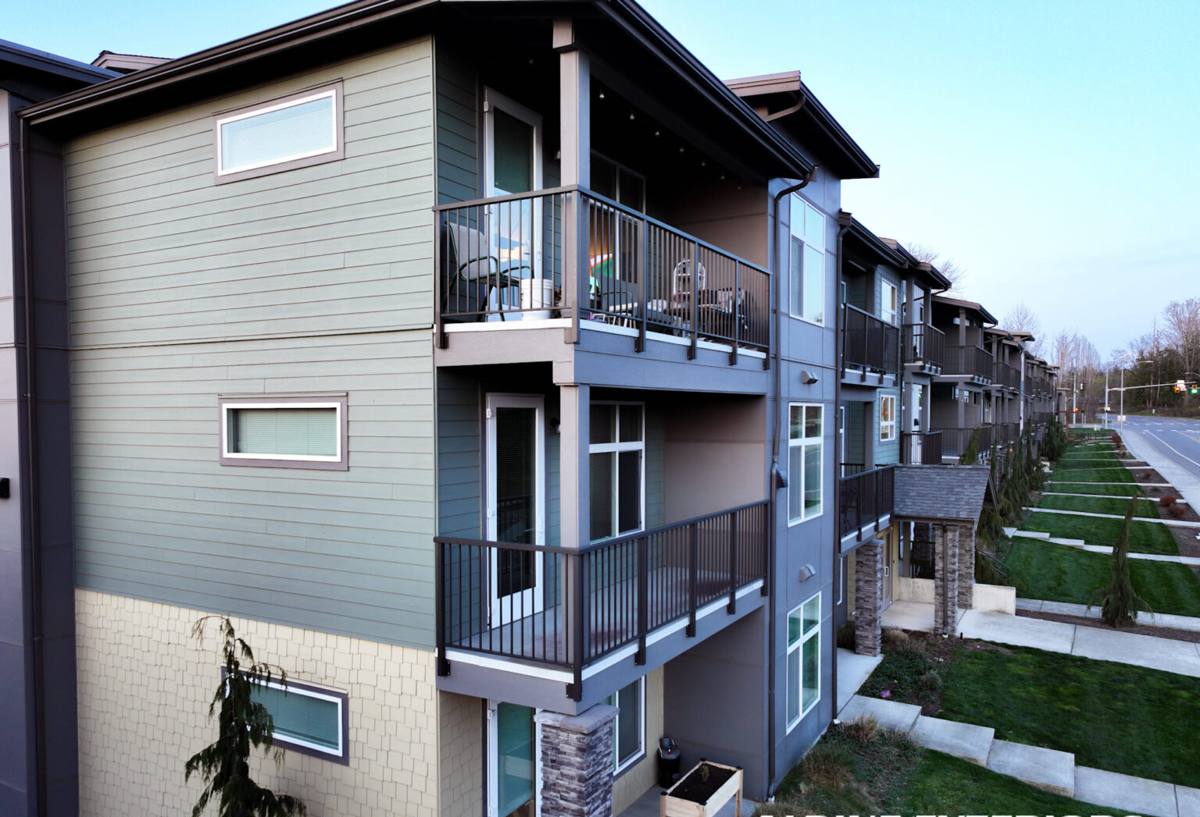
When Repair Genuinely Makes Sense
We're not in the business of talking every homeowner into a full tear-off. Plenty of siding problems are legitimately isolated, and fixing them is the right call — both financially and practically.
Good candidates for repair
- A small number of cracked or split boards on an otherwise sound wall, with no soft spots around them
- Impact damage from a fallen branch or equipment, limited to one or two panels
- Failed caulking or trim joints that are letting water in, but haven't caused wood rot yet
- Isolated moss or algae staining that's cosmetic rather than a sign of trapped moisture
- Siding that's less than 10-15 years old, generally sound, with damage clearly traceable to one event
If a moisture meter and a close inspection confirm the sheathing and framing behind the damaged section are dry, patching or board-replacement is honest, cost-effective work. We'll tell you that directly — there's no upside for us in replacing siding that doesn't need it.
When Repair Is a Band-Aid, Not a Fix
The harder conversation happens when the visible damage is a symptom of something systemic. This is where a lot of homeowners get steered wrong, either by a contractor eager to sell a bigger job, or by one who's happy to "just patch it" and move on without checking what's underneath.
Signs the problem is bigger than it looks
- Soft, spongy, or bubbling siding in multiple areas, not just one spot
- Persistent dark staining, mildew smell, or peeling interior paint on the wall behind the siding
- Siding that's warped, buckling, or pulling away from the wall in more than one location
- Widespread moss growth that's established itself under lap edges rather than just on the surface
- Original siding is 20+ years old and made of a material with a known moisture-sensitivity history
- Damage clusters near ground level, roof valleys, or deck ledger boards — classic water-entry points
When we find one or two of these, we open up a section to look at the sheathing directly. If the wood underneath is compromised, patching the visible board and leaving the rot behind it is exactly the kind of shortcut that turns a $2,000 repair into a $20,000 structural problem five years later. We won't do that kind of patch job, even if it's what a homeowner asks for — we'll explain why and let them decide with full information.
The Material Question: What's Actually On the Wall
How much weight repair-vs-replace decisions carry often comes down to what the existing siding is made of. This matters more in a climate like ours than almost anywhere else in the country.
| Material | How it tends to age here | Repair outlook |
|---|---|---|
| Cedar (untreated or under-maintained) | Absorbs moisture, prone to rot at laps and butt joints, moss takes hold easily | Repairable if caught early; often past the point once damage shows |
| Primed spruce/pine lap | Factory primer is thin protection against sustained wet weather; swells and delaminates at edges | Frequently a sign of widespread failure once one board goes |
| Vinyl | Doesn't rot itself, but traps moisture behind it if installed tight; UV and impact damage common | Individual panels replaceable, but color-matching aged vinyl is often impossible |
| Older fiber cement (non-Hardie or early formulations) | Generally durable, but some older products had known moisture and finish issues | Case-by-case; depends on the specific product and installation quality |
| James Hardie fiber cement (properly installed) | Engineered for wet climates, factory ColorPlus finish resists moisture intrusion at the surface | Rarely needs anything beyond caulk and trim touch-ups |
We say this plainly because it's the honest pattern we see on job sites across Whatcom County: homes sided in wood or vinyl tend to reach a point where repair stops making sense years before homes sided correctly in fiber cement do. It's not that every wood or vinyl job fails — it's that the failure mode, once it starts, tends to be structural and spreading rather than cosmetic and contained.
The Real Cost Comparison
Homeowners usually want a dollar figure up front, and we understand why — but a useful comparison has to include more than the invoice for the work itself.
Factors that belong in the decision, not just the quote
- Remaining life of the untouched siding. Repairing a 22-year-old wall means the new section will still be sitting next to material nearing the end of its service life.
- Color and texture matching. Faded or discontinued products rarely match new material, especially after years of UV exposure and Whatcom County's moss growth patterns.
- Hidden sheathing and framing costs. If rot is found once walls are opened, that cost exists whether you called it a "repair" or a "replacement" going in.
- Frequency of future repairs. A wall that's needed three repair visits in five years is telling you something about the material, not just the workmanship.
- Resale and insurance considerations. Documented full replacement with a modern, non-combustible material can matter to future buyers and insurers alike.
A single-wall repair is almost always cheaper in the moment. Whether it's cheaper over ten years depends entirely on what's causing the damage in the first place.
What a Proper Inspection Actually Looks Like
Before anyone tells you "repair" or "replace," a real inspection should include a few specific steps. If a contractor skips all of these, get a second opinion.
- Moisture meter readings at multiple points, not just the visibly damaged spot
- A look behind at least one board or panel near the worst damage, to check sheathing condition
- Inspection of flashing at windows, doors, and roof-to-wall transitions — the most common hidden entry points for water
- A check of grade and drainage at the foundation line, since splashback is a frequent, overlooked cause of lower-wall rot
- An honest age and material assessment of the siding that isn't currently showing damage
This is the same process we use whether a homeowner ends up doing a two-board patch or a full re-side. The goal is giving you an accurate picture, not steering toward whichever job is bigger.
Why We Rebuild With James Hardie When Replacement Is the Right Call
When an inspection points toward full replacement, we install James Hardie fiber cement siding exclusively. It's a deliberate standard, not a default. Hardie's HZ5 product line is engineered specifically for climates with sustained moisture exposure like ours, the material is non-combustible, and the factory-applied ColorPlus finish is baked on under controlled conditions rather than field-painted — which matters a great deal in a region where paint has to cure through damp, low-light stretches of the year. It also carries a strong transferable warranty, which is worth something concrete if you sell the home before the siding's service life is up.
We don't install LP SmartSide, vinyl, Cemplank, Allura, primed spruce, or cedar. Each of those has legitimate uses in the right application, but we've made a professional judgment that Hardie gives Lynden and Whatcom County homeowners the best combination of moisture performance, finish durability, and long-term value for our specific climate — and we'd rather stand behind one system we know inside and out than offer several we have reservations about.
A Simple Way to Think About It
If you're standing in front of a damaged wall trying to decide what to do, ask three questions: Is the damage isolated to a clearly identifiable cause? Is everything around it dry and sound when checked, not just eyeballed? And is the rest of the siding young enough and durable enough that a patch will actually blend in and hold up? If you can answer yes to all three, repair is a reasonable, honest path. If any answer is no, it's worth getting a full replacement estimate before spending money on a fix that may not last.
If you're not sure which category your siding falls into, we're happy to come take a look. We'll give you a straight answer — repair, replace, or "wait and monitor" — and if it's a job we don't think we're the right fit for, we'll tell you that too. Reach out for a free, no-pressure estimate using the form below.