 Lynden Siding
 Two Fiber Cement Products, One Choice We Made
Every so often a homeowner in Lynden asks us for a quote on Cemplank fiber cement siding, usually because they've seen it at a big box store or a neighbor mentioned it as a cheaper alternative to James Hardie. It's a fair question, and it deserves a straight answer rather than a sales pitch. Cemplank is a real fiber cement product, made by CertainTeed, a legitimate manufacturer. It is not vinyl, it is not a knockoff, and it will do a reasonable job protecting a house for a number of years. We simply don't install it, and we think you deserve to know exactly why before you make a decision that will sit on your walls for decades.
This isn't about running down a competitor's product. It's about explaining the trade-offs we weighed when we standardized our entire business on one fiber cement line, and why that line is James Hardie rather than Cemplank. Whatcom County throws a specific combination of conditions at exterior siding — salt-laden air off Bellingham Bay and the Sound, long stretches of driving rain, and a moss season that can run from October well into April. Those conditions are exactly where the differences between fiber cement products start to matter.
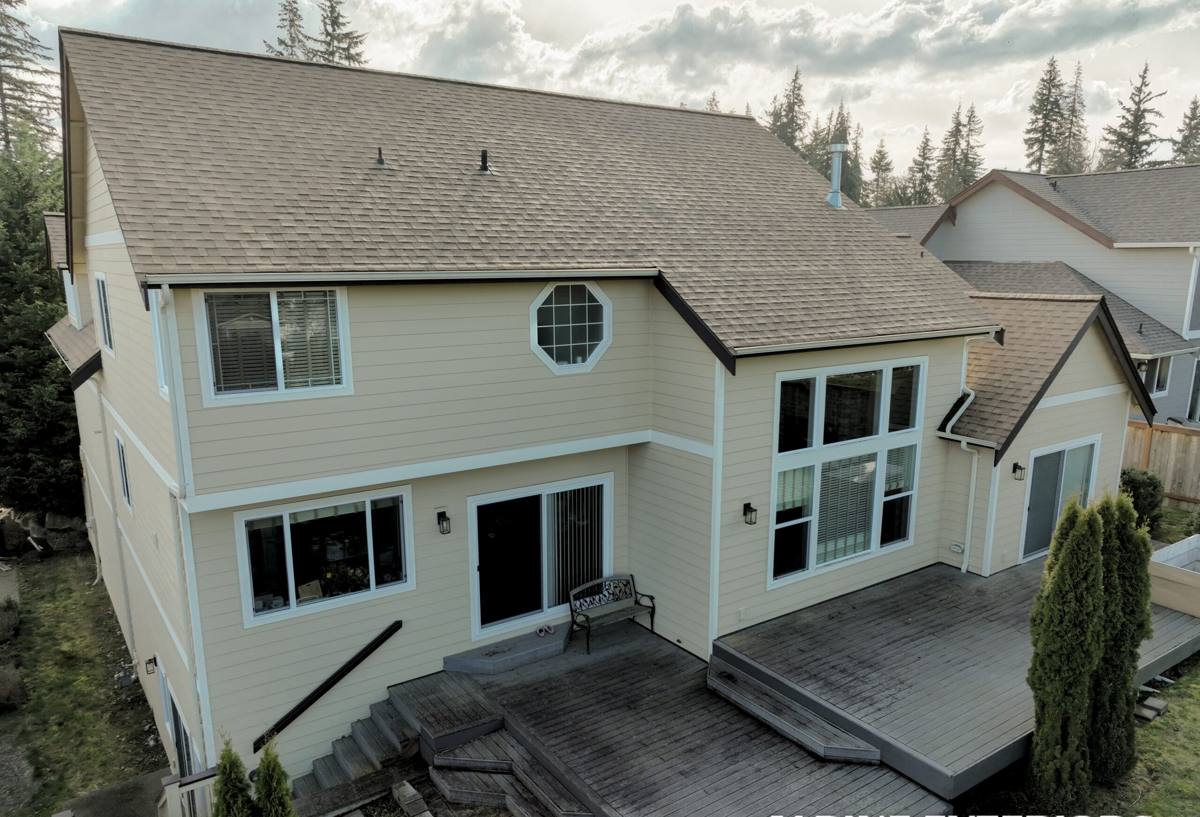
What Cemplank Gets Right
Fiber cement as a category is a good choice for this climate, and Cemplank shares the core advantages of the material: it's non-combustible, it resists rot in a way wood and engineered wood products don't, and it holds paint far better than vinyl over the long run. It's also typically less expensive than James Hardie per square foot, which is a real and understandable draw for homeowners working with a tight budget. If cost were the only factor, we'd understand why some contractors install it.
We're not going to pretend there's some hidden defect in the product itself. The differences that matter to us are in the manufacturing consistency, the climate engineering, the finish system, and the support structure behind the product once it's on your house — and those differences add up over a 20 or 30 year timeline.
Where the Gap Shows Up
Fiber cement is a manufactured product, and manufacturing consistency is not something you can eyeball at the time of installation. It shows up years later, in how evenly a batch of boards weathers, how well factory-applied finish holds its bond, and how closely a repair board purchased later actually matches the boards already on the wall. This is the area where we've seen the most day-to-day friction with non-Hardie fiber cement products in the field.
Climate-Engineered Formulations
James Hardie manufactures its siding in different formulations for different climate zones — HZ5 for the wetter, cooler regions like ours, versus formulations built for hot, dry, or high-UV climates elsewhere in the country. That's not a marketing label; it changes the mix design of the cement board itself to better handle moisture cycling, freeze-thaw at the edges of Whatcom County near the foothills, and the kind of sustained damp exposure we get from driving rain off the Sound.
Cemplank does not offer that same zone-specific engineering. A board that's formulated as one-size-fits-most is going to perform fine in a lot of the country. Whether it's the right call for a house two miles from saltwater, sitting under fir trees that keep it shaded and damp for half the year, is a separate question — and it's the one we're not willing to gamble on when we're the ones standing behind the installation.
Factory Finish and Color Consistency
This is probably the single biggest practical difference homeowners notice, usually a few years in rather than on install day. James Hardie's ColorPlus finish is baked on at the factory in a controlled environment, with a finish warranty backing it separately from the substrate warranty. That baked-on finish is why Hardie board holds color and resists fading, chalking, and peeling significantly better than field-painted fiber cement.
Cemplank is typically sold primed rather than factory-finished in the same way, which means the final paint job depends entirely on the field painting crew, the weather conditions on the day it's painted, and the quality of paint used. In a region where you're often racing rain windows to get exterior work done, that's a real variable. A factory-applied finish removes that variable entirely — the color consistency is set before the boards ever leave the plant, batch after batch.
Warranty Structure
Warranties only matter if they're clear and if someone is actually around to honor them. James Hardie backs its siding with a long-term, transferable limited warranty on the substrate, plus a separate warranty on the ColorPlus finish — and Hardie has been manufacturing fiber cement in North America for decades, with a large enough installed base and dealer network that warranty claims have a track record of actually getting resolved.
| Factor | James Hardie | Cemplank |
|---|---|---|
| Finish | Factory-baked ColorPlus finish, separate finish warranty | Typically field-primed, painted on site |
| Climate formulation | Zone-specific (HZ5 for our region) | General-purpose formulation |
| Warranty | Long-term, transferable, established claims history | Manufacturer warranty exists, shorter track record locally |
| Regional availability | Wide contractor and supply network in the Pacific Northwest | More limited distribution, mainly big-box |
| Upfront cost | Higher per square foot | Generally lower per square foot |
Availability for Repairs and Matching
Siding gets damaged. A ladder slips, a branch comes down in a windstorm, a delivery truck backs into a corner board. When that happens five or ten years after installation, you need to be able to source a matching board without the color, profile, or texture standing out like a patch. James Hardie's distribution network through professional siding suppliers in this region is deep enough that we can reliably get matching product for repairs. Cemplank's distribution leans more heavily on big-box retail, and matching an exact profile and finish years later is a harder problem — sometimes the exact product isn't available at all by the time a repair is needed.
Contractor Training and Installation Standards
Fiber cement is not a forgiving material to install poorly. Fastener placement, clearances, caulking practices, and flashing details all affect how the product performs over time, especially in a climate with this much sustained moisture exposure. James Hardie runs a structured contractor training and certification program, and installers who go through it are held to documented installation standards tied to the warranty itself.
We built our installation crews around that standard because it gives us — and you — a documented, repeatable process rather than relying purely on individual crew experience. That's not a claim that other fiber cement products can't be installed correctly. It's that we didn't want to run two different installation standards across our crews, and we chose to standardize on the one with the deepest training infrastructure behind it.
What We Look For Before Recommending Any Siding Job
- Correct climate-zone product formulation for coastal Whatcom County conditions
- Factory-applied finish with its own separate warranty coverage
- A manufacturer warranty with a real local claims track record
- Reliable long-term availability of matching repair stock
- An installation standard our crews are trained and certified against
- Proper rainscreen or drainage plane detailing behind the siding, not just the siding itself
Why We Standardized on One Product
A siding contractor can install more than one brand — plenty do. We chose not to, on purpose. Running one product line means every crew member knows the fastening schedule, the caulking points, the trim details, and the punch-list standards cold, instead of switching mental models between jobs. It means when we tell you what warranty coverage you have, we're not hedging between two different manufacturer policies. And it means when a homeowner calls us eight years later about a repair, we know exactly what's on the wall and how to match it.
For a house near Lynden dealing with salt air drift, driving winter rain, and months of moss pressure on north-facing walls, that consistency matters more than the savings on a cheaper board. Moss and sustained dampness are unforgiving of any weak point in a siding system — a poorly sealed seam or a finish that starts chalking early gives moisture somewhere to work, and in this climate it will find it.
The Bottom Line
Cemplank is a legitimate fiber cement product, and there are markets and climates where it performs perfectly well. Our decision not to install it isn't a verdict on the product in general — it's a statement about the specific standard we hold ourselves to on every roof we work under in Whatcom County. Between the climate-specific formulation, the factory finish and its separate warranty, the depth of the regional supply and repair network, and the structured installation training behind James Hardie, it's the product we're willing to put our name behind for the long haul.
If you're weighing siding options for a home in Lynden or anywhere else in Whatcom County, we're happy to walk through what we install, why, and what it would look like on your specific house. Reach out for a free, no-pressure estimate — there's no obligation, and we'd rather you make an informed decision than a rushed one.