 Lynden Siding
 Two Fiber Cement Products, One Standard We Hold To
If you've gotten quotes from more than one siding contractor in Lynden, you've probably noticed that not everyone installs the same brand of fiber cement siding. Allura and James Hardie both make a legitimate product category — fiber cement board is cement, sand, and cellulose fiber pressed and cured into a rigid plank that resists fire, rot, insects, and the freeze-thaw cycling that eventually cracks vinyl and wears down wood. That part isn't in dispute.
Our company made a decision a while back to install James Hardie exclusively and turn down jobs where a homeowner specifically wants Allura installed by us. We want to explain that decision honestly, rather than just say "trust us." Whatcom County's climate — the driving rain off the Strait of Georgia, the salt-tinged air moving in from the coast, and a moss season that can run eight or nine months out of the year — is unforgiving of siding that isn't engineered and finished exactly right. That's the lens this whole page is written through.
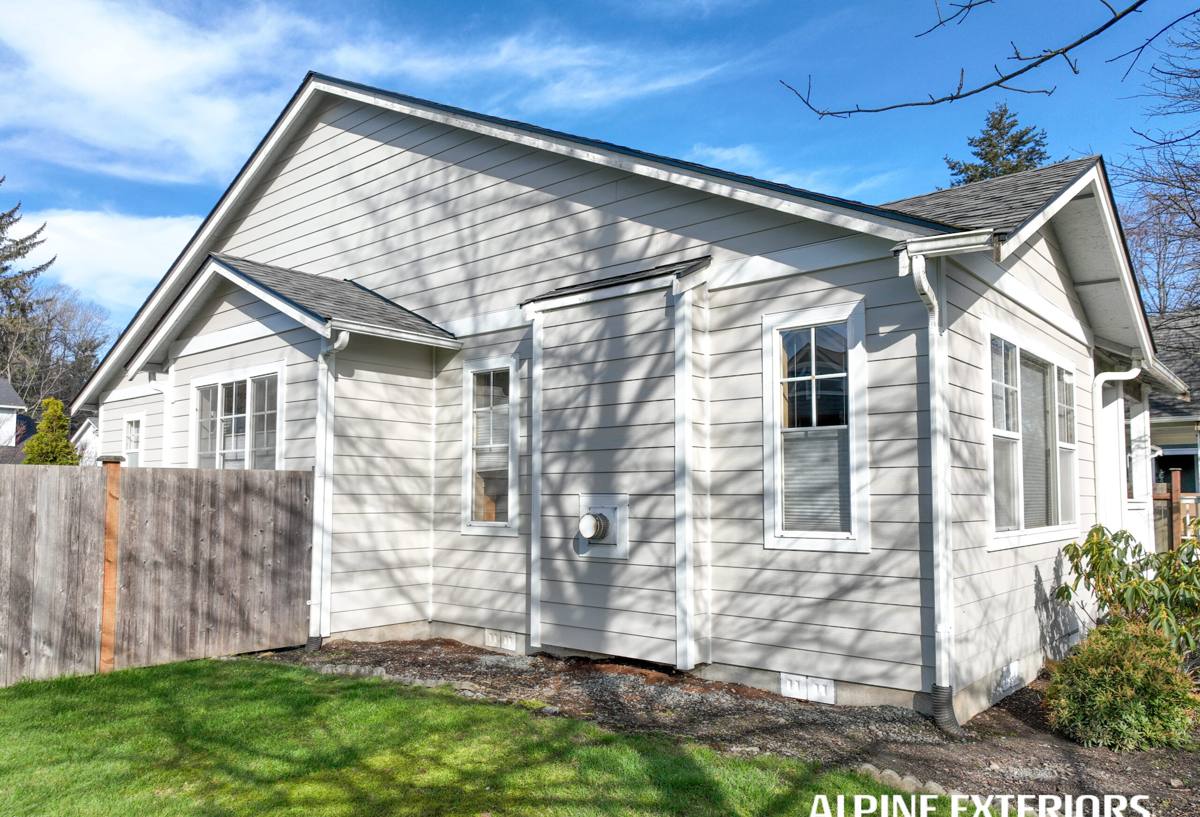
What Allura Gets Right
Allura fiber cement is a real competitor in this space, not a knockoff. It's manufactured to meet the same ASTM standards for fiber cement cladding, it's non-combustible like any fiber cement product, and it's priced competitively — often somewhat below Hardie in material cost. For a homeowner comparing bids on price alone, that gap is real and we won't pretend otherwise.
Allura also offers lap siding, panel products, and trim in profiles similar to what most buyers expect from fiber cement. In dry, moderate climates with a competent installer, it performs as advertised. Our reservations aren't about the base material being fraudulent or dangerous — they're about the practical differences that show up over a 20-30 year ownership window in a place as wet as Lynden.
Where the Trade-Offs Actually Show Up
Factory Finish Depth
The single biggest factor in how fiber cement siding ages isn't the cement board itself — it's the finish bonded to it. A factory-applied, baked-on finish that fully saturates the surface resists fading, cracking, and moisture intrusion at a level field-applied paint can't match, because it's cured under controlled heat and pressure rather than air-dried on a wall in variable weather. Hardie's ColorPlus finish system is built around that principle specifically. Some Allura product lines rely more heavily on field-applied or lighter-coverage finishes, which puts more of the long-term performance burden on installation-day conditions and on repainting cycles down the road.
Cut-Edge and Field Treatment Sensitivity
Every fiber cement product exposes raw, unfinished material wherever it's cut on site — around windows, corners, and butt joints. How forgiving a product is of a crew that skips edge sealing on a rainy Tuesday in November matters a lot in a climate like ours. Products with a shallower factory finish system leave less margin for a rushed or under-trained crew before moisture starts working into a cut edge.
Warranty Structure
Both brands offer product warranties, but the structure differs — length of finish warranty versus substrate warranty, what voids coverage, and how transferable it is to a future homeowner if you sell the house. A warranty is only as good as what it actually covers when a claim comes up, and the fine print between brands is genuinely different, not just marketing language.
| Factor | What to Look At | Why It Matters in Lynden |
|---|---|---|
| Factory finish | Baked/cured vs. field-applied coverage | Determines fade and moisture resistance through repeated wet seasons |
| Climate-zone engineering | Whether the product line is formulated for high-moisture regions specifically | Whatcom County sees sustained damp conditions, not just occasional rain |
| Warranty transferability | Full transfer vs. prorated/limited transfer to new owners | Affects resale value and buyer confidence at listing time |
| Installer network depth | Number of factory-trained crews regionally | Determines who's actually available to service or repair the siding later |
| Touch-up/match availability | Ease of sourcing exact-match paint or replacement boards years later | Repairs after storm damage or a tree limb strike need to blend in |
Climate-Engineered Product Lines
James Hardie sells different formulations of the same core product depending on the climate zone a home sits in — a version engineered for hot, dry regions differs from the version engineered for the Pacific Northwest's sustained moisture exposure. That's not a marketing gimmick; it changes how the board itself is formulated to handle prolonged dampness rather than occasional rain events.
Lynden isn't a coastal town, but Whatcom County's weather pattern is still dominated by moisture — persistent low cloud, driving rain that comes in sideways off storms tracking through the Strait of Georgia, and a moss and algae season on north-facing walls and rooflines that can run most of the year. Siding that sheds water quickly, resists mildew growth on its surface, and holds its finish through repeated wet-dry cycling isn't optional here — it's the baseline. We've standardized on the product line built for exactly this kind of climate rather than juggling formulations depending on which brand a customer prefers that month.
Installer Training and Long-Term Support
Fiber cement siding is not a forgiving product to install poorly. Fastener placement, clearance from grade and hardscape, flashing details around windows and penetrations, and joint treatment all have to be done to spec or the warranty — and the siding's actual performance — suffers regardless of which brand is on the wall. Concentrating our crews on one manufacturer's installation system means every job we do reinforces the same training, the same details, and the same accountability if something needs to be corrected under warranty years later.
It also means when a homeowner calls us five or ten years after installation because a board got cracked by a falling branch or a piece needs replacing after a remodel, we can actually source a matching product and know exactly how it was installed originally. Splitting our crews and inventory across multiple fiber cement brands would thin that out for everyone.
Cost Considerations, Honestly
We won't tell you Allura and Hardie cost the same — material pricing usually favors Allura somewhat. But the total cost of a siding job isn't just material cost. It includes the finish system's expected repainting interval, the strength of the warranty backing it, and what a repair costs in ten years if the product line has thinned out in the regional market. A siding job is a 20-30 year decision; the sticker price difference on materials is a small piece of that math.
Questions Worth Asking Any Siding Contractor
- Is the finish factory-applied and baked, or will it need field painting after installation?
- Is this specific product line engineered for high-moisture climates, or is it a general-purpose formulation?
- What does the warranty actually cover, and is it transferable if I sell the house?
- How many crews in this region are factory-trained and certified on this specific product?
- Can replacement boards and matching paint still be sourced easily in 10-15 years?
- What's the manufacturer's documented performance history in Pacific Northwest conditions specifically?
Our Standard: Why James Hardie Is What Goes On the Wall
We install James Hardie fiber cement exclusively — not LP SmartSide, not vinyl, not Cemplank, not Allura, not primed wood — because narrowing to one system lets us guarantee the details that actually determine how siding performs here: a factory finish deep enough to handle a genuine moss season, a product line engineered specifically for sustained Pacific Northwest moisture, a warranty structure that's transferable and well-documented, and a crew that installs the same system on every job so there's no guesswork about technique. Non-combustibility matters too, given how many Whatcom County properties border wildland or agricultural land where fire risk is a real consideration.
That's a business decision we're upfront about. We'd rather turn down a job than install a product we can't fully stand behind for the next few decades a homeowner is going to live with it.
What to Expect from a Fiber Cement Installation Done Right
Whatever brand ends up on your home, a correctly installed fiber cement job in this climate should include proper flashing at every window and door, a minimum clearance from grade and any abutting hardscape or decking, factory-mitered or properly caulked joints, and fasteners set to the manufacturer's exact spec — not just "close enough." If a contractor can't walk you through those details specifically, that's worth more of your attention than which brand name is on the invoice.
If you're weighing your options and want a straight answer about what's right for your specific home — not just a brand pitch — we're happy to walk your property, look at sun and moisture exposure on each side of the house, and give you a free, no-pressure estimate.