 Lynden Siding
 Siding in a Salt Air, Rain, and Moss Climate
Bellingham sits on Bellingham Bay in Whatcom County, and that location shapes what happens to a house's exterior over time. Homes closer to the water deal with a steady drift of salt-laden air that settles on siding, trim, and fasteners year-round. Add in the long stretch of driving rain that defines a typical Western Washington fall through spring, and you have an exterior that rarely gets a real chance to dry out completely before the next system rolls through.
Then there's moss. Whatcom County's tree cover, cool temperatures, and extended damp season create ideal conditions for moss and algae to take hold on north-facing walls, shaded siding runs, and anywhere airflow is limited. Once moss gets a foothold on a porous or poorly sealed surface, it holds moisture against the wall longer than the wall was ever designed to handle.
What This Combination Does to Siding
None of these three factors is dramatic on its own. Together, over years, they are what actually wears out an exterior:
- Salt air accelerates corrosion on exposed fasteners, flashing, and metal trim details.
- Repeated wet-dry cycling stresses paint films and caulk joints, which is usually where failure starts.
- Moss and algae growth traps moisture against the siding surface and can work into seams over time.
- Wood-based and wood-fiber siding products swell, absorb moisture, and are more prone to rot in this cycle than non-wood alternatives.
Why a Local Crew Matters Here
Siding installation isn't just about nailing panels to a wall — it's about how the whole assembly manages water. A crew that works Whatcom County homes regularly knows how local builders typically detail wall penetrations, how much clearance to leave at grade and roofline transitions, and where a given neighborhood tends to see the worst wind-driven rain. That local pattern recognition matters more here than in a drier climate, where sloppy flashing might go unnoticed for a decade. In Bellingham, water finds mistakes fast.
Being based nearby in Lynden also means we're not disappearing after the job wraps. If a warranty question comes up, or you want a follow-up look at a trim detail a few years down the road, you're calling a crew that's still working in the same county — not chasing down a company that only shows up for storm-damage jobs.
Signs Your Bellingham Home May Need New Siding
Most siding failure is gradual, which is exactly why it gets missed until repairs become expensive. Walk your exterior periodically and look for:
- Soft or spongy spots when you press on the siding, especially near the bottom courses
- Paint that's peeling, bubbling, or needs repainting more often than it used to
- Persistent moss or dark streaking that comes back within a season of cleaning
- Visible warping, cupping, or gaps opening up between boards or panels
- Cracked or crumbling caulk at seams, corners, and window trim
- A musty smell or discoloration on interior walls that back up to exterior siding
Any one of these on its own might just need a repair. Several at once, especially on a home more than 20-25 years old, usually means the underlying material is nearing the end of its useful life rather than a maintenance gap.
Why We Install Only James Hardie Fiber Cement
We get asked why we don't offer vinyl, LP SmartSide, or other wood-fiber siding products. It's a fair question, and the honest answer is that we made a standardization decision based on what holds up in this specific climate, not because every alternative is a bad product everywhere.
Vinyl siding is inexpensive and low-maintenance in the sense that it doesn't need painting, but it's a thin plastic product that can crack in cold snaps, fade over time, and doesn't offer the same fire resistance or rigidity as fiber cement. It also tends to trap moisture behind it if the water-resistive barrier underneath isn't detailed carefully — something that matters a lot more in a rain-heavy county like this one.
Wood-fiber composite products like LP SmartSide use engineered wood strand technology with a resin-treated, factory-primed surface. It's a legitimate product when installed and maintained correctly, but it is still wood-based, meaning cut edges, fastener penetrations, and any coating failure create a direct path for moisture absorption and swelling. In a climate with Bellingham's rain totals and long damp season, that maintenance sensitivity is a real ongoing burden for a homeowner, not a one-time installation concern.
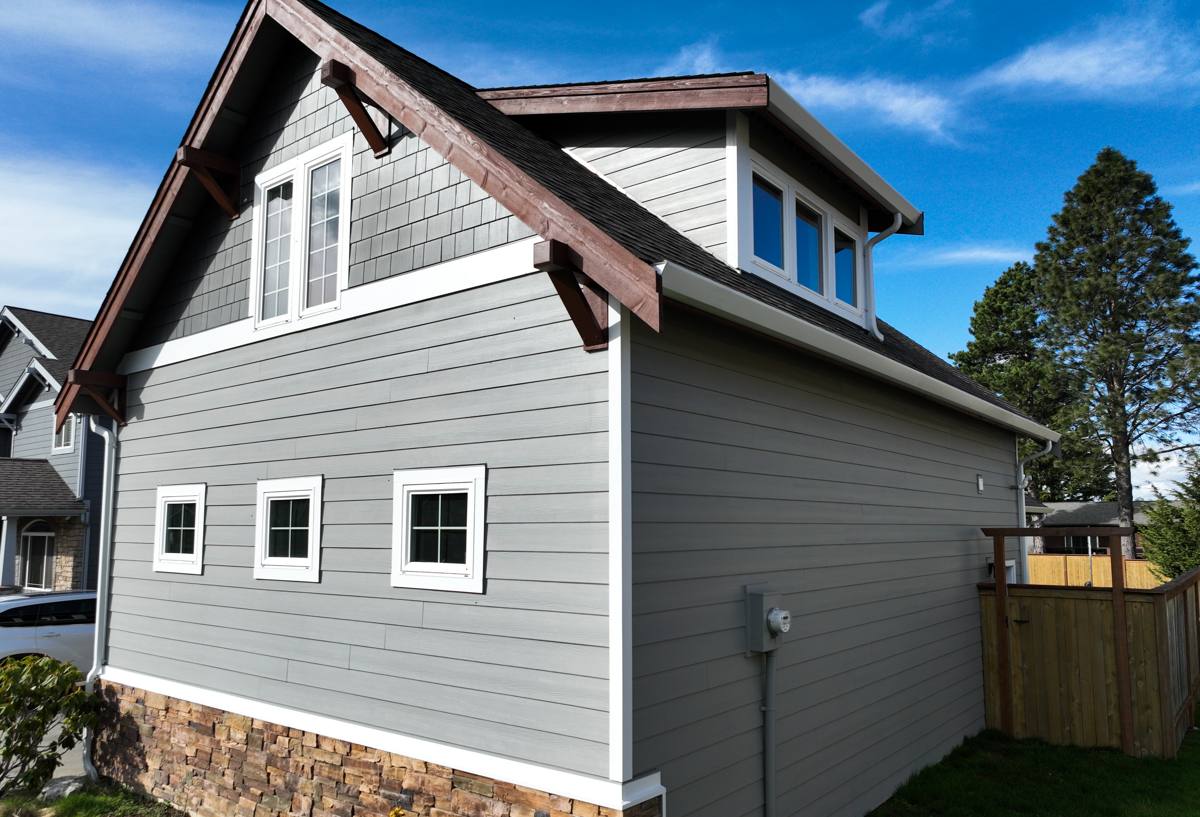
James Hardie fiber cement siding is a mix of cement, sand, and cellulose fiber — it does not have organic wood content to rot, and it's non-combustible. Hardie's HZ5 product line is engineered specifically for climates with extended wet seasons and freeze-thaw cycling, which describes Whatcom County well. The ColorPlus factory finish is baked on under controlled conditions, which holds color and resists fading and chipping better than field-applied paint, and it comes with a real transferable warranty backing that finish.
Side-by-Side: What the Trade-Offs Actually Are
| Factor | Vinyl Siding | Wood-Fiber Composite (e.g. LP SmartSide) | James Hardie Fiber Cement |
|---|---|---|---|
| Moisture/rot risk | Low material risk, but traps moisture behind panels if barrier fails | Higher — wood-based, sensitive at cut edges and fastener points | Very low — non-organic material composition |
| Fire resistance | Combustible plastic | Combustible engineered wood | Non-combustible |
| Finish durability | Color molded in, can fade and become brittle | Factory-primed, needs ongoing field paint maintenance | Factory-baked ColorPlus finish, longer color retention |
| Typical lifespan (installed to spec) | 20-30 years | 20-30 years with diligent maintenance | 30-50+ years |
| Warranty structure | Prorated, varies by manufacturer | Prorated, varies by manufacturer | Strong transferable non-prorated coverage on the substrate |
Our Siding Replacement Process
Every job starts with an honest look at your existing exterior, not just the siding itself. We check the sheathing underneath, the flashing at windows and rooflines, and the water-resistive barrier, because installing new siding over a compromised wall assembly just hides the problem for a few more years.
- On-site inspection and measurement, including a look at trim, flashing, and any moisture-damaged sheathing
- A written estimate that lays out material, labor, and any repair work found during the walk-through
- Removal of the old siding and repair of any damaged sheathing or framing before new material goes on
- Installation of house wrap or a comparable water-resistive barrier, detailed carefully at every penetration
- James Hardie panel or lap siding installation per manufacturer fastening and clearance specifications
- Final trim, caulking, and a walk-through so you know exactly what was done
Beyond Siding: Roofing, Windows, and Decks
Siding rarely fails in isolation. A roof that's shedding water poorly onto a wall, windows with failing seals, or a deck ledger board tied into the siding can all accelerate the exact problems described above. Because we also handle roofing, window replacement, and deck work, we can look at your home's exterior as one connected system instead of treating siding as a standalone project. That matters most at transition points — where a roofline meets a wall, where a deck attaches to the house, where a window is flashed into the siding field — because those are the spots most likely to leak if the trades involved don't coordinate.
What Affects Your Siding Replacement Cost
| Factor | Why It Matters |
|---|---|
| Home size and wall complexity | More corners, gables, and dormers mean more cutting, flashing, and labor time |
| Condition of the sheathing underneath | Hidden rot or water damage found during removal adds repair scope |
| Siding profile chosen | Lap siding, panel siding, and shingle-style Hardie products vary in material and labor cost |
| Trim and accessory work | Corner boards, window trim, and fascia detailing add to the total scope |
| Access and site conditions | Tight lots, slopes, or landscaping that limits staging can affect labor time |
We don't publish blanket pricing because every home is different, but we'll always walk you through exactly what's driving the number on your estimate before you commit to anything.
What to Look for When Hiring a Siding Contractor
- Proper Washington state contractor licensing and insurance you can verify independently
- A written estimate that itemizes material, labor, and any repair contingencies
- Manufacturer training or certification for the specific siding product being installed
- A clear explanation of how they handle water-resistive barriers and flashing details, not just the visible siding
- A warranty that's explained in writing, including what's covered on labor versus material
- Willingness to show you the wall condition once old siding is removed, before covering it back up
If you're in Bellingham and dealing with siding that's showing its age, aging paint, moss you can't seem to keep off, or you just want a second opinion on what's underneath your current exterior, we're happy to come take a look. Reach out for a free, no-pressure estimate using the form below.