 Lynden Siding
 Ferndale's Exterior Climate: Closer to the Water, Harder on Siding
Ferndale sits closer to Bellingham Bay and the Strait of Georgia than most of Whatcom County, and that proximity to open water changes what a house has to deal with year-round. Homes here take on a mix of challenges that inland properties don't see in the same combination: salt-laden air moving in off the water, driving rain that comes in sideways during winter storms, and a moss season that can stretch from October well into spring. None of these are dramatic events on their own. The damage they do is cumulative, and it shows up first on the exterior of the house.
Salt air is corrosive to exposed metal fasteners, flashing, and trim over time, and it accelerates the breakdown of coatings that aren't built to handle it. Driving rain finds every gap in a siding system, working its way behind panels and around window and door openings if the water-resistive barrier and flashing details weren't done right the first time. And moss doesn't just grow on roofs — it establishes on north-facing siding, in the shade of mature trees, and in any spot that stays damp longer than it should. Left alone, moss holds moisture against the substrate and keeps that section of the wall wet far longer than the rest of the house.
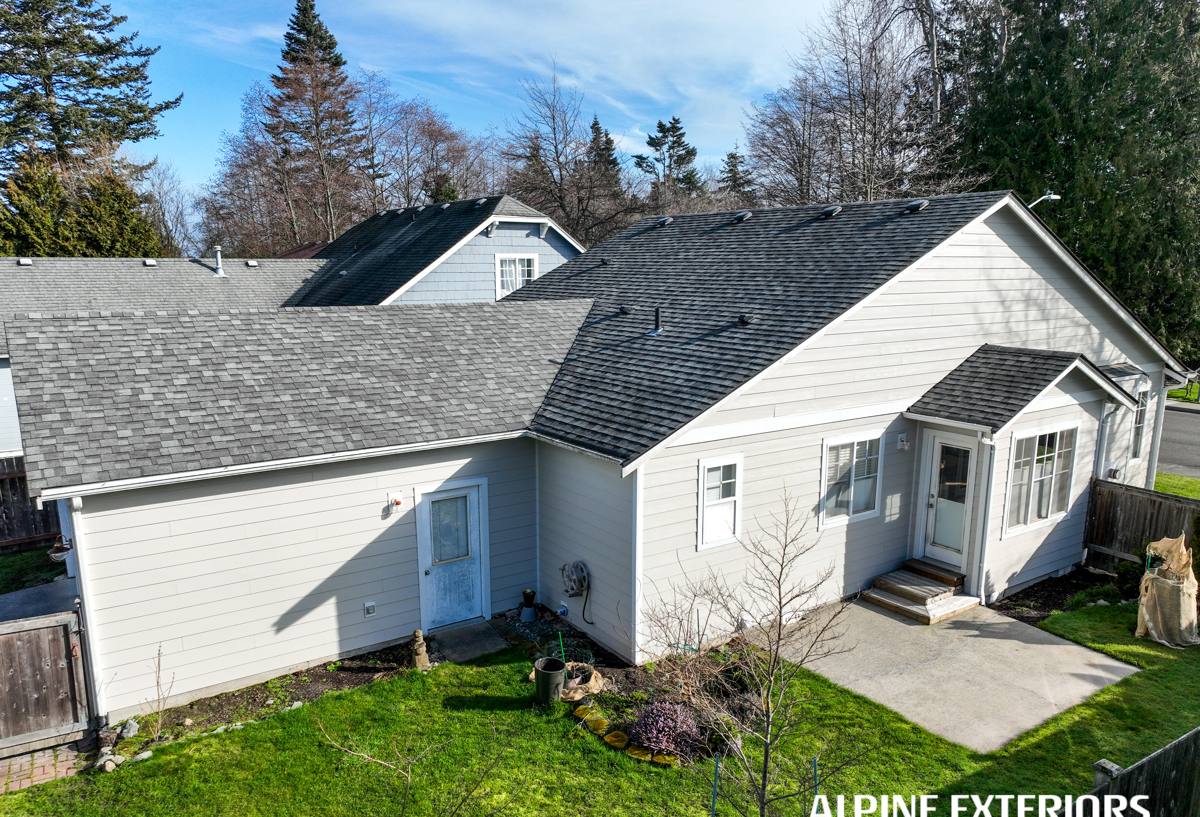
Why We Standardized on James Hardie Fiber Cement
We install exclusively James Hardie fiber cement siding, and Ferndale's climate is a big part of why. Fiber cement is non-combustible, dimensionally stable, and doesn't absorb and release moisture the way wood-based or wood-adjacent products do. That matters directly in a place where the siding is dealing with salt-laden humidity and repeated wetting and drying cycles for months at a time.
The HZ5 Product Line
Hardie engineers its siding for specific climate zones, and the HZ5 line is built for areas with more moisture exposure and temperature swings — which describes most of Northwest Washington. HZ5 panels are formulated to resist moisture-related damage better than the standard formulation used in drier regions. We spec HZ5 as standard on jobs in and around Ferndale, not as an upgrade.
ColorPlus Factory Finish
James Hardie's ColorPlus finish is baked on at the factory under controlled conditions, rather than field-applied with a brush or sprayer on-site. That finish holds up to UV and moisture exposure significantly longer than a standard field-applied paint job, and it comes with its own finish warranty separate from the product warranty. In a salt-air environment, a factory-cured finish is one less variable working against the house.
Why We Don't Install Vinyl, LP SmartSide, or Cedar
We get asked about all three regularly, and we're upfront about why we turned them down as options we install.
Vinyl siding is affordable and low-maintenance in the sense that it doesn't need painting, but it's a thin plastic product that expands and contracts significantly with temperature swings, can warp or crack in impact, and its seams and J-channels give wind-driven rain more opportunities to get behind the cladding. In a driving-rain climate, that's a real liability over the life of the house.
LP SmartSide is an engineered wood product with a resin-treated strand substrate. It performs reasonably well when installation details — caulking, flashing, paint maintenance — are followed exactly and maintained on schedule. But it's still wood-based at its core, and wood-based products are more sensitive to sustained moisture exposure than fiber cement. Given the moisture load Ferndale sees, we don't consider it the right long-term bet.
Cedar siding is a beautiful, traditional material, and we understand its appeal. But solid wood requires the most maintenance of any option — regular refinishing, vigilant caulking, and real attention to any spot where moss or mildew gets a foothold. In a moss-prone, salt-air environment, cedar asks a homeowner for more upkeep than most people want to sign up for, and the consequences of skipping that upkeep show up faster here than they would somewhere drier.
None of these are bad products in every setting. They're products with trade-offs that don't line up well with what a Ferndale house actually experiences most of the year, which is why our crews only install James Hardie.
It's Not Just Siding: The Whole Exterior Works Together
Siding doesn't perform in isolation. The roof, windows, and any exterior decking all interact with the same weather, and a weak point in one system puts stress on the others.
Roofing
A roof with degraded flashing or moss buildup sheds water poorly, and that water often ends up running down the wall assembly behind the siding rather than off the eave where it belongs. We look at roof condition as part of any siding estimate for exactly this reason.
Windows
Window flashing and integration with the siding's water-resistive barrier is one of the most common places we find hidden moisture damage on older homes. Replacing siding is a natural point to correct window flashing that wasn't done to current standards, especially on a house that's been through a few decades of Whatcom County winters.
Decks
Exterior decks face the same driving rain and moss exposure as siding, just horizontally instead of vertically, which means water tends to sit rather than shed. Ledger board flashing where a deck attaches to the house is a frequent source of hidden rot, and it's worth a look any time siding work is happening nearby.
What a Local Crew Actually Means Here
Working out of Lynden, we're in Whatcom County every day, not commuting in from Seattle or Everett for a one-off job. That matters in a few concrete ways. We know which permitting offices to work with for Ferndale and the surrounding unincorporated county areas, we've seen how houses in this specific stretch of the county age, and we're positioned to come back for warranty service or a follow-up question without it being a special trip. A crew that only sees a house once, at the estimate and the final walkthrough, has less reason to get every detail right the first time.
What the Process Looks Like
- Free on-site estimate: we walk the exterior, check for existing moisture damage, and assess roof, window, and deck condition alongside the siding.
- Scope and material plan: we recommend the Hardie product line and profile that fits the house and confirm color and trim details.
- Removal and inspection: old siding comes off and we inspect the sheathing and water-resistive barrier underneath before anything new goes on.
- Correct installation: proper flashing, fastening, and clearances per Hardie's installation specifications — this is where most long-term siding failures actually originate, regardless of product.
- Final walkthrough: we go over the finished work and what maintenance, if any, to expect going forward.
Cost Factors to Expect
Every house is different, but these are the variables that most affect what a Ferndale siding project costs:
| Factor | Why it matters |
|---|---|
| House size and complexity | More linear footage, corners, and roof lines mean more material and labor time. |
| Existing damage found at tear-off | Rotted sheathing or framing discovered once old siding is removed adds repair scope. |
| Siding profile chosen | Lap siding, board and batten, and shingle-style Hardie profiles carry different material and labor costs. |
| Trim and detail work | Window and door trim, corner details, and accent elements add labor beyond flat wall coverage. |
| Access and site conditions | Multi-story sections, tight lot lines, or landscaping near the house can affect staging and time. |
Maintenance: What to Actually Keep an Eye On
James Hardie siding is low-maintenance compared to wood, but "low-maintenance" doesn't mean "no attention needed" in this climate. A short seasonal checklist goes a long way:
- Rinse off accumulated grime and salt residue during a dry stretch, especially on sides of the house facing prevailing wind off the water.
- Check shaded, north-facing sections and areas under trees for early moss or algae growth and address it before it spreads.
- Inspect caulking at trim, window, and door joints annually and recaulk any spots that have opened up.
- Keep gutters clear so overflow doesn't run down the siding face repeatedly during heavy rain.
- Trim back vegetation and tree branches that keep a section of wall shaded and damp longer than the rest of the house.
A House Built for Its Actual Climate
Ferndale's location gives it a distinct combination of salt exposure, driving rain, and moss pressure that inland Whatcom County homes see less intensely. Choosing an exterior system — siding, roofing, windows, and decking — that's actually suited to that environment, and having it installed correctly by a crew that works in this area regularly, is what keeps a house looking good and staying protected for decades rather than years.
If you'd like a straightforward look at how your home's exterior is holding up, we offer free, no-pressure estimates. Fill out the form below and we'll set up a time to take a look.