 Lynden Siding
 Siding in Sumas: A Whatcom County Valley With Its Own Weather Habits
Sumas sits at the far northeastern edge of Whatcom County, pressed against the Canadian border where the Nooksack River valley opens into farmland and Sumas Mountain rises just to the south. It's a short drive from Lynden, but the setting is different enough that siding decisions shouldn't be copy-pasted from a coastal town's playbook. Sumas trades some of the direct salt spray you'd get right on Bellingham Bay for something almost as hard on a wall: low-lying valley humidity, fog that lingers after storms, and wind that funnels down out of British Columbia's Fraser Valley during winter cold snaps. Add in the driving rain and long moss season that define exterior work across this whole region, and you get a climate that's steadily demanding even when it isn't dramatic.
We're based out of Lynden and install siding for homes throughout Whatcom County, including Sumas and the surrounding valley communities. Roofing, windows, and decks are part of what we do too, because an exterior wall doesn't fail in isolation from the roof and windows around it. But siding is where we've drawn the hardest line: we install James Hardie fiber cement exclusively, and we've turned down other products on purpose.
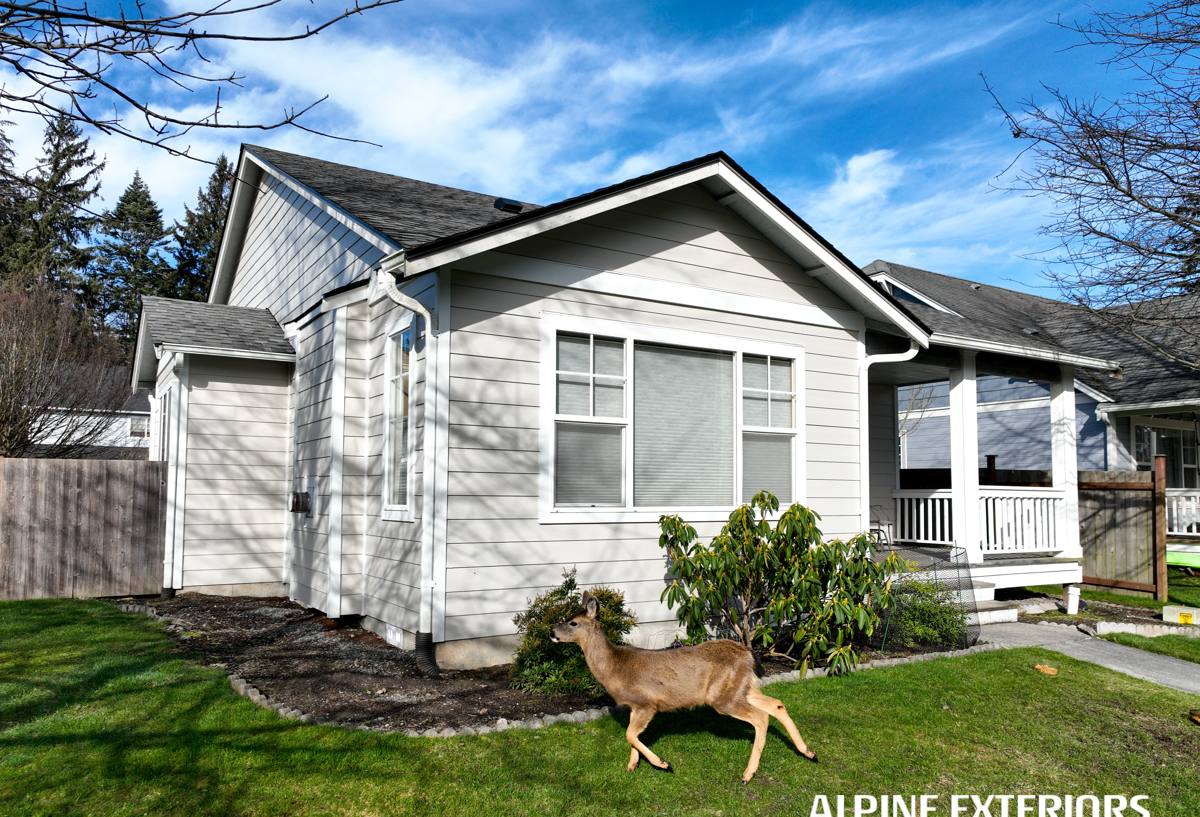
What Sumas's Valley Climate Does to Siding
Driving Rain, Not Just Rainfall Totals
Rain in this part of Washington rarely falls straight down. Wind pushes it sideways into lap joints, trim seams, and window flashing, which is a more demanding load on a wall assembly than a simple annual rainfall number suggests. Siding that would hold up fine in a calm, dry climate can still fail here because water is finding its way in from the side, not from above, and that's a detail a lot of generic installations miss.
Valley Humidity and Lingering Fog
Sumas sits low in the Nooksack valley, and valley floors like this hold moisture and fog longer after a storm passes than higher, more exposed ground does. That extra dwell time matters for siding specifically — the longer a wall stays damp, the more chance there is for moisture to work into seams, fastener holes, and any porous spot in the material before it has a chance to dry out.
A Moss Season That Runs Most of the Year
Mild temperatures, tree cover, and steady moisture add up to a moss and mildew season that runs across most of Whatcom County for the better part of the year, and the Sumas valley is no exception. Shaded, north-facing walls are usually the first place it shows up. Any siding material that's even slightly porous, or that holds moisture against the substrate instead of shedding it, becomes a growth surface over time rather than a surface that dries out between rain events.
Salt-Tinged Marine Air, at a Distance
Sumas is farther from open water than towns like Blaine or Birch Bay, so it doesn't take the same direct salt spray. But Whatcom County's marine air mass reaches well inland, and homes here still see more of it over a year than you'd find in a truly dry, continental climate. It's a smaller factor here than driving rain or valley humidity, but it's part of why we spec hardware and finishes rated for a genuinely wet, mildly corrosive climate rather than a dry one.
Wind Off the Fraser Valley
Sumas sits near the mouth of the corridor that funnels cold air down from British Columbia's Fraser Valley, and homes here can see stronger, colder wind during winter cold snaps than towns farther south in the county. That combination of wind-driven cold and moisture puts extra stress on siding seams, corner trim, and fastener lines, which is why installation detail carries as much weight here as the material itself.
Why We Only Install James Hardie Siding
We used to install a wider range of siding products. We don't anymore. That change came from what we kept finding on service calls and tear-offs across this climate, not from a supplier relationship or a sales incentive.
- Non-combustible core: Fiber cement doesn't feed a fire the way wood-based siding can, which matters for both household safety and insurance considerations.
- Factory-applied ColorPlus finish: The color is baked on under controlled factory conditions rather than brushed on in the field, and it holds up longer against fading and moisture than site-applied paint does.
- Climate-engineered HZ product lines: Hardie's HZ5 formulation is built for regions with significant moisture exposure and freeze-thaw cycling, which fits a Nooksack valley winter well.
- Dimensional stability: Fiber cement doesn't swell, cup, or warp the way engineered wood products can after repeated wetting over a long wet season.
- Strong transferable warranty: Hardie backs the product with one of the more substantial warranty structures in the industry, provided installation follows their spec.
We won't install LP SmartSide, vinyl siding, Cemplank, Allura, primed spruce, or cedar. Each of those products has a legitimate place in the market, and plenty of homeowners elsewhere are satisfied with them. But we've made a professional call that in a climate with this much sustained moisture, valley humidity, and winter wind exposure, we'd rather stand fully behind one system than offer a cheaper option that quietly shifts long-term maintenance risk onto the homeowner.
What Correct Hardie Installation Actually Requires
The material is only half the equation. A Hardie installation that performs the way it's engineered to needs the right fastener type and spacing, proper clearance from grade and roof lines, correctly lapped and sealed joints, and house wrap or drainage detailing that works with the siding rather than against it. A quality product installed loosely will still develop moisture problems in a climate like this one — which is exactly why we treat installation detail with the same seriousness as the material spec.
Repair vs. Full Replacement in Sumas
Not every siding problem here calls for a full tear-off. A section that took storm impact, or trim that's failed around a single window, can sometimes be repaired and matched into existing Hardie siding without redoing the whole house. But if moisture has been tracking behind the wall for a while, or the existing siding is an older product nearing the end of its service life, patching it usually just delays a bigger job a year or two down the road. We'll tell you plainly which situation you're actually in rather than defaulting to whichever answer is more profitable for us.
Siding Cost Factors for a Sumas Home
| Factor | What It Affects | Why It Matters in Sumas |
|---|---|---|
| Home size and wall complexity | Total material and labor | More corners, dormers, and trim mean more joints where wind-driven rain can intrude |
| Tear-off vs. overlay | Labor scope and substrate access | Tear-off reveals hidden moisture damage that's common under older siding in this valley |
| Substrate condition | Repair costs before new siding goes on | Sustained valley humidity behind failing siding can rot sheathing and framing over time |
| Trim and color selection | Material cost and finish longevity | ColorPlus factory finishes outlast field-applied paint against fading and moisture |
| Site access and lot layout | Labor time and staging | Larger rural or farm-adjacent lots common around Sumas can add setup time |
Exact numbers depend on the specific home and its condition, which is why we walk each property in person before giving a real estimate rather than quoting off a generic price sheet.
Signs a Sumas Home's Siding Needs Attention
- Moss or dark staining that returns quickly after cleaning, especially on shaded or north-facing walls
- Soft or spongy siding, particularly low on the wall or around window and door trim
- Peeling paint, bubbling, or visible warping on siding boards
- Cracked, chipped, or missing sections after wind events
- Visible gaps at seams, corners, or trim joints where water can track in
- Rising energy bills that may point to a wall assembly no longer sealing properly
Roofing, Windows, and Decks Alongside Your Siding
Siding rarely fails on its own. A leaking roof valley, a poorly flashed window, or a deck ledger board trapping moisture against the house can all show up as siding damage even though the siding itself isn't the actual source of the problem. Because we also handle roofing, windows, and decks, we can look at a Sumas home as one connected exterior system rather than diagnosing a wall in isolation and missing where the water is really getting in.
Why a Local Crew Matters
A crew that works across Whatcom County day to day, from Lynden and the farmland in between out to a border valley town like Sumas, sees how driving rain, valley humidity, and moss actually behave on real houses over a full year, not just how a product performs on a spec sheet. That repeated exposure shapes practical decisions: where extra flashing attention matters most, which wall orientations stay wet the longest, and which details are worth the extra time on install day so a homeowner isn't dealing with a callback two winters later. Sumas's valley setting, with its wind funneling down from the north and its low-lying fog, isn't identical to every other town in the county, and a crew with local experience accounts for that instead of applying a one-size-fits-all approach.
A Simple Checklist Before Hiring for Siding Work Near Sumas
- Ask what siding material they install and why, and whether they back it with a written warranty
- Confirm they carry current Washington contractor licensing and active liability insurance
- Ask how they detail flashing at windows, doors, and trim joints for wind-driven rain
- Ask how they handle unexpected substrate damage found once old siding comes off
- Get a clear, written scope of work before signing anything
Get a Free, No-Pressure Estimate
If your Sumas home needs new siding, repair work, or an honest second opinion on what's actually going on behind an aging wall, we're glad to take a look. We work out of Lynden and know this valley's weather habits well enough to spec a siding system that's built for it, not just installed and hoped for. Reach out using the form below to schedule a free estimate — no pressure, no upsell script.