 Lynden Siding
 Bellingham Decks Face a Specific Set of Problems
A deck in Bellingham doesn't age the way a deck does in a dry inland climate. Between the salt-laden air rolling in off Bellingham Bay, the long stretch of driving rain that defines a Whatcom County winter, and the moss and algae that take hold on any shaded or north-facing surface for months at a time, outdoor structures here are under near-constant pressure. Most of the deck failures we get called out for aren't dramatic — they're slow. A fastener corrodes a little more each wet season. A ledger board stays damp a few extra days after every storm. Moss holds moisture against a board long after the surface looks dry. None of that shows up overnight, but over several years it adds up to soft boards, loose railings, and structural connections that aren't doing their job anymore.
Repairing a deck correctly in this area means understanding those specific failure patterns, not just patching whatever looks bad on the surface. That's the difference between a repair that holds and one you're paying for again in three years.
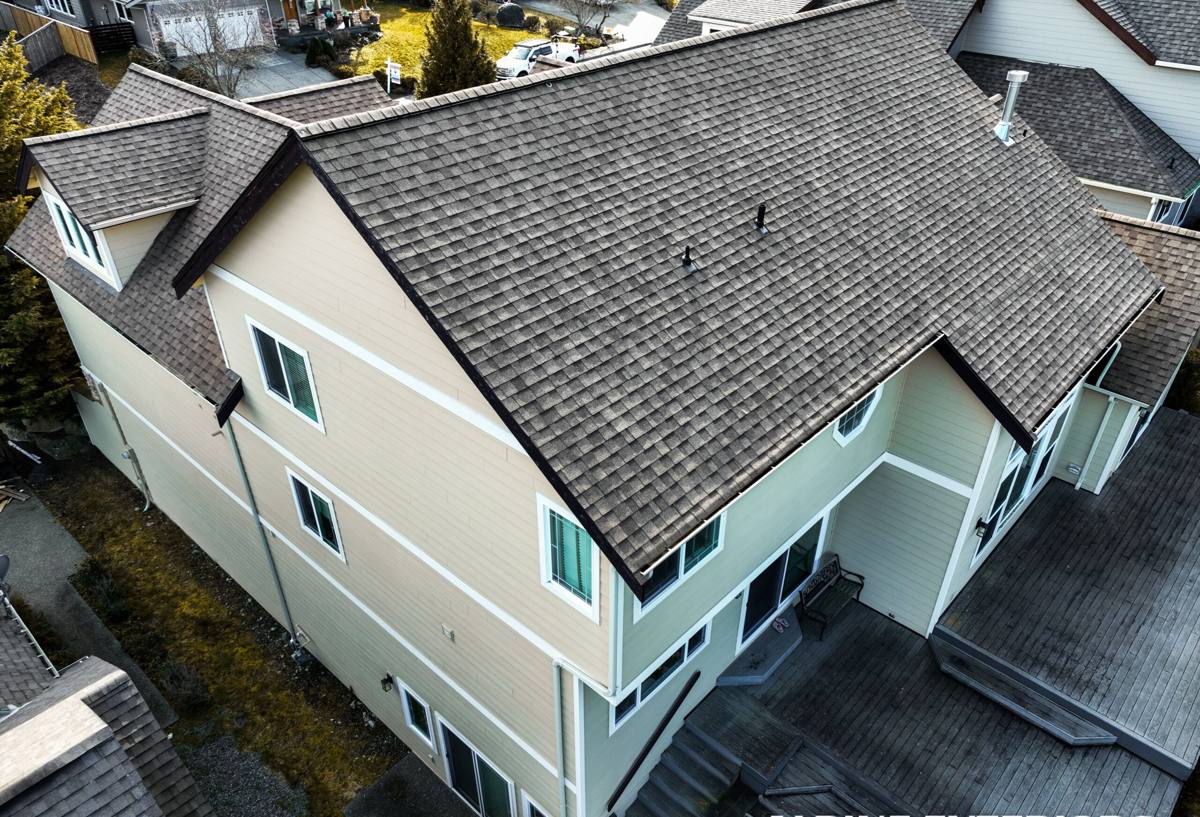
Signs Your Deck Needs Attention
Homeowners often wait until a board gives way underfoot, but there are earlier warning signs worth acting on. Catching these while they're still repairs — not full rebuilds — saves money and keeps the deck safer in the meantime.
- Boards that feel spongy, springy, or noticeably softer than neighboring boards
- Dark staining or a persistent green-black film that keeps returning after cleaning
- Visible gaps, movement, or rust streaking where the deck meets the house (the ledger board connection)
- Railings or posts that wiggle, lean, or feel less solid than they used to
- Fasteners with rust bleed, popped heads, or corrosion around the screw or nail
- Stairs that feel uneven, bounce, or have developed a slight lean
- Gaps opening up between deck boards wider than when the deck was built
- Standing water that doesn't drain within a few hours after rain stops
Any one of these on its own might be minor. Several together usually mean moisture has been working on the structure for a while, and it's worth a proper inspection before it turns into something bigger.
What a Correct Deck Repair Actually Involves
A repair that just replaces the board you can see, without checking what's underneath it, is a repair that doesn't last. Decking boards are the part everyone notices, but they're not usually the part that fails first — the framing underneath is. A repair worth paying for looks at the whole system:
The Structural Framing
Joists, beams, and posts carry the actual load of the deck. In our climate, the most common failure point is where a joist sits against or near the ledger board, or anywhere water has been able to pool against wood without draining or drying. We check for soft spots with a probe, not just a visual look, because rot can hollow out a joist from the inside while the surface still looks intact.
The Ledger Board and Flashing
This is the board that attaches the deck to the house, and it's the single most important connection on the structure from a safety standpoint. If the flashing behind it has failed or was never installed correctly, water gets channeled directly into the house's rim joist and the deck's structural connection at the same time. We see this often enough on older Whatcom County homes that it's one of the first things we check, even on a repair that was called in for something else entirely.
Fasteners and Hardware
Salt-influenced air and constant moisture cycles are hard on standard fasteners. Repairs done with the wrong grade of screw or a joist hanger that isn't rated for exterior, coastal-adjacent use tend to fail again within a few years. Matching hardware to the environment isn't an upgrade — it's the baseline for a repair that's supposed to actually solve the problem.
Decking Boards and Railings
Once the structure underneath is sound, replacing individual boards, fixing railing connections, and re-securing stair stringers is straightforward work — but it only holds up long-term if it's built on a frame that's actually solid.
Common Problems We See on Bellingham Decks
Moss and Algae Buildup
Shaded decks, north-facing decks, and anything under tree cover hold moisture far longer than an open, sun-exposed deck. Moss doesn't just look bad — it holds water directly against the wood surface, which accelerates rot and makes boards slick and unsafe underfoot. In Whatcom County's moss season, which can stretch across most of the fall, winter, and spring, this is one of the most common reasons boards need replacing years before they should.
Ledger Board and Flashing Failure
Older decks, and decks built without proper flashing detail, are prone to water intrusion at the house connection. This is often invisible from the top of the deck and only shows up as staining or soft framing when you look underneath.
Fastener Corrosion
Nails and screws that aren't rated for exterior, coastal-influenced conditions rust, weaken, and eventually let boards or railings work loose. This is especially common on decks that were repaired once already with mismatched hardware.
Railing and Post Movement
Wind, rain-driven wood movement, and loose original construction all contribute to railings that no longer feel solid. Because railings are a safety item, we treat any looseness here as a priority repair, not a cosmetic one.
Repair or Replace? How We Help You Decide
Not every deck problem means starting over, and not every deck is worth patching indefinitely. The honest answer depends on how much of the structure is still sound.
| Factor | Usually Repairable | Usually Needs Replacement |
|---|---|---|
| Decking boards | A few soft or damaged boards among otherwise sound ones | Widespread softness across most of the surface |
| Framing (joists/beams) | Isolated soft spots near a known leak point | Rot found at multiple joists or the main beam |
| Ledger board connection | Flashing failure caught early, framing behind it still solid | Rim joist or wall framing behind the ledger has failed |
| Railings and posts | Loose connections, minor wood movement | Posts rotted at the base or structurally unsound |
| Age of the deck | Under 15-20 years, built to a reasonable original standard | Original construction was undersized or poorly detailed from the start |
We'll always tell you plainly when a repair is the right call and when it isn't — including when a rebuild is genuinely the more cost-effective path over the next several years.
Our Deck Repair Process
- Inspection. We walk the full structure — decking, framing, ledger connection, railings, stairs — and probe suspect areas rather than relying on a visual check alone.
- Honest assessment. We tell you what's actually wrong, what's driving it (usually moisture in some form), and what your realistic options are, including cost ranges for each.
- Scope and estimate. You get a clear, written scope of the repair — what's being replaced, what hardware and materials we're using, and why.
- Repair work. We address the root cause first — flashing, drainage, or framing — before replacing any visible boards or railings, so the fix actually holds.
- Final check. We walk the deck with you when it's done so you know exactly what was repaired and what to watch for going forward.
Materials and Hardware We Use
Material choice matters more here than in a drier climate, because the wrong choice just means a faster repeat repair. We select materials based on how they actually perform in sustained coastal moisture and repeated wet-dry cycling, not just on upfront cost.
| Material | Where We Use It | Trade-Off to Know |
|---|---|---|
| Pressure-treated framing lumber | Joists, beams, structural repairs | Needs proper fasteners rated for treated wood to avoid corrosion |
| Composite decking | Board replacement on decks where low maintenance matters | Higher upfront cost, but resists moisture and moss buildup far better than untreated wood |
| Cedar or treated wood decking | Board replacement matching an existing wood deck | Requires regular sealing and cleaning to keep moss and rot at bay |
| Stainless or coated exterior fasteners | All repair work | Costs more than standard hardware, but avoids the corrosion that causes repeat failures |
| Self-adhering flashing membrane | Ledger board and any deck-to-house connection | Correct installation sequence matters more than the product itself |
Keeping Your Deck in Good Shape After the Repair
A repair only holds as long as the deck is kept ahead of the climate that caused the original problem. A few habits make a real difference in Whatcom County:
- Clean moss and algae off the surface at least once a year, before it has a chance to establish through a full wet season
- Keep gutters and downspouts near the deck clear so water isn't dumping directly onto or near the structure
- Check for standing water after heavy rain and address any spots that aren't draining
- Reseal or refinish wood decking on the schedule the product calls for, not just when it looks faded
- Trim back overhanging branches to cut down on shade and debris that keep boards damp longer
- Do a quick check of railings and stair connections each fall before the wet season sets in
None of this is complicated, but it's the difference between a repair that lasts a decade and one that starts unraveling in three or four years.
Why Hire a Crew That Already Works in Bellingham
Deck problems in this area follow patterns — where moss takes hold first, which ledger connections tend to have been flashed poorly, which fastener choices hold up and which ones don't after a few Whatcom County winters. A crew that works this area regularly isn't guessing at any of that. We know what to check first, what usually turns out to be the real cause once we get underneath the visible damage, and what materials are worth the extra upfront cost versus what's fine to keep simple. That local pattern recognition is what keeps an inspection from missing something, and what keeps a repair from being a repeat of the last one.
If your deck has soft spots, loose railings, moss that keeps coming back, or you're just not sure whether it needs a repair or a full rebuild, we're happy to take a look and give you a straightforward answer. Reach out for a free, no-pressure estimate using the form below.