 Lynden Siding
 Exterior Work Built for Maple Falls Conditions
Maple Falls sits up the Mt. Baker Highway corridor in Whatcom County, in the transition zone between valley farmland and Cascade foothill forest. That location gives it a different exterior-wear profile than homes closer to town. More tree canopy means more shade, more standing moisture on north-facing walls, and a longer moss and algae season than you'd see on an open lot in Lynden proper. Add the driving rain that rolls through Whatcom County for much of the year, and you've got a climate that is genuinely hard on exterior building materials, even when a house looks fine from the road.
We've worked on homes throughout Whatcom County, from open valley properties to shaded, tree-lined lots closer to the foothills, and the pattern holds: siding, roofing, trim, and decking fail first where moisture sits longest and dries out slowest. That's the problem we solve, not with a generic install, but with materials and workmanship matched to how a specific property actually behaves through a wet Northwest year.
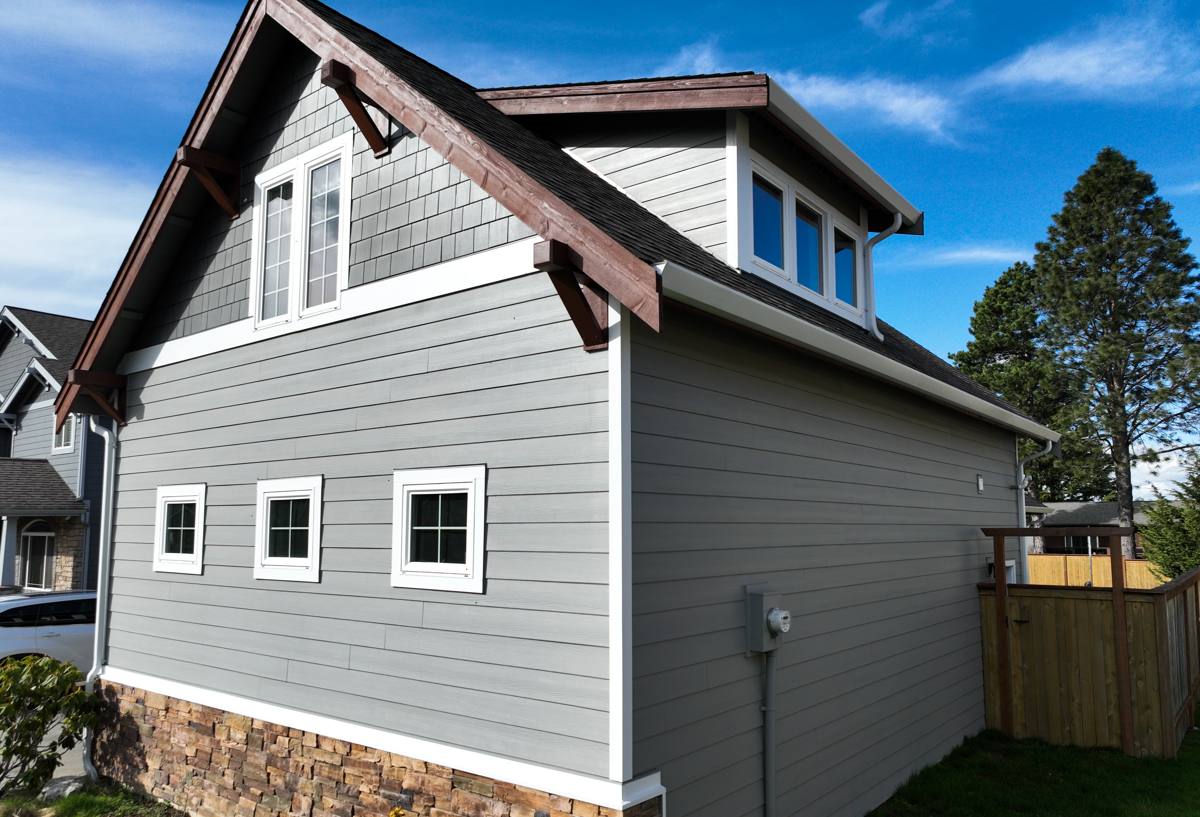
What Foothill-Adjacent Homes Tend to Deal With
Moisture That Doesn't Leave
Homes tucked under trees or set back in wooded lots don't get the same drying wind and sun exposure as open properties. Rain lands, and instead of evaporating off within a day, it lingers in shaded corners, under eaves, and on north- and east-facing walls. Over years, that constant damp cycle is what breaks down poor-quality siding, softens trim, and feeds moss and algae growth on roofing and wall surfaces.
A Long Moss and Algae Season
Moss doesn't need much to get established: shade, moisture, and time. In a heavily wooded setting, that combination is present most of the year, not just in the darkest winter months. Left unchecked, moss and algae hold water against a surface, which accelerates rot in wood-based products and can stain or degrade lower-quality siding finishes.
Temperature and Precipitation Swings
Elevation and proximity to the mountains mean more variation between a warm, dry stretch in summer and a cold, saturated stretch in winter. Materials that expand, contract, and absorb moisture with those swings are under more stress here than in a milder, drier climate. That's a real factor in choosing what goes on the outside of a house meant to last decades, not years.
Why We Only Install James Hardie Fiber Cement
We made a deliberate decision as a company: we install James Hardie fiber cement siding, and we don't install vinyl, LP SmartSide, Cemplank, Allura, primed spruce, or cedar. That's not a marketing angle, it's a standard we hold to because of what we've seen play out on real Whatcom County homes over time.
Vinyl siding is affordable and low-maintenance in the sense that it doesn't need painting, but it's a thin plastic product that can warp in heat, crack in cold, and simply doesn't hold up structurally the way a fiber cement plank does. Wood-based options like primed spruce or cedar look great when new, but they're organic materials in a climate that rarely lets them fully dry out. In a shaded, moisture-heavy setting like Maple Falls, that's exactly the wrong pairing. Engineered wood siding (LP SmartSide) improved on older wood products but is still a wood-strand composite, meaning its long-term performance still depends heavily on caulking, paint maintenance, and keeping water away from cut edges. Other fiber cement brands like Cemplank and Allura are legitimate competitors to Hardie, but we've standardized on one manufacturer, one installation system, and one warranty structure so our crews install it the same correct way every time, and homeowners get a single point of accountability.
James Hardie fiber cement is non-combustible, doesn't feed moss and rot the way wood does, and comes with a factory-applied ColorPlus finish that holds color far longer than field-painted siding. Hardie also engineers specific product lines (HZ5 and HZ10) for different climate zones, which matters in a county that ranges from coastal to mountain-adjacent. For a home dealing with shade, moss, and sustained moisture, that combination of durability and low maintenance is the deciding factor.
How a Siding Project Works Here
Assessment First
We start by walking the property and looking at how water actually moves across it: which walls stay wet longest, where moss has already taken hold, where trim and flashing show early wear. That assessment shapes the plan more than any standard checklist would, because every lot's shade and drainage pattern is different.
Installation Detail Matters More Than the Product
Fiber cement performs the way it's rated to only when it's installed correctly: proper clearance from grade and roof lines, correct fastening pattern, sealed and flashed openings, and rain-screen or drainage detailing where the site calls for it. A high-quality product installed loosely will still fail early. This is a big part of why we keep our install standard narrow instead of stocking multiple siding brands.
Finish and Trim
Corner boards, window and door trim, and fascia details get finished to shed water, not just to look clean on install day. In a shaded, high-moisture setting, trim detailing is often where problems start if it's rushed.
Roofing, Windows, and Decks: The Rest of the Envelope
Siding doesn't work in isolation. We handle roofing, windows, and decks because they all interact with the same water-management system that keeps a house dry.
- Roofing: A roof under heavy tree cover sheds moss and debris differently than an open one, and valleys, flashing, and gutters need to be sized and maintained for that load. Roof condition also directly affects how water drains onto siding below.
- Windows: Old or poorly flashed windows are one of the most common hidden water-entry points behind siding, especially on shaded walls where a leak can go unnoticed for a long time. Replacement windows are also an opportunity to correct flashing details that were never right to begin with.
- Decks: Wood decks under tree canopy face the same moss and moisture pressure as walls, plus foot traffic wear. Proper board spacing, flashing where the deck meets the house, and material choice all affect how long a deck stays safe and solid.
Because these systems overlap, we look at the whole exterior when we're on a property, not just the one thing a homeowner called about.
Comparing Siding Options for a Shaded, Wet Property
| Factor | James Hardie Fiber Cement | Vinyl | Wood / Engineered Wood |
|---|---|---|---|
| Moisture resistance | High — cement-based, does not rot | Won't rot, but can warp and gap | Vulnerable to rot without diligent maintenance |
| Moss/algae resistance | Good with factory finish; cleanable | Moderate; can trap moisture at seams | Poor in shaded, damp conditions |
| Fire resistance | Non-combustible | Can melt or deform under heat | Combustible |
| Finish longevity | Factory ColorPlus finish, long color retention | Color molded in, can fade and chalk | Requires repainting/staining on a cycle |
| Maintenance | Low — periodic wash, minimal touch-up | Low, but panels can crack/need replacement | Higher — regular paint/seal cycle required |
Cost Factors Homeowners Should Understand
Every quote depends on the specifics of the house, but a few factors consistently move the number more than homeowners expect:
- Existing wall condition: hidden rot or moisture damage found once old siding comes off adds repair scope.
- Trim and detail complexity: homes with lots of corners, dormers, or architectural trim take more labor per square foot.
- Accessibility: steep grades, tree-crowded walls, or limited staging space affect crew time.
- Tear-off vs. overlay: full removal of old siding versus working around it changes both cost and long-term performance.
- Product line: HZ5 versus HZ10 Hardie panels, plank width, and texture selection all factor into material cost.
We walk through these specifics on-site rather than quoting blind, because a number that doesn't account for the actual condition of the house isn't a useful number.
Why a Local Crew Matters Here
A crew that works Whatcom County regularly understands that a shaded property up the highway corridor behaves differently than an open lot on the valley floor, and plans the job accordingly, from scheduling around wet weather windows to knowing which details need extra attention on a moss-prone wall. That local knowledge shows up in the small decisions made on-site, not just in the sales pitch.
It also matters for warranty and follow-up. If a question comes up two years after installation, you're calling a crew that's still working in the area, not chasing down a company that moved on to other regions.
What to Ask Before Hiring a Siding Contractor
- Are you a certified installer for the specific product you're proposing?
- What does your workmanship warranty cover, and for how long?
- Will you remove and inspect the existing wall sheathing, or install over it?
- How do you handle flashing at windows, doors, and roof intersections?
- Can you explain, in plain terms, why you recommend one product over another for this specific property?
A contractor who answers those clearly and specifically, rather than in general marketing language, is worth taking seriously.
Get a Free, No-Pressure Estimate
If you're noticing moss buildup, soft trim, or siding that's showing its age on a Maple Falls property, it's worth having a local crew take a look before small issues turn into structural repairs. Use the form below to request a free estimate on siding, roofing, windows, or decks — no pressure, just a straight assessment of what your home actually needs.