 Lynden Siding
 Storm Damage Roof Repair Built for Everson's Weather
Everson sits in the part of Whatcom County where weather off the water and weather off the foothills both have a say in what happens to a roof. Salt-tinged marine air works on exposed metal and fasteners year-round, storms push rain sideways under roof edges instead of letting it run straight off, and long stretches of gray, damp weather feed a moss season that settles into shaded roof planes and doesn't let go until well into summer. None of that is unusual for this region, but it does mean storm damage here rarely looks like a single dramatic event. More often it's a combination of one bad windstorm plus months of the roof already being worn down by moisture it never fully dried out from.
This page is about what storm damage roof repair actually involves for a home in Everson specifically — what counts as storm damage in the first place, what a correct repair looks like once we're up there, how our process runs from the first call to the final walkthrough, and why it matters to hire a crew that already knows this stretch of Whatcom County rather than one working from a generalized playbook.
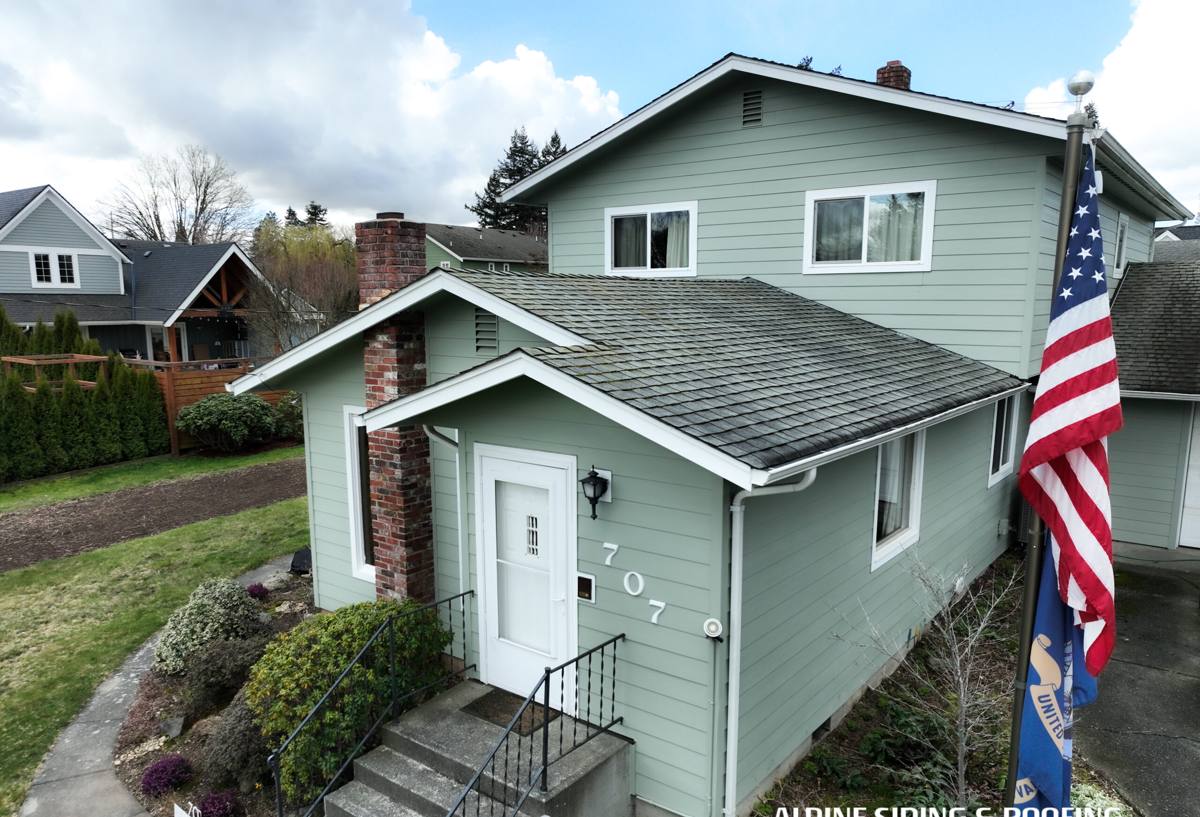
What Actually Counts as Storm Damage
Homeowners often picture storm damage as something obvious — a tree limb through the roof, a section of shingles torn off and sitting in the yard. Real storm damage is frequently much quieter than that, which is part of why it goes unrepaired longer than it should.
Wind
Sustained wind and gusts lift shingle tabs at the edges and ridge lines first, sometimes just enough to break the factory seal without fully detaching the shingle. From the ground it can look untouched. Up close, that broken seal is an open door for the next round of rain.
Wind-Driven Rain
When rain is being pushed sideways and upward rather than falling straight down, it finds gaps that a calmer rain never would — under lifted shingle edges, around flashing that's slightly short, through nail holes that have backed out over time. This is the mechanism behind a lot of "mystery leaks" that show up well after the storm that actually caused them has passed.
Moss, Debris, and Compounding Damage
A storm that knocks debris loose or deposits it on the roof can trap moisture against the shingle surface, and on planes that already hold moss through the wet season, that trapped moisture accelerates the damage a storm started. This is why a roof that "made it through" a storm can still fail within the following year if nobody looked closely at what the wind actually did to it.
What a Correct Storm Damage Repair Involves
A repair that only addresses what's visible from the ground is a repair that's likely to be redone. Doing it right means working through the same layers a full roof system is built from, not just patching the surface.
A Real Inspection, Not a Drive-By
We get on the roof itself whenever conditions allow it safely, because storm damage is frequently only diagnosable up close — a lifted tab, a hairline crack in a flashing seam, or fastener heads that have backed out a fraction of an inch are invisible from the driveway. We also check the attic side when accessible, since staining, damp insulation, or daylight showing through the decking tells us things the exterior alone won't.
Emergency Mitigation When It's Needed
If a storm has left an active leak or exposed decking, stopping water intrusion comes before anything else. A temporary tarp or dry-in, done correctly and secured against the next round of wind, buys time to plan the actual repair properly instead of rushing it under pressure.
Matching Materials Honestly
Shingle colors and profiles change over the years a roof ages, and an exact match isn't always possible. We tell you upfront when a repaired section won't blend perfectly rather than letting you find out after the fact, and we talk through whether a larger repair section or a full slope replacement makes more sense visually and structurally.
Flashing Repair Done as a System
Storm damage very often shows up at flashing before it shows up in the open shingle field — valleys, chimney flashing, and the step flashing where a roofline meets a wall. Repairing flashing means integrating it back into the underlayment properly, not just running a bead of sealant over a gap and calling it fixed. Sealant is a short-term patch, not a repair.
Decking and Structural Repair
When wind or water has gotten far enough to soften or rot the roof decking underneath, that has to be cut out and replaced before any new shingles go down. Covering soft decking with new roofing material hides the problem instead of solving it, and it's one of the more common shortcuts we see on repairs done in a hurry after a storm.
Repair or Replace? A Practical Comparison
Not every storm-damaged roof needs to come off entirely, and not every roof is a good candidate for a targeted repair. The right call usually comes down to the roof's age, how widespread the damage is, and how many previous repairs it's already had.
| Situation | Repair Usually Makes Sense | Replacement Usually Makes Sense |
|---|---|---|
| Roof age | Under roughly 12-15 years old, no prior major repairs | Nearing or past its expected service life |
| Extent of damage | Isolated to one slope or a small area | Spread across multiple slopes or the whole roof |
| Decking condition | Solid, no rot found on inspection | Soft spots or rot found in more than one area |
| Prior repair history | First significant repair on this roof | Roof has already had several patch repairs over the years |
| Material availability | Reasonable color/profile match still available | Discontinued product, poor match likely |
We'll always give you our honest read on which side of that table your roof falls on, along with the reasoning behind it, before we recommend one option over the other.
Insurance Claims: What We Can and Can't Do
Storm damage repairs often involve a homeowner's insurance claim, and it's worth being clear about our role in that process. We're a roofing contractor, not an insurance adjuster or a public adjuster, and we won't promise an outcome we don't control. What we can do is document the damage thoroughly — photos, a written scope of the actual repair needed, and a straightforward estimate you can hand to your adjuster or use to compare against their assessment. If your adjuster wants to meet us on-site to look at the roof together, we're glad to do that. Whether a claim gets approved and for how much is between you and your insurance company, but we make sure the documentation on our end is accurate and complete either way.
How Our Process Works
- Initial call and timeline: We ask what happened and when, so we can prioritize active leaks over cosmetic damage and give you a realistic sense of timing.
- On-site inspection: We get up on the roof and, where accessible, check the attic, documenting exactly what the storm did with photos and notes.
- Written estimate: You get a clear, itemized scope — what's being repaired, what materials are involved, and what it will cost — not a vague single number.
- Emergency mitigation, if needed: Any active leak gets a secure temporary fix before we move to the permanent repair.
- The repair itself: Decking, underlayment, flashing, and shingles are addressed as a system, with attention paid to the specific points storm damage tends to originate from in this area.
- Final walkthrough: We review the completed work with you in person and do a site cleanup, including a magnetic sweep for stray fasteners, before considering the job finished.
Cost Factors in Storm Damage Repair
Two estimates for what sounds like the same repair can land far apart, and the gap is almost always about scope rather than one contractor overcharging. Knowing what drives the number makes it much easier to compare bids that don't look alike on paper.
| Factor | What It Affects |
|---|---|
| Extent of the damage | Whether the job is a small patch or a full slope tear-off |
| Decking condition | Whether structural repair is needed underneath the roofing material |
| Flashing scope | How thoroughly valleys, chimneys, and wall transitions are rebuilt versus resealed |
| Material match | Whether an exact shingle match is available or a larger section needs to be redone |
| Roof pitch and access | Staging, safety equipment, and labor time on steeper or harder-to-reach roofs |
| Emergency mitigation | Whether a temporary tarp or dry-in was required before the permanent repair |
Ask any contractor to walk through their estimate line by line before you compare it against another bid. A repair scoped honestly, even if it costs more upfront, is usually the cheaper option once you account for having to redo a rushed patch job a year or two later.
Signs Your Everson Home May Have Storm Damage
Storm damage doesn't always announce itself right away. These are the signs worth checking for after any significant wind or rain event, and periodically through the wetter months even without an obvious storm to point to.
- Shingles that look lifted, curled, or slightly out of alignment along ridges and edges
- Granules collecting in gutters or at downspout outlets after a storm
- New or worsening water stains on ceilings, especially near valleys or roof penetrations
- Visible daylight through the attic decking, or damp insulation, when the attic is accessible
- Flashing that looks bent, pulled away from a surface, or has visible gaps at the seams
- Moss buildup that's thicker or spreading faster than it was before the last storm season
- Debris still resting on the roof more than a few days after wind has died down
If more than one of these applies, it's worth having the roof looked at before the next system moves through rather than waiting to see if it gets worse on its own.
Why Hiring a Crew That Already Works in Everson Matters
A crew that regularly works roofs in and around Everson already knows how this area's storms behave — which roof orientations take the worst of the wind, how far wind-driven rain can travel under a lifted shingle edge before it starts causing real damage, and how quickly moss reclaims a shaded slope after a repair if ventilation isn't addressed at the same time. That's the kind of practical knowledge that shows up in dozens of small decisions during a repair, not something a crew passing through the area for a single job is likely to have picked up.
It also matters after the repair is finished. A workmanship warranty only means something if the company behind it is still reachable a few years down the road, with an established, ongoing presence in Whatcom County rather than having moved on to the next region.
A Practical Checklist Before You Choose a Storm Repair Contractor
- Do they get on the roof for a real inspection, or estimate from photos and the ground?
- Does the estimate specify decking, underlayment, flashing, and shingle work separately?
- Will they document damage clearly enough to support an insurance claim if you're filing one?
- Do they carry current WA contractor licensing, liability insurance, and workers' compensation?
- Can they point to recent, real repair work in or near Everson and Whatcom County?
- Is the workmanship warranty separate and clearly explained from the manufacturer's material warranty?
If a recent storm has left you wondering whether your roof needs attention, we're glad to come take an honest look and put together a written estimate with no pressure attached. Use the form below to request a free estimate.