 Lynden Siding
 Aldergrove, BC's Climate Is Harder on Siding Than It Looks
Aldergrove, BC sits close enough to Lynden that the two towns are connected by their own border crossing, and just as close in climate. Homes on both sides of that line deal with the same wet, marine-influenced weather that moves through Whatcom County and up into the Fraser Valley: long stretches of driving rain pushed in off the Pacific, salt-tinged air drifting inland from the Strait of Georgia and Boundary Bay, and a moss season that can run from October clear through April. None of that is dramatic. It's just relentless, year after year, and siding either holds up to that combination or it starts showing it within a decade.
Driving rain matters more than steady rain. When wind pushes water sideways into a wall instead of letting it run straight down, it finds every weak seam, every under-caulked joint, every spot where a panel wasn't lapped correctly. Salt air adds a slow corrosive edge to fasteners and trim that inland siding never has to deal with. And moss and algae need almost nothing to get established here — just shade, moisture, and time, all of which this region has in abundance. Siding on an Aldergrove home is doing more work than the same product would on a house in a dry climate, whether the material is rated for it or not.
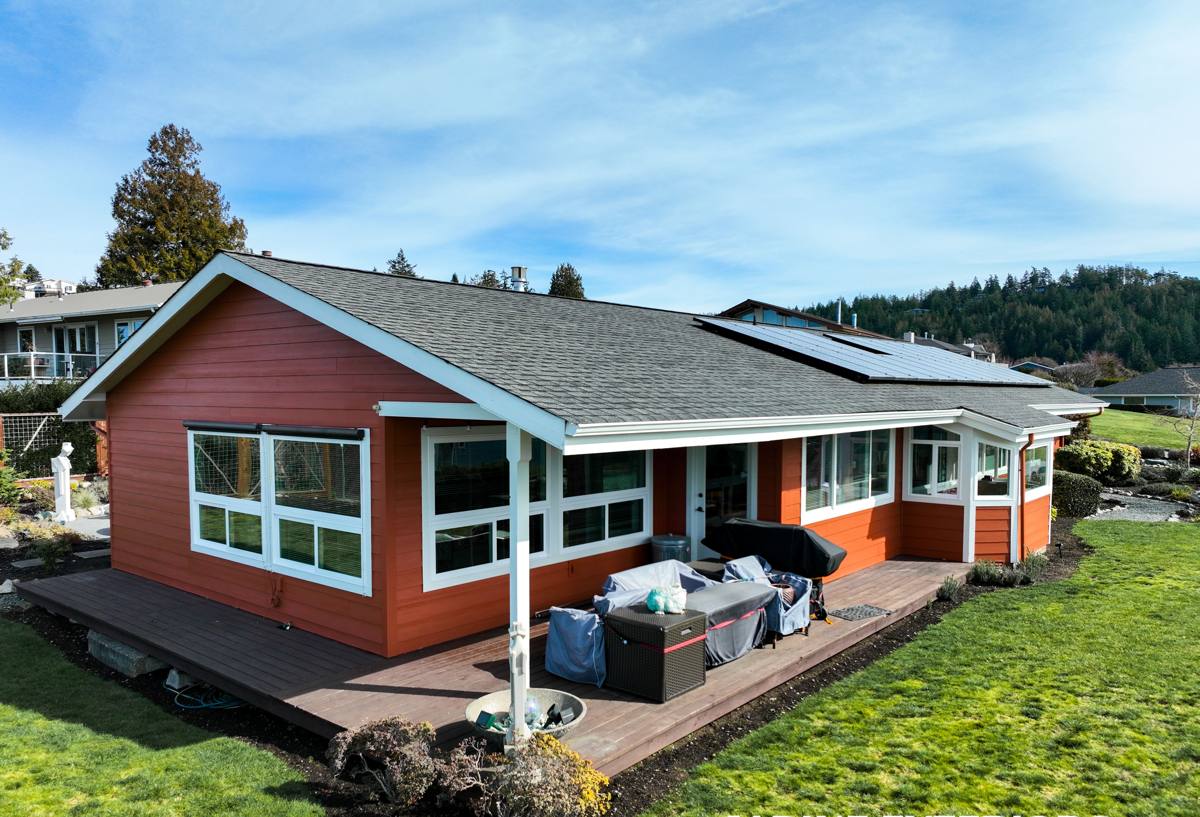
Why We Only Install James Hardie Fiber Cement Here
We're a Lynden-based crew, and we install one siding system: James Hardie fiber cement. Not because it's the only product on the market, but because after years of working this specific stretch of border climate, it's the one we're willing to put our name behind for the long term.
Fiber cement doesn't rot, doesn't feed mold and moss the way wood-based products can, and it's dimensionally stable enough that it doesn't expand and contract with every wet-dry cycle the way vinyl and some engineered wood products do. James Hardie's HZ5 formulation is engineered specifically for climates like this one — cold, wet Pacific Northwest winters paired with humid, moisture-heavy air for most of the year. The factory-applied ColorPlus finish is baked on under controlled conditions, which matters in a region where field-painted surfaces rarely get the dry cure time they need before the next rain moves in.
We're not going to tell you every other siding product is junk — that's not honest and it's not our call to make about materials we don't install. What we will say is why we standardized on one system: fewer moisture failure points, a finish that's proven itself in this exact climate, and a warranty structure that follows the homeowner, not just the installer.
What HZ5 Actually Changes
James Hardie's standard formulations are built around general climate zones, but HZ5 is specifically formulated for wet, freeze-prone regions. It resists moisture intrusion and cracking better than a generic fiber cement mix would, which is the difference that shows up ten or fifteen years in, not on install day.
What a Correct Installation Involves
James Hardie siding is only as good as the installation underneath it. This is the part that gets skipped when a crew is unfamiliar with wet climates or is rushing through a job, and it's the part that determines whether siding lasts 30 years or starts failing in five.
Moisture Management
- Proper weather-resistive barrier behind the siding, lapped correctly with all seams sealed
- Rainscreen or drainage gap where conditions call for it, so water that gets behind the panel has somewhere to go
- Correct flashing at every window, door, and roofline intersection — the majority of siding failures we see trace back to bad flashing, not bad panels
- Minimum clearance between the bottom of the siding and grade, decking, or roofing, so panels aren't sitting in standing water or snowmelt
Fastening and Panel Layout
Fasteners have to be driven to the manufacturer's specified depth and pattern — overdriven or underdriven nails are one of the most common causes of premature cracking. Panels need correct overlap, gapping at butt joints per Hardie's specifications, and factory-cut or properly sealed field cuts. Caulking gets used at transitions and penetrations, but it's not a substitute for correct flashing — it's a backup layer, not the primary defense against water.
How James Hardie Compares to Other Options Homeowners Consider
Most homeowners shopping for siding look at three or four products before deciding. Here's how they stack up against the climate conditions Aldergrove homes actually face.
| Material | Moisture Behavior | Moss/Algae Resistance | Maintenance Burden | Typical Lifespan |
|---|---|---|---|---|
| James Hardie Fiber Cement | Dimensionally stable, engineered for wet climates (HZ5) | Resists organic growth better than wood-based products | Occasional wash; factory finish reduces repainting | 30+ years with correct install |
| Vinyl Siding | Can warp or buckle with temperature swings; seams are vulnerable | Growth resistance depends on surface texture | Low, but color fades and can't be easily repainted | 20-30 years, shorter in harsh exposure |
| LP SmartSide (engineered wood) | Wood-based core is more moisture-sensitive at cut edges and seams | More susceptible if moisture gets past the coating | Requires consistent edge sealing and repainting over time | 20-25 years, dependent on maintenance |
| Cedar / Primed Spruce | Natural wood movement; absorbs moisture without diligent finishing | Prone to moss and mildew in shaded, damp areas | High — regular refinishing and moisture inspection needed | 15-25 years, heavily maintenance-dependent |
Every product on that list has a legitimate use case somewhere. In this specific climate — heavy driving rain, salt air, and long moss seasons — the products with wood-based cores or seam-dependent moisture control are the ones we've seen struggle earliest. That's the trade-off we made when we standardized on Hardie: less product variety, more confidence in how it performs here specifically.
Our Process, Start to Finish
- Walkthrough and assessment — we look at the existing siding, sheathing condition, moisture history, and any problem areas before quoting anything
- Written estimate — scope, product line, color, and timeline laid out clearly, no vague allowances
- Tear-off and sheathing check — old siding comes off and we inspect what's underneath before anything new goes up; hidden rot or damaged sheathing gets addressed, not covered over
- Weather barrier and flashing — the moisture management layer goes in correctly before a single Hardie panel is installed
- Installation — panels installed to James Hardie's fastening and clearance specifications, not shortcuts that trade accuracy for speed
- Final walkthrough — we go over the finished job with the homeowner before calling it done
Why Hiring a Crew That Already Works Aldergrove, BC Matters
Cross-border service isn't complicated for us — Aldergrove and Lynden are close enough that it's a routine part of how we schedule jobs, not a special trip. But familiarity with the area is worth more than proximity alone. A crew that regularly works this stretch of the border knows what the wet season does to a job site, plans installation timing around it, and has already seen how these homes age under this specific exposure to salt air and driving rain.
That matters more than it sounds. A crew that mostly installs siding in a drier region might do a technically fine job on a sunny day and still get the moisture detailing wrong, because they're not thinking about how water behaves in this climate specifically. We are, because it's what we deal with on every job in this area.
Signs Your Siding Is Already Losing the Fight
Most siding problems in this climate don't show up as a sudden failure — they show up as a slow accumulation of small signs that get easy to write off individually. Catching them early is usually the difference between a repair and a full replacement.
- Persistent green or black staining in shaded sections, especially north-facing walls
- Soft spots or visible warping when you press on lap siding or trim boards
- Paint that's bubbling, peeling, or failing faster than it should on a repainted surface
- Caulk lines that have cracked, shrunk, or pulled away from trim and window edges
- Interior signs such as a musty smell, discoloration, or soft drywall near exterior walls, which can point to moisture getting in behind the siding
None of these mean the whole house needs new siding immediately, but they're worth a professional look before the next wet season adds to the damage.
What to Expect After Installation
James Hardie siding is low-maintenance, not no-maintenance. In a climate like this, a small amount of regular upkeep goes a long way toward hitting the full lifespan of the product.
- Rinse the siding with a garden hose once or twice a year to clear salt residue, pollen, and early moss growth before it establishes
- Keep gutters clear so overflow doesn't run down the face of the siding repeatedly
- Trim back vegetation and tree cover that keeps sections of the wall shaded and damp longer than the rest of the house
- Check caulking at trim and penetrations every couple of years and touch up as needed
- Watch for any staining or discoloration near the bottom courses, which can signal a grade or drainage issue worth addressing early
What Affects the Cost of a Hardie Siding Job
| Factor | Why It Matters |
|---|---|
| Home size and complexity | More corners, gables, and trim details mean more cutting, fitting, and labor time |
| Condition of existing sheathing | Rot or moisture damage found during tear-off adds repair scope before new siding goes up |
| Product line and profile | Lap siding, shingle-style panels, and board-and-batten carry different material and labor costs |
| Color selection | Factory ColorPlus finishes vary in cost by line; custom field-painting adds labor |
| Access and site conditions | Steep lots, tight setbacks, or limited equipment access affect labor time |
We don't publish blanket per-square-foot pricing because these factors genuinely change the number from one house to the next — a walkthrough is the only honest way to get a real figure.
If your Aldergrove, BC home is due for new siding, or you're seeing early signs of moisture damage, moss buildup, or failing caulk lines, we're glad to take a look. The estimate is free, there's no pressure, and you'll get a straight answer about what your home actually needs — use the form below to get started.