 Lynden Siding
 Bellingham's Climate Asks More of a Deck Than Most Places
A deck in Bellingham does not live an easy life. You're close enough to Bellingham Bay that salt-laden air reaches fasteners, flashing, and metal hardware long before it would in a drier inland town. Add Whatcom County's long stretch of driving, wind-blown rain each fall and winter, and then the shaded, damp months where moss and algae get a real foothold on any horizontal wood surface, and you have a climate that finds every weak point in a deck within a few years instead of a few decades.
None of this means you can't have a deck that lasts. It means the deck has to be built with that climate in mind from the framing up, not just picked from a lumber yard display and nailed together the way it might be built somewhere drier. We build decks for homes in and around Bellingham regularly, and almost every repair call we get traces back to the same handful of shortcuts: missing flashing, the wrong fasteners, or decking laid without enough airflow underneath to ever fully dry out.
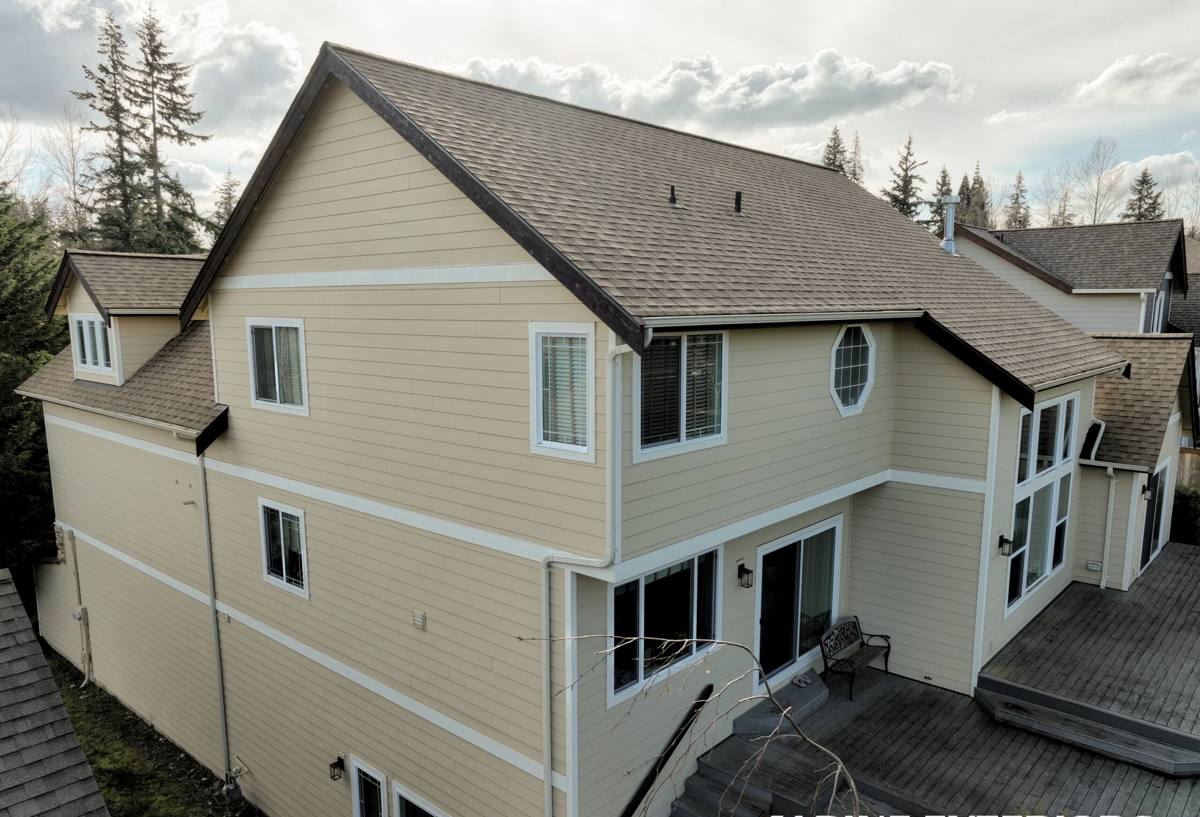
What a Deck Built for This Area Actually Needs
Flashing and moisture control at every connection
The single most common failure point on decks in wet coastal climates is the ledger board — the framing member that bolts the deck to the house. If that connection isn't properly flashed to shed water away from the house rim joist, moisture works its way in behind the siding and rots the structure from the inside where you can't see it until it's serious. Every deck we attach to a house gets proper ledger flashing integrated with the house's water-resistive barrier, not just caulk and hope.
Fasteners and hardware that can take salt air
Standard hot-dip galvanized hardware holds up fine in a lot of the country. In a coastal-influenced climate like Bellingham's, we lean toward stainless steel or heavier-coated fasteners at the connections that matter most — joist hangers, structural screws, and any hardware that's exposed rather than buried in dry framing. It costs a little more up front. Replacing a rusted-out joist hanger five years in, after it's already let a joist shift, costs a lot more.
Airflow underneath the decking
Wood and composite decking both need to dry out between rain events. Decking laid too tight, over framing with no ventilation gaps, or too close to grade traps moisture against the underside of the boards and against the joists below. That's where you see premature rot, delamination on composite boards, and the black staining that's really early-stage mold rather than dirt.
Choosing a Decking Material That Holds Up Here
There's no single "best" decking material — there's a best material for your budget, your maintenance appetite, and how much sun versus shade the deck gets. Here's how the common options actually perform in Whatcom County's rain-and-moss conditions:
| Material | How it handles our climate | Maintenance | Typical lifespan |
|---|---|---|---|
| Pressure-treated wood | Affordable and strong, but needs consistent sealing or it grays, cracks, and grows moss in shaded areas | Annual cleaning, re-sealing every 1-2 years | 10-15 years with upkeep |
| Cedar | Naturally rot- and insect-resistant, handles moisture well, but still needs finish maintenance to keep its color | Cleaning and finish renewal every 1-3 years | 15-20 years with upkeep |
| Composite decking | Resists rot and doesn't need sealing, but can trap moisture and grow algae/moss film if boards aren't spaced and ventilated properly | Periodic washing to remove algae film | 25-30 years |
| PVC / capped polymer decking | Fully sheds water, no wood fibers for mold to feed on, best moss resistance of the group | Occasional rinsing | 25-30+ years |
We're honest with homeowners that composite and PVC decking cost more per square foot up front. For a lot of Bellingham properties — especially decks under tree cover or facing north where sun never dries the surface — the reduced moss and staining problem pays that difference back in saved weekends of scrubbing and refinishing. For sunnier, more exposed decks, a well-built cedar deck can be the right call and a good value.
Framing and Substructure: Where Deck Failures Actually Start
The decking boards are what you see and walk on, but the framing underneath is what determines whether the deck is safe and how long it lasts. Problems here don't show up as a single loose board — they show up as bounce underfoot, a railing that feels less solid than it used to, or in the worst cases, a structural failure.
Things we pay close attention to on every deck:
- Post footings set below frost depth and sized for the actual load of the deck, not guessed at
- Beam and joist spans sized to the decking material and joist spacing being used, not just "what we had on the truck"
- Joist protection — either factory-treated lumber or a protective tape/flashing over the top of each joist to keep water from soaking into end grain
- Proper blocking and bracing so the structure doesn't rack or sway over time
- Railing posts bolted through the rim joist with structural connectors, not just lag-screwed into the decking
A deck that looks finished from the top can still be cutting corners underneath. If you're getting quotes and one is noticeably cheaper, ask specifically what's happening at the ledger connection, the footings, and the joist protection — that's usually where the difference in price and the difference in lifespan both come from.
Our Deck Building Process
We walk every Bellingham deck project through the same sequence so nothing gets rushed or skipped:
- Site visit and design conversation — we look at sun exposure, drainage on the lot, how the deck connects to the house, and what you actually want to use the space for.
- Material and layout decisions — we walk through decking options, railing style, and any built-in features like stairs or a lower patio connection, with honest cost and maintenance trade-offs for each.
- Permitting — most decks above a certain height or attached to the house require a building permit locally; we handle that process rather than leaving it to you.
- Demolition and site prep, if an old deck is being replaced, including a check of the house framing behind it once the old ledger comes off.
- Framing — footings, posts, beams, ledger flashing, and joists, inspected before anything gets covered up.
- Decking, railing, and stairs installed with attention to fastener pattern and board spacing for drainage.
- Final walkthrough with you before we call the job done.
Permits and Local Considerations
Deck construction in Whatcom County and the City of Bellingham generally falls under the same residential building code framework as the rest of the state, with permitting required for most attached decks and any deck built above a certain height off grade. Requirements can vary depending on your specific property and jurisdiction, and they do get updated, so we always confirm current requirements before pulling a permit rather than relying on what applied last year. Skipping the permit step might save time upfront, but it can create real problems at resale or with insurance if something's built out of code — it's not worth the risk.
Keeping Moss and Algae From Taking Over
Bellingham's damp, often-overcast stretch of the year is exactly what moss and algae need to establish themselves on any horizontal wood or composite surface, especially in shaded corners or under trees. The building-side fix is airflow and drainage, covered above. The ongoing-maintenance fix is simpler than most homeowners expect:
- Sweep debris and fallen leaves off the deck regularly through fall — trapped organic matter is what feeds moss growth
- Rinse or lightly wash the deck surface a couple of times a year, more often in shaded areas
- Keep nearby shrubs and tree branches trimmed back so more sunlight and air reach the deck surface
- Address any standing water or slow-draining spots on the deck surface promptly — that's where moss gets its start
Maintenance Checklist to Protect Your Investment
Whatever material you choose, a short annual check catches small issues before they become expensive ones:
- Inspect the ledger board area and flashing for any sign of water staining on the siding above or below it
- Check railing posts and connections for looseness
- Look underneath the deck for signs of moisture, rot, or pest activity on joists and beams
- Re-seal wood decking on the schedule the finish product recommends — don't wait until it looks gray and dry
- Clear gaps between boards so debris isn't holding moisture against the framing
Why Hiring a Crew That Already Works in Bellingham Matters
A deck builder who mostly works drier inland areas isn't necessarily going to over-flash a ledger board or spec stainless fasteners by default — because where they usually work, it isn't strictly necessary. Around Bellingham and the rest of Whatcom County, those details aren't optional extras; they're the difference between a deck that needs major repair in eight years and one that's still solid in twenty-five. We build decks in this specific climate as our normal, everyday work, which means the moisture control, hardware choices, and material recommendations above aren't upsells — they're just how we build a deck that's going to hold up here.
If you're planning a new deck or replacing one that's showing its age, we're happy to take a look and talk through honest options for your property, your budget, and how you actually want to use the space. Reach out for a free, no-pressure estimate using the form below.