 Lynden Siding
 Why Birch Bay's Marine Climate Is Harder on Siding Than Inland Lynden
Birch Bay sits right on the water, and that changes what siding has to survive compared to homes a few miles inland around Lynden. The salt-laden air off the bay settles on exterior surfaces every day, wind-driven rain hits west and south-facing walls at an angle that pushes water into seams and laps that would stay dry elsewhere, and the shade and moisture from tree cover extends moss season well past what most of Whatcom County deals with. None of this means Birch Bay is a bad place to own a home — it just means siding here needs to be installed and maintained with that exposure in mind, and repairs need to actually solve the problem instead of covering it up.
We've made a lot of repair calls out to this stretch of coastline, and the failures we find are rarely random. They follow patterns tied directly to salt exposure, wind direction, and how long moss and algae have been left to sit against the material. Understanding those patterns is most of what separates a repair that lasts from one that fails again in a year or two.
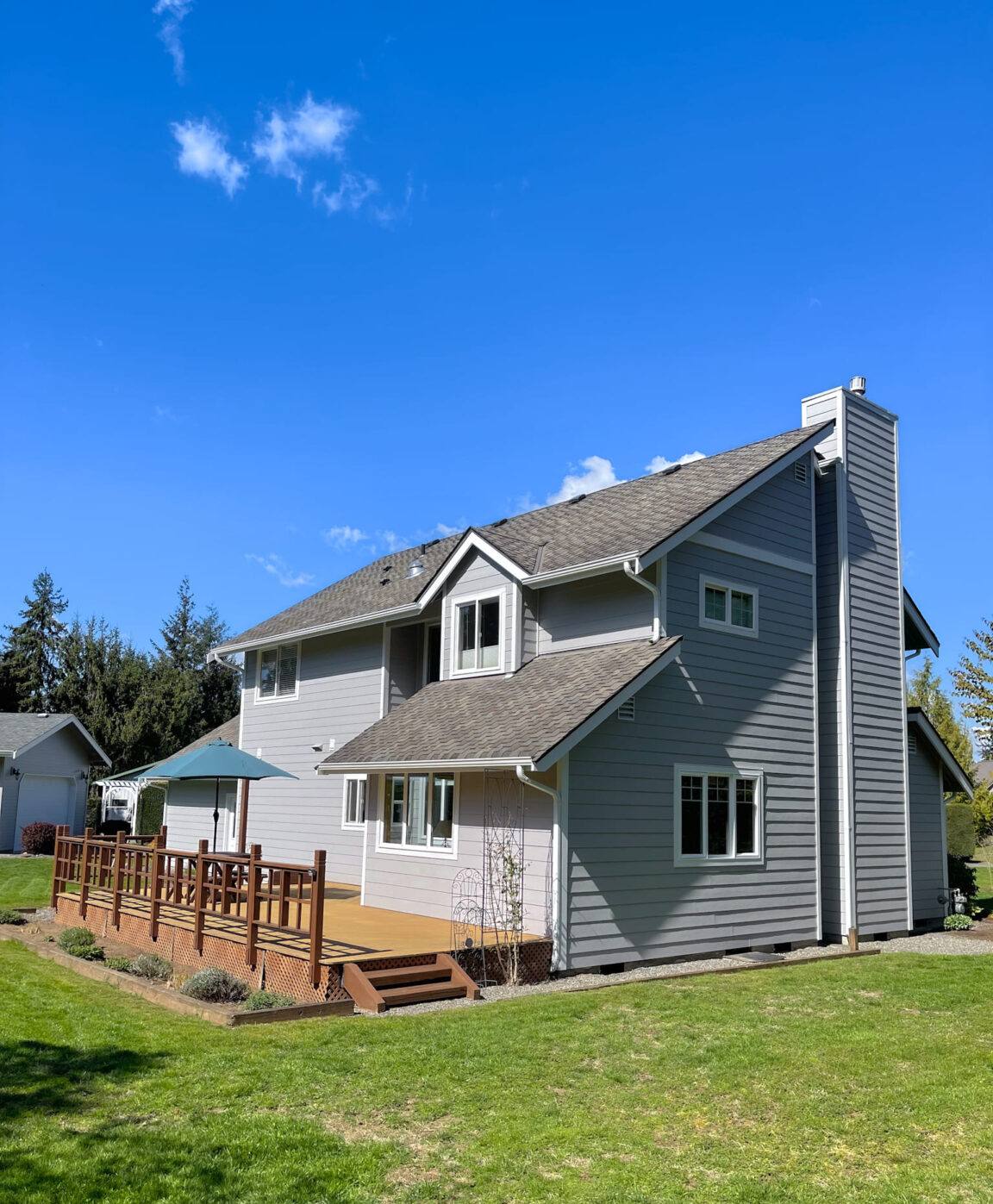
Signs Your Birch Bay Home Needs Siding Repair, Not Just a Cleaning
Moss and Algae Growth vs. Real Water Damage
Green or black staining on siding is often just surface growth, and a lot of homeowners assume that's all it is. But moss holds moisture against the siding surface far longer than open air would allow, and over time that constant dampness can work its way into seams, nail holes, and butt joints — especially on older wood, LP, or lower-grade composite siding that wasn't built to handle sustained moisture contact. If the discoloration is thick, has been there more than a season, or the siding underneath feels soft, spongy, or bows slightly when pressed, that's no longer a cleaning problem.
Corroding Fasteners, Trim, and Hardware
Salt air accelerates corrosion on anything metal — nail heads, flashing, trim fasteners, and hose bibs or light fixtures mounted through the siding. Rust streaks bleeding down from a nail or screw, trim that's started to separate at the corners, or flashing that's visibly pitted are early warnings. Left alone, corroding fasteners stop holding siding tight to the wall, which opens a path for wind-driven rain to get behind the material entirely.
A few things worth checking, or having a contractor check, before deciding a repair is needed:
- Soft or spongy spots when you press on siding near the bottom courses or around windows
- Visible gaps, warping, or buckling in individual boards or panels
- Paint or finish that's bubbling, peeling, or chalking heavily in one area but not others
- Rust staining below nail heads, screws, or metal trim pieces
- Moss or algae that's thick, long-standing, or growing in a consistent band low on the wall
- Interior signs — a musty smell, discoloration on interior walls, or trim that's damp to the touch on the other side of an exterior wall
- Caulking at joints and penetrations that's cracked, shrunk, or pulled away from the siding
What a Correct Siding Repair Actually Involves
Finding the Real Water Path, Not Just the Symptom
The visible damage on siding is almost never where the water actually got in. A stained or soft board at the bottom of a wall is frequently the result of water entering higher up — at a window head, a poorly flashed penetration, or a seam where two courses meet — and running down behind the siding until it finds somewhere to pool or soak through. Replacing just the damaged board without tracing that path back to its source is the single most common reason siding repairs fail again within a year or two, especially in a wind-and-rain environment like Birch Bay's.
Matching the Existing Material and Finish
A repair also has to account for what's already on the house. Fiber cement, wood, and vinyl all move, weather, and fasten differently, and mismatched materials or incompatible fasteners can create new problems — galvanic corrosion between dissimilar metals, moisture trapped behind a rigid patch on a material that expands and contracts, or a visible seam where color and texture don't line up. Where James Hardie fiber cement is already installed, repairs are relatively straightforward because the product line and ColorPlus finish are consistent and well documented. Where a home has older wood siding, LP SmartSide, or vinyl, we're upfront about what a patch can and can't accomplish, and when full replacement is the more honest answer.
Repair or Replace? How We Help Birch Bay Homeowners Decide
Not every damaged section needs a full re-side, and not every repair is worth doing on its own. The table below covers the factors that usually tip the decision one way or the other.
| Factor | Leans Toward Repair | Leans Toward Replacement |
|---|---|---|
| Extent of damage | Isolated to one or two areas | Spread across multiple walls or elevations |
| Underlying material condition | Sheathing and framing are still sound | Rot has reached the wall structure itself |
| Siding material | James Hardie fiber cement, matched and available | Discontinued vinyl, wood, or LP that can't be matched |
| Age of existing siding | Well within its expected service life | Near or past the end of its practical lifespan |
| Root cause | A fixable flashing or fastener issue | Systemic moisture intrusion behind large sections |
| Cosmetic match after repair | Color and texture will blend acceptably | Patch would be visibly mismatched |
We'll walk you through where your home falls on that list before we recommend either option — our job is to give you an honest read, not to upsell a full re-side when a targeted repair will genuinely hold up.
Our Siding Repair Process, Start to Finish
- On-site inspection. We look at the damaged area and everything around it — flashing, trim, caulking, and the wall assembly behind the visible siding — to find the actual water path.
- Moisture and structural check. Where damage looks deeper than surface-level, we check the sheathing and framing behind it before quoting anything, so there are no surprises once work starts.
- Honest scope and estimate. You get a clear explanation of what needs to happen, why, and what it will cost — including whether a repair is really the right call or replacement makes more sense long-term.
- Removal and correction of the cause. We remove the affected siding, fix the underlying issue — bad flashing, a failed seal, corroded fasteners — and confirm the wall assembly underneath is dry and sound before closing it back up.
- Reinstallation to spec. New material goes in with correct fastening, flashing, and clearances, matched to the existing siding as closely as the product allows.
- Final check. We walk the repair with you, confirm the finish and seams look right, and explain any maintenance steps specific to your home's exposure.
Why We Repair and Install Only James Hardie Fiber Cement
We install James Hardie exclusively — we don't put vinyl, LP SmartSide, Cemplank, Allura, or primed wood siding on homes, and that standard shapes how we approach repairs too. In a marine environment like Birch Bay, the differences between materials show up fastest. Vinyl can warp or become brittle with age and temperature swings and offers little to repair once cracked. Wood and primed spruce need consistent repainting and sealing to hold up against salt air and constant damp, and once moisture gets past the finish, rot can spread quickly. LP SmartSide and other engineered wood products are more moisture-resistant than raw wood but still rely on an intact factory coating to keep water out at the edges and fastener points.
James Hardie fiber cement is non-combustible, doesn't rot, and holds its ColorPlus factory finish for years without repainting, which matters in an environment where repainting exterior surfaces is its own ongoing maintenance burden. Its HZ5 product line in particular is engineered for harsh climate exposure — freeze-thaw cycling, humidity, and moisture — which is exactly the profile Birch Bay's coastline creates. When we repair Hardie siding, we're working with a product that behaves predictably and has a strong transferable warranty behind it. When we're asked to patch other materials, we'll do honest work, but we're candid that a full Hardie re-side is usually the better long-term investment for a home this exposed.
Why a Crew That Already Works Birch Bay Matters
Siding repair in a coastal environment isn't the same trade as repair work fifteen miles inland. A crew that regularly works Birch Bay already knows which elevations tend to take the worst of the wind-driven rain, how much longer moss holds on in shaded, low-lying yards near the water, and what corrosion actually looks like at six months versus two years in this air. That local pattern recognition means fewer surprises once a wall is opened up, and it means the repair gets built to handle the specific conditions of your lot rather than a generic set of assumptions.
It also matters for follow-through. A contractor based in the area, working Lynden, Birch Bay, and the rest of Whatcom County regularly, is going to be around if a question comes up after the work is done — not a crew that drove in once and moved on.
Keeping Salt Air and Moss From Coming Back
A good repair buys you time, but a few habits stretch that time considerably longer in this climate:
- Rinse siding periodically to clear salt residue and organic buildup before it has a chance to establish
- Trim back vegetation and tree cover that keeps siding shaded and damp longer than the rest of the house
- Check caulking at trim, windows, and penetrations once a year, and re-seal anything that's cracked or shrunk
- Look at fasteners and metal trim for early rust staining rather than waiting for a visible failure
- Address small issues — a lifted piece of trim, a gap at a seam — as soon as they're noticed, before wind-driven rain has a season to work on them
If you're seeing any of the warning signs above, or just want a second opinion on a section of siding that doesn't look right, we're happy to take a look. We offer free, no-pressure estimates for siding repair throughout Birch Bay and the surrounding Lynden area — there's a form below to get started.