 Lynden Siding
 Replacement Is a Different Decision Than Repair
Not every siding problem calls for a full replacement, but a lot of Blaine homeowners end up there anyway, because the conditions that damage siding in this town don't stay contained to one wall or one panel. Salt air off the water, driving rain that comes in sideways during winter storms, and a moss season that can run most of the year all work on a house continuously, not occasionally. When siding starts failing under that kind of pressure, the damage is often more widespread than it looks from the driveway, and patching one section while the rest of the system is a few years behind it in the same failure process usually just delays the inevitable.
This page is specifically about full siding replacement for Blaine homes — tearing off an existing system that's reached the end of its useful life and putting on a new one — not spot repair, and not new construction. If you're trying to figure out whether your house needs a patch or a full re-side, or you already know it's time and want to understand what a correct replacement job actually involves, this is written for that decision.
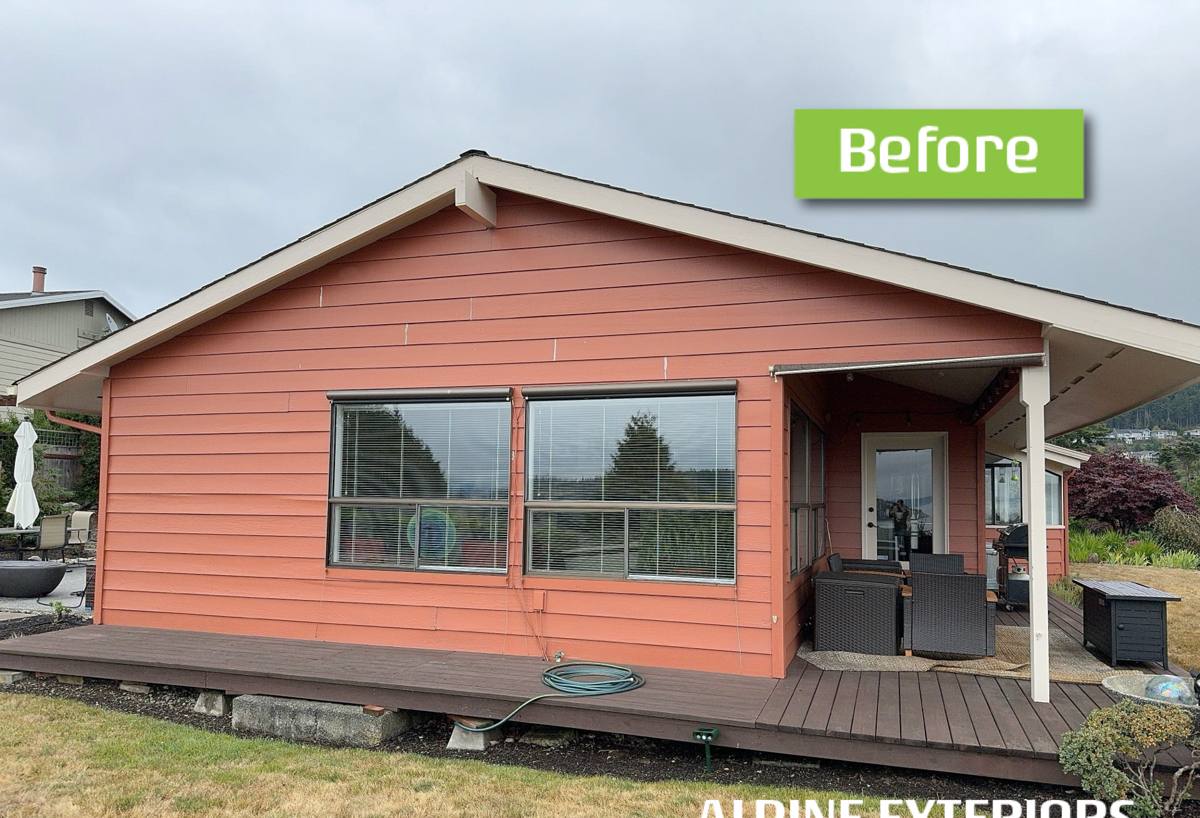
Signs a Blaine Home's Siding Has Reached the End of Its Life
What You Can See From the Ground
Some warning signs are visible on a walk around the house, without any special tools:
- Paint that keeps failing within a couple of years of each repaint, especially on walls facing the water or prevailing wind
- Soft or spongy spots when you press on the siding, particularly near the bottom courses or under windows
- Visible cracking, cupping, or warping across multiple panels or boards, not just one damaged spot
- Persistent moss or dark staining that comes back within weeks of being cleaned off
- Gaps opening up at seams, corners, or trim that weren't there when the siding was newer
- Rot visible at the bottom edge of the siding or around window and door trim
What Shows Up Only Once the Old Siding Comes Off
A lot of the real story is hidden until tear-off. Water-resistive barriers that were never properly lapped, sheathing that's been slowly absorbing moisture for years without any visible sign on the surface, and insulation that's compressed or waterlogged behind the wall are all common finds on older Blaine homes, especially ones that were originally sided with a moisture-sensitive product or installed without much attention to drainage detail. This is one of the practical reasons a full replacement is often the more honest answer than another round of patching — repair addresses what you can see, but it can't fix what's happening behind the wall.
Why Blaine's Climate Wears Out the Wrong Siding Faster
Salt Air Off the Water
Blaine's position on Semiahmoo Bay and Drayton Harbor means salt-laden air reaches most homes in town, not just the ones with a direct water view. Salt exposure accelerates corrosion on fasteners and hardware and speeds up the breakdown of moisture-sensitive siding materials, which is part of why siding that performs acceptably twenty miles inland can fail years earlier here.
Driving Rain at Every Seam and Penetration
Storms coming off the water tend to arrive with real wind behind them, which pushes rain sideways into panel seams, trim joints, and window flashing instead of letting it run straight down the wall. Siding and installation details that would hold up fine under a gentle vertical rain get tested much harder under wind-driven rain, and older systems without proper flashing or drainage detailing show that stress first.
A Moss Season That Doesn't Really End
Cool, wet conditions for most of the year keep any wall that stays damp from ever fully drying out, and moss and algae growth follow. On siding that's already compromised — cracked, delaminating, or holding water at a seam — moss isn't just cosmetic; it's a sign that a section of wall is staying wet longer than it should, which speeds up whatever damage is already underway.
Repair or Full Replacement? How We Make the Call
We don't default to recommending replacement just because it's the bigger job. The honest answer depends on how much of the system is affected and what's likely going on underneath.
| Situation | Usually points toward | Why |
|---|---|---|
| One damaged panel or a small localized area, siding otherwise sound | Repair | The rest of the system still has useful life left and isn't showing the same failure pattern |
| Failure showing up on multiple walls or in multiple spots | Replacement | Widespread failure usually means the whole system is at the same point in its life cycle, not just one section |
| Siding is a moisture-sensitive product (untreated wood, older engineered wood, damaged fiber cement) nearing typical end-of-life | Replacement | Patching an aging system with a mismatched material rarely holds up as well as starting fresh |
| Soft sheathing or suspected water intrusion behind the wall | Replacement | Repair can't address damage that's already behind the siding; it has to be opened up and inspected |
| Siding is sound but the home is being repainted or updated cosmetically | Repair or maintenance | No structural or moisture reason to remove sound siding just for a color change |
What a Correct Replacement Involves on an Older Blaine Home
Full Tear-Off, Not an Overlay
Installing new siding over an existing layer is sometimes offered as a cheaper shortcut, but it buries whatever condition the old siding and the wall behind it are actually in. On a coastal, wet climate like Blaine's, that's a real risk — trapped moisture behind two layers of siding has nowhere to go. We tear off down to the sheathing on a full replacement, which is slower and more expensive than an overlay, but it's the only way to actually know what's underneath.
An Honest Look at What's Behind the Old Siding
Once the old material is off, we inspect the sheathing, framing, and existing water-resistive barrier before anything new goes up. Soft or rotted sheathing gets replaced, not covered. This step is where a replacement project can turn up more scope than originally estimated, and we'd rather flag that honestly at this stage than have it become a problem years after the new siding is up.
Matching Trim, Transitions, and Existing Details
Replacement work on an occupied home usually means working around existing rooflines, decks, window trim, and sometimes an addition that was sided at a different time than the original house. Getting those transitions right — consistent reveal, proper flashing where new siding meets an existing roof or deck — takes more judgment than siding a blank wall on new construction, and it's a big part of what separates a clean replacement from one that looks patched together.
Our Replacement Process, Step by Step
- Walk the house with the homeowner, assess visible condition, and identify which walls are seeing the most exposure to wind and salt air
- Provide a written estimate that separates the base siding scope from any conditional allowance for sheathing repair, since that can't be fully known until tear-off
- Tear off the existing siding and inspect sheathing, framing, and the condition of any existing barrier or insulation
- Repair or replace any damaged sheathing before moving forward
- Install a new water-resistive barrier with proper lapping and taped seams at every penetration
- Install James Hardie siding to manufacturer fastening, spacing, and clearance specifications
- Flash and seal every window, door, and penetration as it's installed, not as an afterthought
- Walk the finished job with the homeowner and go over basic maintenance for a home in this climate
Timeline and Cost Factors for a Blaine Replacement Project
Every replacement estimate is specific to the house, but a few factors consistently drive both price and schedule:
| Factor | Why it matters |
|---|---|
| Condition found at tear-off | Rotted or water-damaged sheathing adds repair scope that can't be fully priced until the old siding is off |
| Square footage and number of stories | More wall area and height mean more labor, and taller walls often need more staging and access equipment |
| Trim, window, and roofline complexity | Homes with more transitions require more flashing and detail work per square foot of siding |
| Exposure to wind and open water | Water-facing walls generally warrant closer attention to flashing, hardware, and drainage detail |
| Product line and ColorPlus finish selection | James Hardie offers multiple panel styles, textures, and factory-finish colors at different price points |
Weather also plays a bigger role in scheduling a Blaine replacement than it does in more sheltered parts of Whatcom County. Wind off the water can shut down safe tear-off and panel handling on days that would be workable further inland, so we build some flexibility into project timelines rather than committing to a fixed date that a bad stretch of weather is likely to break.
Why We Replace Old Siding With James Hardie, Not a Like-for-Like Match
Homeowners sometimes ask why we don't just replace old siding with the same or a similar product, especially if cost is a factor. Our answer is straightforward: we install James Hardie fiber cement exclusively because we've seen how it holds up in this specific climate compared to vinyl, LP SmartSide, and other engineered wood or cement-board alternatives — non-combustible material, a factory-applied ColorPlus finish that isn't relying on field paint to survive salt air and driving rain, and a product line engineered for wet, freeze-thaw climates like this one. That's a professional standard we hold to on every replacement job, not a sales pitch, and it's the direct result of watching which products actually go the distance on homes exposed to what Blaine's weather does year-round.
Why a Crew That Already Works Blaine Matters for a Replacement Job
Replacement work rewards experience more than new construction does, because so much of it depends on judgment calls made in the moment — what a soft spot in the sheathing actually means, how to detail a transition where new siding meets an older deck or addition, which fastener and flashing choices actually hold up on a wall that takes direct salt air off the water. A crew that works Blaine regularly has already made those calls dozens of times on houses very similar to yours. That's a different level of confidence than a contractor tackling a Blaine job as an occasional trip between projects elsewhere in the county.
If your siding is showing its age or you're not sure whether repair or full replacement is the right call, we're glad to come take a look and give you a straight answer. Reach out using the form below for a free, no-pressure estimate.