 Lynden Siding
 Building a Deck That Can Handle Custer's Weather
Custer sits in the northwest corner of Whatcom County, close enough to Puget Sound and the Strait of Georgia that salt-laden air reaches wood, fasteners, and metal hardware year-round. Pair that with Western Washington's long rainy season and the shade many lots carry from mature evergreens, and you get months of damp conditions that push moss and algae onto any horizontal wood surface that doesn't dry out quickly. A deck built off a generic spec sheet will show the wear within a few seasons — cupped boards, screw heads bleeding rust through the finish, a slick green film on the walking surface by late winter. A deck designed for this specific stretch of Whatcom County accounts for salt air, driving rain, and a long moss season from the first framing decision, not as an afterthought once problems show up.
This page is about one thing: building and maintaining a custom deck for a home in the Custer area, and what separates a deck that holds up here from one that doesn't.
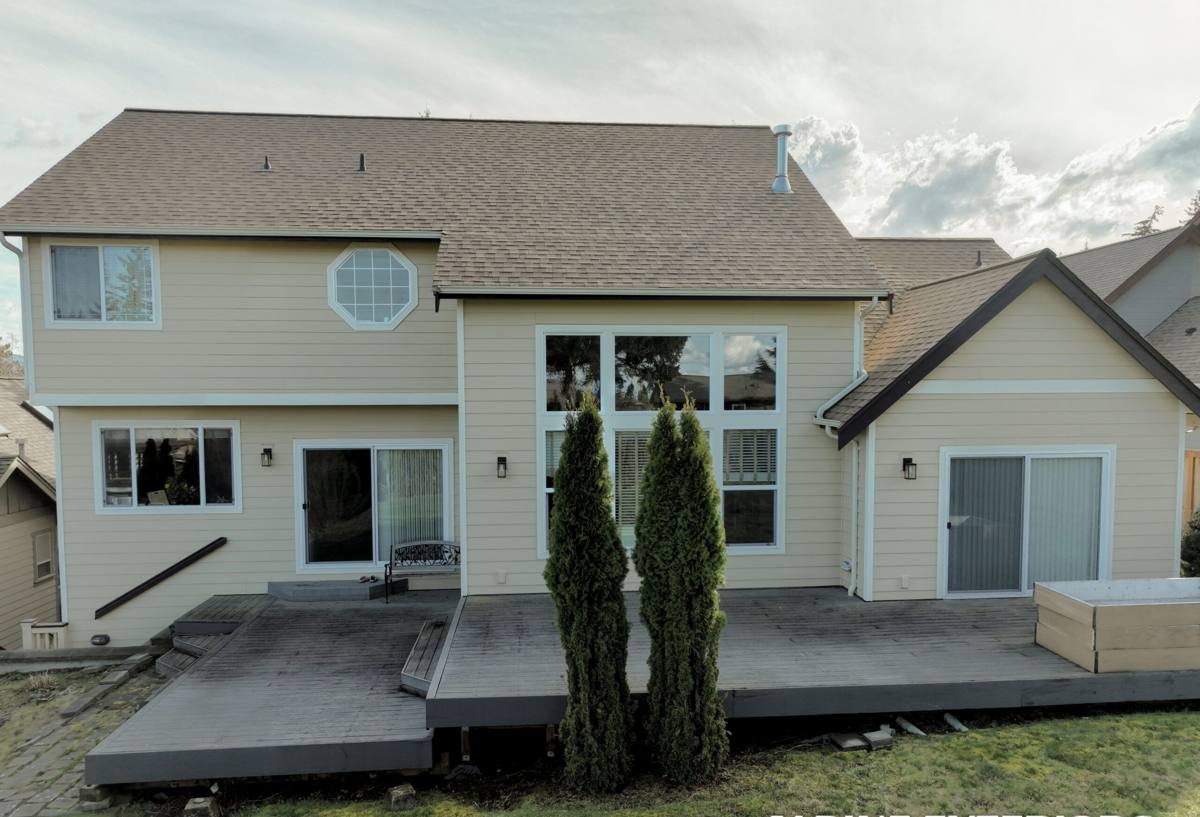
What "Custom" Actually Means for a Custer Deck
Site and Sun
No two lots around Custer get the same weather exposure. Some properties sit out in open farmland with full sun most of the day, which dries a deck out fast but also bakes and fades certain finishes faster than the manufacturer's sample chip suggests. Others back up to a tree line or sit under mature firs and cedars, which means near-constant shade, slower drying after rain, and a much shorter window between moss treatments. A custom deck design starts with a walk of the actual site — sun path, wind exposure, how close the ground is to the framing, and where water naturally wants to drain — rather than a one-size layout dropped onto every lot.
How the Deck Will Actually Be Used
The right custom deck also depends on how the household plans to use it: a simple entertaining space off the kitchen, a multi-level layout working around a sloped yard, a deck built to carry a hot tub, or a covered section meant to stay usable through the wet months. Each of those changes the framing spec, the footing layout, and sometimes the material choice — a deck rated for a hot tub's static load isn't built the same way as a basic sitting deck, and that difference has to be designed in before the first post hole is dug, not patched in afterward.
Choosing Decking Material for Salt Air, Rain, and Moss
The decking surface is the most visible decision, and it's also the one most affected by this climate. There's no single "best" material for every project — it depends on budget, how much upkeep the homeowner wants to do, and how exposed the deck is to shade and standing moisture.
| Material | Upfront Cost | Moss & Moisture Resistance | Upkeep | Notes for This Climate |
|---|---|---|---|---|
| Pressure-treated fir/hem-fir | Lowest | Fair — needs sealing | Annual cleaning and re-sealing | Budget-friendly but shows moss fastest in shaded spots if maintenance slips |
| Cedar | Moderate | Good natural resistance | Periodic cleaning, occasional stain | Natural look, but salt air and UV will gray it without upkeep |
| Capped composite | Higher | Very good | Occasional wash, no staining | Resists moss buildup best of the low-upkeep options; still needs airflow underneath |
| PVC/vinyl decking | Highest | Excellent | Rinse as needed | Fully moisture-sealed board; best for deep-shade lots with a heavy moss problem |
Composite and PVC boards cost more up front, but on a shaded Custer lot where moss is a recurring fight, the reduced maintenance can be worth it. On an open, sunny site, a well-sealed cedar or treated deck can perform just as well for a lower price. We'll walk the actual site with you before recommending one over the other — this isn't a decision we make from a brochure.
What's Underneath Matters More Than What's on Top
Footings and Framing
A deck is only as good as what's buried and hidden. Footings need to be set below frost depth and sized for the actual load the deck will carry, not a minimum guess. Framing lumber should be rated for ground contact where it's close to soil or damp mulch beds, and joists need enough clearance and airflow underneath to actually dry between rain events — a deck framed too close to grade in a shaded Custer yard will stay damp for days after a storm, which is exactly the condition moss and rot need.
Ledger Board and Flashing
Where the deck attaches to the house is the single most common failure point on any deck in this climate. The ledger board needs proper flashing that sheds water away from the house band joist, not just caulk and a screw pattern. Done wrong, this is how water quietly works its way into the wall framing behind the siding — a problem that can go unnoticed for years in a climate that's wet most of the year anyway.
Joist Protection
Self-adhering joist tape over the top of every joist keeps standing water out of the fastener holes and end grain, which is where rot typically starts. It's a small material cost relative to the whole project, and it's one of the details that separates a deck built to actually last in Whatcom County weather from one that's just built to pass a walkthrough.
Fasteners and Hardware: The Detail Salt Air Punishes First
Hardware is usually the first thing to show damage on a coastal-influenced deck, often years before the structural lumber has any real problem. Salt air accelerates corrosion, and mixing incompatible metals — say, standard steel screws with aluminum flashing, or the wrong coating against treated lumber's chemical makeup — speeds it up further through galvanic reaction. For structural connectors and any hardware close to grade or fully exposed to weather, we spec stainless steel or heavy hot-dip galvanized fasteners rated for ground-contact treated lumber, matched to the metals they'll be touching. It costs more than a box of standard deck screws, but replacing rusted-out ledger bolts or corroded joist hangers a few years in costs far more.
Managing Moss, Mildew, and Standing Water
Even a well-built deck needs some ongoing defense against Whatcom County's wet season, especially on shaded lots. The goal is to stop water from sitting anywhere on the deck for extended periods, since standing moisture is what lets moss and mildew establish in the first place.
- Board gaps sized correctly for the material, so water drains through instead of pooling on the surface
- Deck framed with a slight pitch away from the house so water sheds off the edge
- Gutters and downspouts routed away from the deck footprint, not dumping straight onto or under it
- Underside airflow maintained — skirting, if used, should still allow ventilation rather than sealing the space
- Overhanging branches trimmed back where practical to cut down on shade and falling debris that traps moisture
None of these steps eliminate the need for occasional cleaning, but together they cut down significantly on how often moss becomes a real problem rather than a minor one.
Our Process for a Custer Deck Build
- Site walk and consultation — we look at sun exposure, drainage, grade, and how you plan to use the space before talking materials.
- Design and material selection — layout, decking material, railing style, and any features like built-in seating or a covered section, priced honestly against your budget.
- Permitting — we handle the permit application and inspections through Whatcom County so you don't have to chase paperwork.
- Framing and structural work — footings, ledger flashing, joist tape, and hardware sized and rated for this climate, not just code minimum.
- Decking, railing, and finish work — installed to the manufacturer's spacing and fastening spec, which matters for warranty coverage down the road.
- Final walkthrough — we go over the finished deck with you, including what maintenance it actually needs and how often.
Permits and Whatcom County Considerations
Custer is unincorporated, so deck permitting goes through Whatcom County rather than a city building department. Requirements vary by deck height, size, and whether it's attached to the house, but most decks above a certain height off grade need a permit, an inspected footing, and a guardrail and stair design that meets current code for rail height, baluster spacing, and stair rise and run. We pull the permit and coordinate inspections as part of the job — it's part of doing the work correctly, not an optional add-on, and it protects you if you ever sell the house and a buyer's inspector checks the deck's history.
Why a Crew That Already Works Custer Matters
A deck contractor who already works this part of Whatcom County isn't guessing at how the site will behave. We've seen how shaded lots near the tree lines hold moisture longer than open farmland a half mile away, how salt-influenced air treats bare hardware differently than it would further inland, and how a wet spring here can stall a build schedule if you don't plan around it. That local pattern recognition shows up in small decisions throughout the project — where to add extra airflow underneath, which fastener spec to use on a fully exposed rail post, when to schedule the pour so footings cure properly. It's also easier to get a warranty call answered quickly by a crew that's already routinely working in Custer and greater Lynden, rather than one dispatching from across the region.
Keeping Your New Deck in Good Shape
A well-built deck in this climate still needs some seasonal attention. None of it is complicated, but skipping it is how moss and moisture problems get a foothold.
- Sweep debris and needles off the deck regularly, especially in fall
- Rinse or wash the surface at least once or twice a year, more often on shaded sections
- Check and clear gaps between boards so drainage isn't blocked by dirt buildup
- Inspect fasteners and hardware yearly for early rust or loosening
- Re-seal or re-stain wood decking on the schedule the product actually calls for, not just when it looks bad
- Keep gutters and downspouts near the deck clear so water isn't redirected under it
If you're planning a new deck in Custer or want an honest opinion on one that's already showing its age, we're happy to take a look. Reach out for a free, no-pressure estimate using the form below — we'll walk the site with you and give you a straight answer on what it needs.