 Lynden Siding
 Nooksack Sits in a Demanding Corner of Whatcom County
Nooksack sits along the river valley just northeast of Lynden, in the farm country that stretches toward the Canadian border. It's not a waterfront community, but it doesn't need to be — the same marine-influenced weather system that shapes exterior work across Whatcom County still moves through this part of the valley. Moist air drifts in off the Sound and travels up the river corridor, rainfall arrives more often sideways than straight down, and the valley's mix of shade, farmland humidity, and mild temperatures gives moss a long season to work on any exterior surface that stays damp. None of that is unusual for this region, but it adds up differently on a house than most homeowners expect until they're the ones dealing with it.
Siding on a Nooksack-area home has to shed wind-driven rain, resist a moss and mildew season that runs most of the year on shaded walls, and hold its finish against salt-tinged air moving up the valley from the water — all while sitting on a house that may see wider temperature swings than in-town properties closer to Bellingham Bay. That's a specific set of demands, and it's why we install one siding system rather than offering a menu of options that all perform differently under that load.
What "Driving Rain" Actually Means for a Wall
A lot of siding marketing talks about rainfall totals, but total inches of rain isn't what damages a wall assembly — direction is. When wind pushes rain sideways into a lap joint, a corner trim detail, or a window head flashing, it's testing the water management of the whole system, not just the surface material. A siding product and installation that handle vertical rain fine can still leak under sustained horizontal pressure if the joints, caulking, and flashing weren't detailed for it. That's the condition a Nooksack-area wall faces during a normal fall or winter storm, not an occasional extreme.
A Moss Season That Doesn't Take Much of a Break
Shaded, north-facing, and tree-lined walls around Nooksack properties can stay damp for days after a storm passes, and that dwell time is exactly what moss, algae, and mildew need to establish themselves on a siding surface. Once organic growth takes hold, it traps moisture against the wall longer than an open, dry, or south-facing wall ever would, which accelerates whatever damage the underlying material is already prone to. A siding material with an inorganic core doesn't stop moss from landing on the surface, but it doesn't feed on it or break down from it the way an organic substrate can if moisture works its way underneath a compromised finish.
Why We Install Fiber Cement — and Only One System
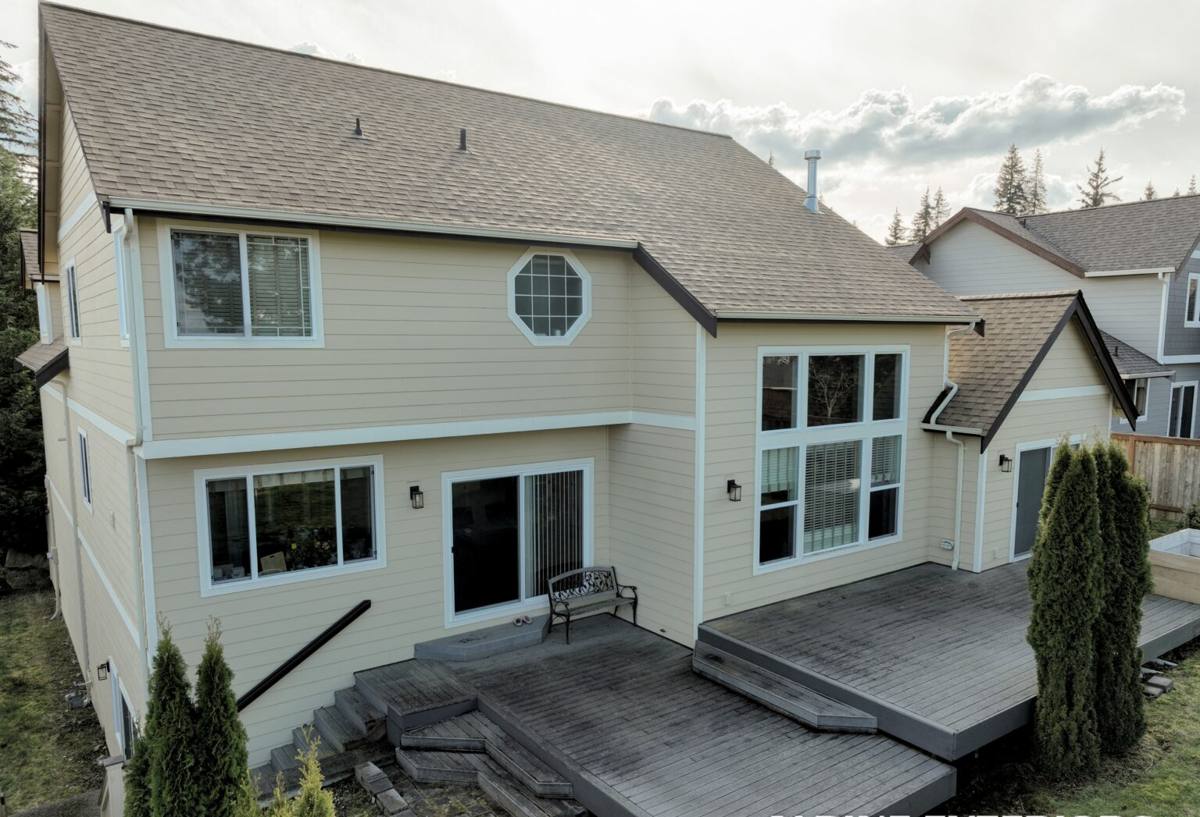
We install James Hardie fiber cement siding exclusively. We don't offer vinyl, LP SmartSide, Cemplank, Allura, primed spruce, or cedar, and that's a deliberate professional standard, not a lack of options. Each of those products has real strengths, and none of them are junk. What changed our approach was watching how material choice and installation quality interact under sustained valley moisture over years, not just on install day — and fiber cement's inorganic core gave us a wider margin for error and a longer service life under that specific stress.
What James Hardie Fiber Cement Actually Is
Hardie siding is a cement-based composite — portland cement, sand, and cellulose fiber, formed into planks or panels and cured under controlled conditions. The core material doesn't have wood fiber to absorb water and swell, and it doesn't have an organic component for fungus or insects to feed on. Most of what we install comes with Hardie's factory-applied ColorPlus finish, a baked-on coating applied in a plant rather than brushed on in the field after the siding is already on the wall.
Why the HZ5 Formulation Matters Here
James Hardie makes different fiber cement formulations for different climate zones, and the HZ5 line is engineered specifically for regions with significant moisture exposure and freeze-thaw cycling — a fit for a Nooksack valley winter, where damp cold and periodic freezes both show up. Specifying the right formulation for the climate zone, rather than defaulting to whatever a distributor has on the truck, is a detail that matters more here than in a drier, milder region.
What a Correct Fiber Cement Installation Actually Involves
The material is only half of what makes fiber cement siding perform the way it's supposed to. The other half is installation discipline, and this is where a lot of the real-world problems with any siding system — fiber cement included — actually originate.
Moisture Barrier and Wall Prep
Before the first plank goes up, the house needs a correctly lapped weather-resistant barrier, properly flashed window and door openings, and attention to any existing rot or substrate damage underneath the old siding. Skipping this step to save time is one of the most common ways a good material ends up performing poorly — moisture that gets behind the siding through a bad flashing detail doesn't care how good the plank itself is.
Fastening, Clearances, and Joint Detail
Hardie's installation specifications call for particular fastener types, spacing, and penetration depth, along with minimum clearances from grade, roof lines, and decks so the bottom edge of the siding never sits in standing water or splash-back. Butt joints need to be properly sealed or backed with flashing tape rather than just caulked and hoped for. None of this is complicated, but all of it is easy to shortcut on a job that's being rushed, and shortcuts here are exactly what shows up as a maintenance problem five or ten years later.
Factory Finish vs. Field-Applied Paint
ColorPlus finishes are cured in a factory environment and hold their color and moisture resistance longer than field-applied paint, particularly at the coating level where salt-tinged, humid valley air tends to accelerate breakdown of a lower-grade finish over time. Cut edges at trim and corners still need field-applied touch-up product matched to the ColorPlus system — leaving a cut edge unsealed is a small mistake that undercuts an otherwise good installation.
How Our Process Works on a Nooksack-Area Job
- Walkthrough and assessment: We look at the existing siding, substrate condition, flashing details, and any problem areas before quoting anything, since a valley property's moisture exposure and shading can vary a lot lot-to-lot.
- Written estimate: You get a clear scope, product and formulation spec (including whether HZ5 is called for), and a realistic timeline — no pressure to sign on the spot.
- Prep and tear-off: Old siding comes off, substrate damage gets addressed and documented rather than covered up, and the weather-resistant barrier and flashing go in correctly before a single plank is hung.
- Installation to Hardie spec: Fastening, joint sealing, and clearance details are followed to manufacturer specification, not shortcut to save a day of labor.
- Final walkthrough: We go over the finished job with you, including any touch-up detail at cuts and corners, before calling it done.
Fiber Cement vs. the Other Options Nooksack Homeowners Consider
| Factor | James Hardie Fiber Cement | Vinyl | Engineered Wood (e.g. LP SmartSide) |
|---|---|---|---|
| Core material | Cement, sand, cellulose fiber (inorganic) | PVC plastic | Strand wood fiber with resin treatment |
| Moisture response | Dimensionally stable; doesn't swell or warp | Doesn't absorb water, but can warp under heat/cold swings | Treated to resist moisture, but core is still wood-based |
| Wind-driven rain performance | Strong when joints and flashing are detailed correctly | Adequate, but seams can work loose over time | Vulnerable at exposed cut edges if sealing isn't precise |
| Combustibility | Non-combustible | Combustible | Combustible |
| Finish longevity | Factory-baked ColorPlus finish available | Color molded through material; can fade and chalk over time | Factory-primed or pre-finished; field-painted at seams and cuts |
| Typical warranty structure | Long-term, often transferable when installed to spec | Varies widely by manufacturer and grade | Limited warranty, terms vary by product line |
None of the columns here are a trick. Vinyl is genuinely inexpensive and low-maintenance in a general sense, and engineered wood is genuinely lighter and faster to install. The question for a Nooksack property isn't which product wins in the abstract — it's which material and installation combination holds up best under this valley's specific moisture load over twenty-plus years, and that's the comparison we make our decision on.
What Drives the Cost of a Nooksack Re-Side
Every property is different, so we don't quote a number until we've walked the job, but a few factors consistently move the price on valley properties in this area:
- Substrate condition: Hidden rot or moisture damage under old siding, common on older farmhouses and homes with a history of deferred maintenance, adds repair scope before new siding can go on.
- Home size and wall complexity: More corners, dormers, and roof intersections mean more flashing and trim detail, which adds labor time regardless of material.
- Formulation and finish choice: Standard Hardie planks versus HZ5, and standard ColorPlus colors versus premium finishes, carry different material costs.
- Site access: Rural and agricultural properties around Nooksack sometimes have longer driveways, gravel access, or setback from the road that affects staging and material delivery logistics.
- Trim and accessory scope: Full re-sides that also replace trim boards, fascia, and soffit run higher than a siding-only job, but mismatched old trim against new fiber cement rarely looks or performs as well as replacing both together.
Maintenance: What Fiber Cement Still Needs From You
Fiber cement is lower-maintenance than wood-based siding, but "lower-maintenance" isn't "no-maintenance," especially in a climate that gives moss and mildew this much runway. A rinse-down once or twice a year on shaded and north-facing walls, keeping gutters clear so overflow doesn't run down the wall face, and touching up any nicked or scratched finish before bare material is exposed to weather will keep a correctly installed job performing for decades. None of that requires a contractor visit — it's ordinary homeowner upkeep, and it's a lot less than what a wood-based product asks for in this valley.
Why a Crew That Already Works This Area Matters
A siding contractor who mainly works drier, milder markets and occasionally takes a Whatcom County job doesn't always spec the formulation, flashing details, or clearances the way a valley property actually needs — not out of carelessness, but because it's not the climate they build habits around. A crew that regularly works the Lynden and Nooksack area already knows which walls on a typical property face the worst moss exposure, how far wind-driven rain actually travels into an unprotected joint here, and why the HZ5 conversation is worth having before the material order goes in, not after a callback five years later. That familiarity doesn't show up on a spec sheet, but it shows up in how the job performs.
A Few Questions Worth Asking Any Contractor Before You Hire
- Are you licensed and insured to do exterior work in Washington state, and can you show current documentation?
- Which James Hardie formulation are you specifying for this property, and why that one over the standard line?
- How do you detail flashing and clearances at grade, rooflines, and decks — and can you explain it, not just point to a brochure?
- Have you worked on other homes in the Nooksack or Lynden area, and do you know this valley's moisture and moss patterns?
- What does your warranty actually cover, and is it transferable if you sell the home?
If your Nooksack-area home is due for new siding, or you just want an honest read on what's happening behind an aging wall, we're glad to take a look. Reach out using the form below for a free, no-pressure estimate — we'll walk the property, explain what we see, and give you a straight answer either way.
```