 Lynden Siding
 Custom Windows for Maple Falls: What "Custom" Really Means
Most homes in Maple Falls weren't built with today's standard window sizes in mind. Older cabins, additions built over the years, and homes with unusual rooflines or view walls often have rough openings that don't match anything on a big-box shelf. "Custom" simply means the window is built to fit the opening you actually have, rather than forcing your home to accept a stock size that's close but not quite right.
That matters more here than in a lot of places. A window that's even a half-inch off in a wall exposed to driving rain leaves a gap that gets packed with foam, caulk, and hope instead of proper flashing. Over a few wet Whatcom County winters, that gap is where the damage starts.
When Custom Is Necessary vs. When It's Not
Not every window job in Maple Falls needs a fully custom unit. If your home has standard-sized openings and you're doing a straight replacement, a quality stock window can be the more economical choice. Custom fabrication earns its cost when you're dealing with:
- Non-standard rough openings from older construction or past remodels
- Odd shapes — arched, angled, or specialty geometric windows
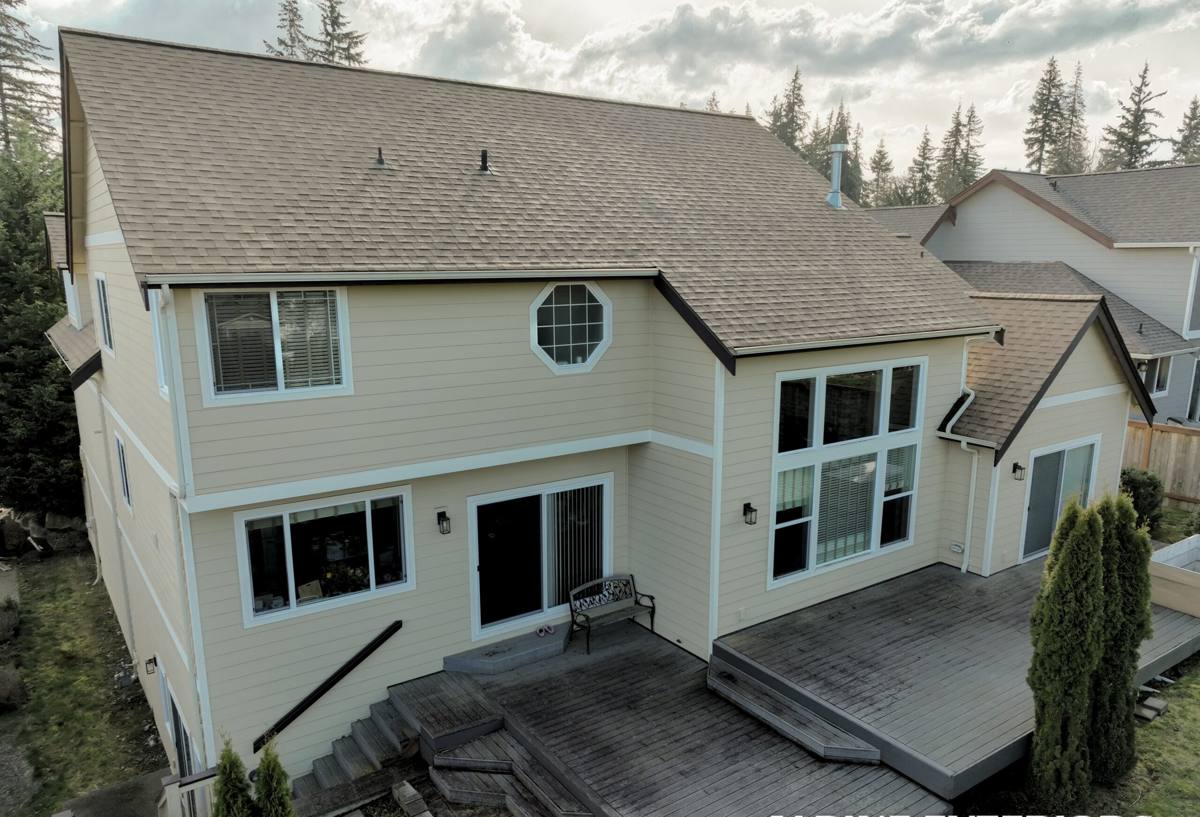
- Larger view or picture windows sized to a specific wall
- Openings where you're correcting a past installation that was never sealed correctly
- Matching window lines across additions built in different decades
What Whatcom County Weather Does to Windows Over Time
Whatcom County's marine-influenced climate is hard on exterior building materials, and windows take more of that abuse than most homeowners realize. Three things do most of the damage: sustained rain, shade-driven moisture and moss, and salt-tinged marine air moving inland off the Sound. None of it is dramatic in the moment — it's cumulative, and it shows up years later as soft framing, fogged glass, or hardware that won't turn anymore.
Driving Rain and Flashing
Wind-driven rain doesn't just hit a window — it gets pushed sideways and upward into any gap in the flashing. A window that was installed with tape instead of proper metal or membrane flashing may look fine for years and still be feeding water into the wall cavity behind it. By the time you see staining on interior trim, the sheathing behind it has usually been wet for a while.
Shade, Moisture, and the Long Moss Season
Homes tucked into tree cover — common around Maple Falls — dry out slower after every rain. That extended dampness is exactly what moss and algae need to take hold on sills, tracks, and cladding near the window. Moss doesn't just look bad; it holds moisture against wood and vinyl surfaces far longer than open air would, which accelerates rot in wood-framed windows and breaks down sealants faster on any frame type.
Marine Air and Hardware
The salt-tinged air that moves through Whatcom County isn't as aggressive as true coastal exposure, but it's persistent, and it accelerates corrosion on cheaper hinges, locks, and balance hardware over time. This is one reason we pay attention to hardware quality on custom units, not just glass and frame.
Signs Your Maple Falls Home Needs Custom Window Work
Most homeowners call us after noticing one or two of these — rarely all at once. If you're seeing any of the following, it's worth having someone look before the next wet season:
- Visible gaps, daylight, or drafts around the frame
- Fogging or moisture between panes on double- or triple-glazed units
- Soft or discolored trim and sill wood, especially on north- or shade-facing walls
- Moss or dark staining building up on sills and lower frames
- Windows that stick, won't latch fully, or have hardware that's corroded or seized
- Noticeable temperature difference near the window compared to the rest of the room
- A past installation that was never properly flashed or sealed
Frame Materials: What Actually Holds Up Here
Frame material matters more in a wet, shaded climate than manufacturer marketing usually admits. Here's how the common options compare for a Maple Falls property specifically:
| Material | Moisture Behavior | Maintenance | Best Fit |
|---|---|---|---|
| Vinyl | Won't rot; can warp slightly in extreme temperature swings | Low — occasional cleaning | Straightforward replacements, budget-conscious projects |
| Fiberglass | Excellent — dimensionally stable, resists moisture and moss buildup | Low | Custom shapes, larger units, long-term durability |
| Wood-clad | Good if the cladding is intact; vulnerable at joints and cuts where wood is exposed | Higher — needs periodic inspection and sealing | Homes wanting a wood interior look with protected exterior |
| Aluminum | Durable but conducts cold, leading to condensation in our climate | Low | Limited use; usually not our first recommendation for this region |
We don't install every option in that table on every job. Aluminum, for example, conducts temperature in a way that tends to cause condensation and even frost on the inside of the frame during cold, damp stretches — a maintenance headache we'd rather steer clients away from than deal with as a callback later. That's a trade-off judgment on our part, not a knock on the material for every application.
What a Correct Custom Window Installation Actually Involves
Measuring and Fabrication
Custom work starts with precise field measurements of the actual opening — not the framed-in dimension from the original plans, which is often different after years of settling or prior repairs. The window is then fabricated to that opening, accounting for the reveal needed for shimming, flashing, and expansion.
Flashing and Water Management
This is the step that determines whether a window lasts fifteen years or fifty in this climate. A correct installation includes a sill pan to catch and direct any water that gets past the window, side and head flashing integrated with the house wrap in the right shingled order (so water is always directed outward and down), and sealant used to supplement the flashing — never to replace it.
Insulation and Air Sealing
The gap between the window frame and rough opening gets sealed with low-expansion foam or backer rod and sealant, not packed solid with material that can bow the frame. Done right, this stops both drafts and the kind of moisture infiltration that leads to hidden rot.
Interior and Exterior Finish
Trim, casing, and any interior finish work are completed last, once the crew has confirmed the window operates correctly and the exterior water management is fully tied in.
Our Process, Start to Finish
- Free on-site assessment — we look at the actual openings, current window condition, and any signs of past water intrusion before quoting anything.
- Measurement and material selection — we walk through frame and glass options suited to the specific wall and exposure, not a one-size-fits-all recommendation.
- Fabrication — custom units are built to the confirmed measurements.
- Removal and installation — old units are removed carefully to inspect the opening for hidden damage before the new window and flashing go in.
- Sealing and finish work — flashing, insulation, and trim are completed and checked for proper operation.
- Final walkthrough — we go over the finished work with you before calling the job done.
Why a Crew That Already Works Maple Falls Matters
Window installation isn't just a product spec — it's a judgment call about how a specific wall, exposure, and roofline will handle water over time. A crew that regularly works Maple Falls and the surrounding Lynden area has already seen how the local combination of shade, rainfall patterns, and older housing stock plays out over years, not just at the moment of installation. That experience shapes decisions a homeowner would never think to ask about — where to add extra flashing, which walls need a more moisture-resistant frame, and which shortcuts common elsewhere in the country simply don't hold up in Whatcom County.
It also means accountability. A local crew has a reputation in the community to maintain and is easy to reach if a question comes up after the job is finished — not a name from an out-of-area sales team that's moved on to the next county.
Getting the Timing Right
Window installation can happen in most seasons, but scheduling around the wettest stretches of the year reduces the window of time the opening is exposed before flashing and sealing are complete. If you're planning ahead, late spring through early fall tends to give the most predictable conditions for this kind of work, though we install year-round and manage exposure carefully regardless of season.
If you're noticing drafts, moisture, moss buildup, or just have an older custom opening that's never fit right, we're happy to take a look. Estimates are free and there's no pressure to move forward — fill out the form below and we'll set up a time to come by.