 Lynden Siding
 Siding Repair for Aldergrove Homes
Aldergrove sits just across the line from our home base in Lynden, close enough that it's regular territory for our crew rather than an occasional drive. Homes here deal with the same Pacific Northwest weather pattern that shapes exterior work across this whole corner of the region: salt-tinged air carried inland off the Strait of Georgia and the Sound, driving rain that hits walls sideways more often than it falls straight down, and a moss season that runs long and doesn't fully let up even in the drier months. That combination is hard on siding, and it's why repair calls in this area tend to involve more than a quick patch — the damage is often further along than it looks from the ground.
This page is specifically about siding repair, not full replacement. Plenty of siding problems on an Aldergrove home don't need a whole new exterior — they need a correct, honest diagnosis and a repair that actually addresses what caused the damage, not just what's visible. We install and repair James Hardie fiber cement siding exclusively, and that focus shapes how we approach every repair call: what we look for, what we recommend, and what we won't paper over.
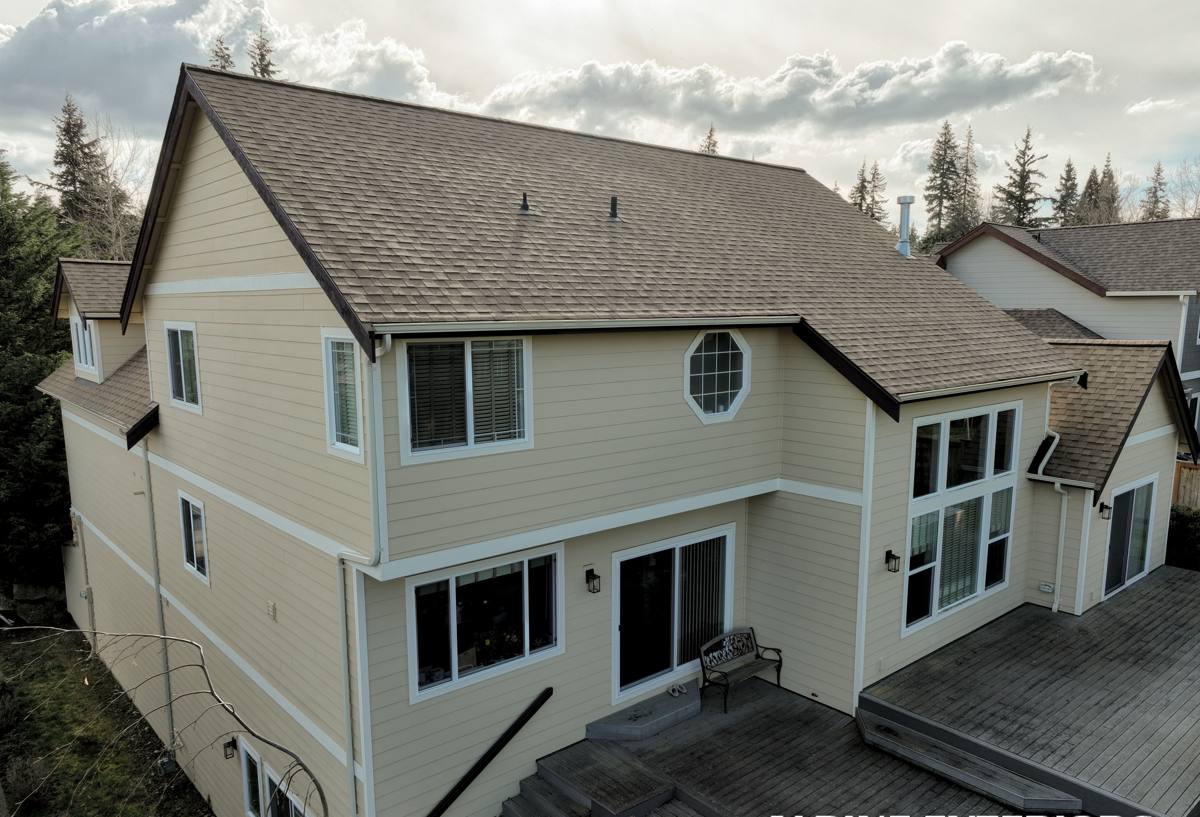
What This Climate Does to Siding That Needs Repair
Salt-Tinged Air Working Quietly Over Time
Aldergrove isn't a waterfront community, but it's close enough to the coast that salt-laden air still reaches inland on a regular basis, especially with wind off the water. Salt accelerates corrosion in fasteners, flashing, and any exposed metal trim, and it wears down lower-quality finishes faster than a dry inland climate would. On a repair call, this shows up as rust bleeding through paint at nail heads, corroded trim fasteners, or a finish that's chalking well ahead of schedule.
Driving Rain Finding the Gaps
Storms moving through the Fraser Valley and lower Whatcom County don't just drop rain straight down — wind pushes it sideways into wall assemblies, window flashing, and the joints where trim meets siding. That sideways load finds weak points a calmer climate never would test: a lap joint that wasn't sealed correctly, a piece of flashing that's slightly short, a caulk line that's failed. Most of the repair calls we get that turn out to be more serious than expected trace back to wind-driven rain finding one of these gaps over years, not a single dramatic event.
A Long Moss and Mildew Season
Mild temperatures and near-constant regional moisture add up to a moss and mildew season that can run most of the year on shaded or north-facing walls. Moss and mildew are more than a cosmetic problem — sustained growth holds moisture directly against the siding surface, and on damaged or improperly sealed sections, that trapped moisture is exactly what turns a small repair into a larger one if it sits unaddressed through another wet season.
Common Repair Issues We Find on Aldergrove Homes
Every repair call is different, but a handful of problems come up often enough in this area that we've learned to check for them specifically, even when the homeowner called about something else entirely.
- Cracked or chipped fiber cement panels, usually near a corner, a fastener, or an impact point
- Failed caulking at butt joints, trim, and window and door transitions, letting water track behind the siding
- Rust staining or corroded fasteners and trim, more common on walls that face prevailing wind and moisture
- Soft or discolored trim boards, especially at the bottom courses and anywhere close to grade
- Moss or mildew buildup on shaded walls that's holding moisture against the siding longer than it should
- Sections of siding that were patched before with mismatched material, profile, or color
- Warping or separation at panel edges on non-fiber-cement siding sections mixed into an otherwise Hardie exterior
Repair vs. Replacement: How We Make the Call
Not every siding problem calls for the same response, and an honest repair estimate starts with telling the difference correctly rather than defaulting to whichever job is bigger.
| Factor | Usually Points to Repair | Usually Points to Replacement |
|---|---|---|
| Extent of damage | Isolated to a few panels or one wall section | Spread across multiple walls or the full exterior |
| Substrate condition | Sheathing underneath is still sound | Rot or moisture damage found in the sheathing or framing |
| Age of existing siding | Siding is mid-life and otherwise performing well | Siding is near or past its practical service life |
| Material match available | Reasonably close profile and color match can be sourced | Discontinued profile or finish makes a clean match impossible |
| Underlying cause | A specific, fixable install detail (caulk, flashing, fastener) | A systemic issue tied to the original material or install |
We'll give a straight answer on which side of that line a given home falls, including when a full re-side is genuinely the more sensible long-term choice rather than repeated patching.
What a Correct Siding Repair Actually Involves
Matching Material, Profile, and Finish
A repair that doesn't match the existing plank width, exposure, and finish reads as a patch from across the street. On James Hardie siding, that means sourcing the correct profile and, where possible, a ColorPlus finish batch close enough that the repaired section doesn't stand out. When an exact color match isn't available, we say so upfront rather than after the work is done, since that's a real factor in whether a targeted repair or a broader replacement makes more sense.
Addressing What's Behind the Siding, Not Just the Visible Damage
A cracked panel or failed caulk joint is a symptom. The cause is usually a moisture path that's been active for a while — a missing piece of flashing, a gap at a penetration, or a fastener pattern that let water track behind the plane of the wall. Replacing the visible damage without correcting what let moisture in means the same repair call again in a few years, often for more money the second time.
Fastening and Flashing to Spec
James Hardie has specific fastening and clearance requirements, and a repair that ignores them undermines the same durability the product is known for. We fasten and flash repaired sections to the same standard as new installation, including correct clearance at grade, decks, and roof lines, rather than treating a repair as a lesser scope than a full install.
Our Repair Process
- Inspection and diagnosis. We look at the visible damage and check the areas around it — flashing, caulk lines, fastener condition, and any soft spots — before recommending a scope of work.
- Honest scope and options. We explain what we found, what caused it, and whether repair or replacement makes more sense, including realistic expectations on color and profile matching.
- Sourcing the right material. For Hardie repairs, we source matching plank profile and finish where available, and we're upfront about it when an exact match isn't possible.
- Correcting the cause. Before any new siding goes on, we address the moisture path, flashing gap, or fastener issue that caused the original damage.
- Repair to install spec. Fastening, clearance, and sealing follow the same standard as new construction, not a reduced version of it.
- Final walkthrough. We show you what was repaired, what we found underneath, and what to keep an eye on going forward.
Why We Only Install and Repair James Hardie Siding
We install James Hardie fiber cement exclusively, and that standard carries over into how we handle repair work. We won't install patch material like LP SmartSide, vinyl, Cemplank, Allura, primed spruce, or cedar as part of a repair, even when it might be the faster fix. That's a professional call based on what we've seen hold up in this climate, not a sales position.
If your home already has Hardie siding, repair work is usually the cleanest path, because the product's factory-applied ColorPlus finish and consistent panel dimensions make color and profile matching far more predictable than with field-finished materials. If your home has a different siding product with damage that's more than isolated and cosmetic, we'll say so plainly. In some cases a targeted repair using a comparable material is the honest recommendation. In others, especially where damage keeps recurring in the same areas, we'll explain why we think a future full re-side with fiber cement is the better long-term answer, rather than continuing to chase the same problem with patches.
What We Stand Behind
- Non-combustible core: Fiber cement doesn't feed a fire the way wood-based siding products can.
- Factory-applied ColorPlus finish: Baked on under controlled conditions, so it holds color and resists chalking better than field-applied paint, which also makes repair matching more reliable.
- Climate-engineered HZ formulations: Hardie's HZ5 line is built for sustained moisture and freeze-thaw conditions, which describes this region well.
- Dimensional stability: Fiber cement doesn't swell, cup, or warp the way engineered wood products can after repeated wet-dry cycling.
- Strong transferable warranty: Backed by Hardie when installed and repaired to spec, which is part of why we won't cut corners on repair fastening and flashing.
Why a Crew That Already Works Aldergrove Matters
A repair estimate is only as good as the diagnosis behind it, and that diagnosis is more accurate when the crew doing it has seen how salt-tinged air, driving rain, and a long moss season actually behave on homes in this specific area over time. We're not learning Aldergrove's conditions on your project — we already know which wall orientations stay wet the longest, where failed caulk joints tend to show up first, and which repair shortcuts don't hold up through another wet winter. Working this area regularly, on both sides of the border, also means straightforward scheduling and a crew that shows up knowing the site conditions rather than treating a cross-border job as an exception.
That familiarity shows up in the estimate itself: fewer surprises once repair work is underway, because the inspection already accounted for how this climate actually wears on siding rather than applying a generic checklist built for a drier region.
Simple Upkeep Between Repairs
- Rinse siding periodically to clear salt residue and organic buildup before it works into caulk joints and seams
- Check caulking at trim, windows, and doors annually, and re-seal before a joint fails completely
- Keep gutters clear so overflow isn't running down the wall face and feeding moss growth
- Trim back landscaping that keeps a wall shaded and damp longer than it needs to be
- Address soft spots, cracked panels, or visible rust staining promptly rather than waiting for the next inspection
- Have flashing at roof-to-wall transitions checked every few years, since it's a common failure point that isn't visible from the ground
If your Aldergrove home has damaged, cracked, or aging siding and you want a straight answer on whether it needs a targeted repair or something more, we're glad to take a look. Reach out using the form below to schedule a free, no-pressure estimate.