 Lynden Siding
 Siding Replacement for Laurel Homes
Laurel sits in the rural stretch of Whatcom County between Lynden and the surrounding farmland, and homes out here take on the same weather load as the rest of the county without always getting the same attention from siding crews based farther away. A full siding replacement is a different job than a routine repair or a spot patch — it's the point where a home's exterior either gets corrected for the long term or gets another layer of cladding that hides whatever problems are underneath for a few more years. This page is about that specific job: what triggers a full replacement rather than a repair, what a correct replacement actually involves on a Laurel property, and how the work runs from first inspection to finished wall.
We install James Hardie fiber cement exclusively, and on a replacement project that standard matters even more than on new construction, because a replacement is also the one chance to fix whatever the old siding was hiding — water intrusion, missing flashing, an undersized or missing weather-resistive barrier — before it gets sealed behind a new wall system for another few decades.
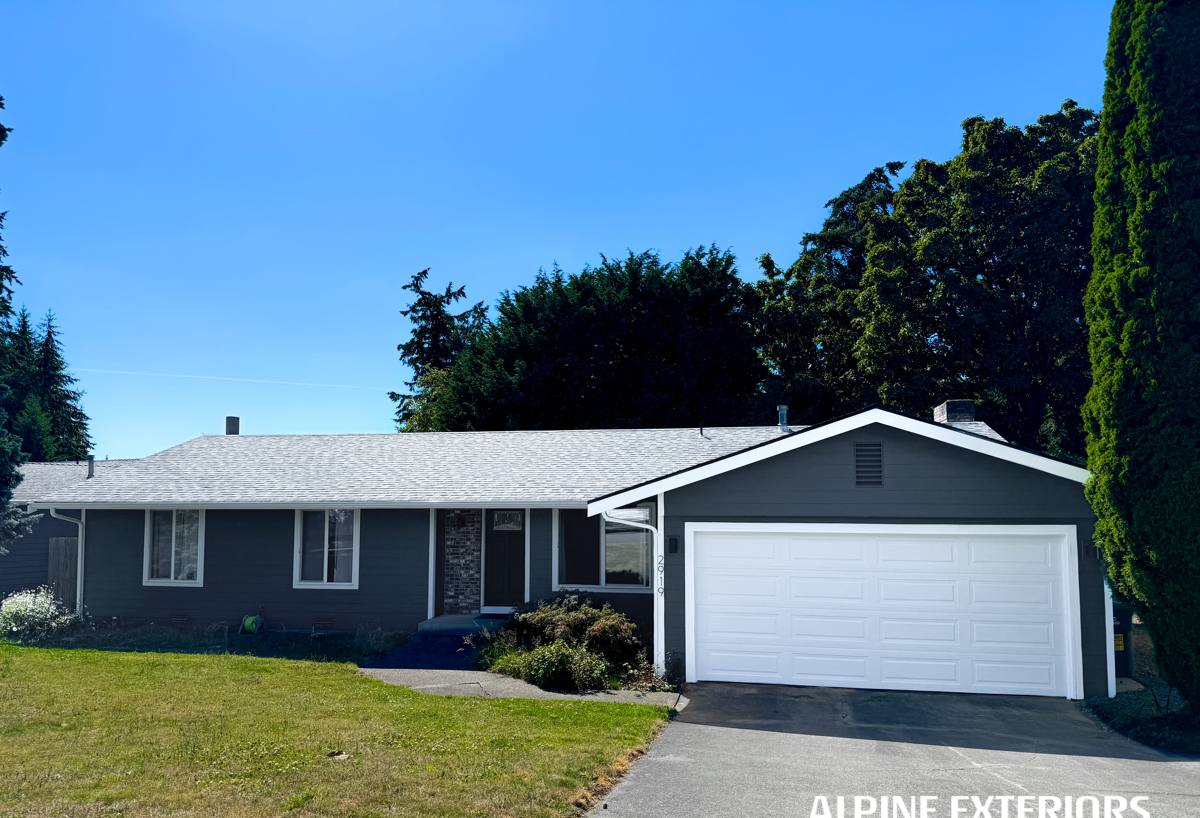
What Laurel's Climate Does to Siding Over Time
Whatcom County's weather is consistent enough that it shapes how every exterior product ages here, and Laurel's mix of open agricultural land and tree-lined properties means individual walls on the same house can weather very differently.
Salt Air
Laurel is inland, but marine air off the Salish Sea moves across this whole part of the county, and over years it works on fasteners, flashing, and any exposed metal hardware. It's a slower process than it would be right on the water, but it's steady, and it's one of the reasons hardware and fastener choice matters as much as the siding material itself on a replacement job.
Driving Rain
Rain in this region rarely falls straight down through the fall and winter months. Wind pushes it sideways into wall assemblies, and that sideways load finds any joint, lap, or fastener point that wasn't detailed correctly the first time. On a replacement, this is exactly the kind of failure we're usually called out to fix — water that got behind the old siding at a window, a corner, or a butt joint and did its damage slowly, out of sight.
A Long Moss Season
Between the tree cover on some Laurel lots and the area's mild, damp winters, shaded and north-facing walls can stay damp for most of the year. Moss and mildew take hold on any surface that's even slightly porous or that traps moisture against the substrate, and on wood-based siding that ongoing dampness eventually turns into softening and rot at the edges — usually starting well before it's visible from the ground.
Signs a Laurel Home Needs Replacement, Not a Repair
Not every siding problem calls for a full tear-off. But there's a point where patching individual boards costs more over time than doing the job right once, and where hidden damage behind the siding makes patching pointless anyway. Signs worth taking seriously include:
- Soft, spongy, or crumbling siding when pressed, especially near the bottom courses or around windows and doors
- Visible warping, cupping, or separation at seams and butt joints
- Paint that won't hold anymore no matter how often it's redone, or peeling that returns within a year or two
- Persistent moss or mildew staining on walls that dry out slower than the rest of the house
- Soft or discolored sheathing visible once a section of siding is pulled or damaged
- Interior signs like musty smells, staining near exterior walls, or unexplained drafts that trace back to a wall assembly rather than windows or doors
- Siding that's simply reached the end of its practical service life — 20-plus-year-old wood-based or engineered wood siding especially
Any one of these on its own might be a repair. Several of them together, or any sign of sheathing damage once you're past the surface, usually means the siding system as a whole has failed and a full replacement is the honest recommendation.
What a Correct Replacement Actually Involves
Full Tear-Off vs. Covering Over
It's possible to install new siding over old siding, and in some cases over vinyl it's even a common shortcut. We don't recommend it on a real replacement job. Covering over existing siding traps whatever moisture, rot, or gaps already exist behind a second layer, and it removes the one opportunity to actually inspect and correct the wall assembly underneath. On a full replacement, we remove the old siding down to the sheathing.
What's Underneath Matters More Than What Goes On Top
Once the old siding is off, the sheathing and weather-resistive barrier tell the real story. Soft or delaminated sheathing gets replaced, not covered. Missing or degraded house wrap gets replaced with a properly lapped weather-resistive barrier. Flashing at every window, door, and penetration gets installed or corrected so water sheds outward instead of tracking behind the new siding. Skipping this step is the single most common reason a siding replacement fails early — the new material can be excellent and still not perform if what's underneath it wasn't fixed first.
Installing to Manufacturer Spec
James Hardie's performance depends on installation matching its published specifications: correct fastener type and spacing, proper clearance above grade, hardscape, and roofing, and joints and laps detailed to shed water rather than collect it. We follow those specs as a baseline, not a best-effort target, because it's also what keeps the manufacturer's warranty intact.
Why We Replace With James Hardie Fiber Cement Only
We don't install vinyl siding, LP SmartSide, Cemplank, Allura, primed spruce, or cedar. That's a professional standard, not a limitation — we've chosen to stand behind one system rather than offer a cheaper option that shifts maintenance risk onto the homeowner later. James Hardie is non-combustible, doesn't swell or feed rot the way wood-based products can, and its ColorPlus finish is baked on at the factory rather than field-applied, which holds up far longer under the kind of sustained damp and salt exposure Laurel sees. Hardie also builds climate-specific HZ formulations rather than one generic board, and backs the product with a strong transferable warranty when it's installed to spec.
| Material | Moisture Behavior Locally | Long-Term Maintenance |
|---|---|---|
| James Hardie fiber cement | Non-combustible; resists moisture absorption and won't feed rot or moss | Low — factory finish holds color and adhesion through repeated wet seasons |
| Vinyl | Won't rot, but can warp, crack, or loosen under wind-driven rain and temperature swings | Low upfront; panel replacement rather than repair once it fails |
| LP SmartSide / engineered wood | Wood-strand core is more moisture-sensitive at cut edges and seams than fiber cement | Moderate — edge sealing and coating upkeep matter more in sustained damp |
| Primed spruce or cedar | Natural wood absorbs moisture readily and is a preferred surface for moss | Highest — regular repainting, caulking, and moss treatment required |
None of this means every alternative is a bad product everywhere. It's why our own standard, for a climate that puts this much sustained moisture and salt exposure on a wall, is fiber cement installed correctly rather than a material that trades a lower price today for a heavier maintenance load over the next fifteen years.
Our Replacement Process for Laurel Properties
- On-site inspection: We look at current siding condition, check for soft spots and moisture signs, and assess how sun, shade, and wind exposure differ across the walls of the house.
- Written estimate: Based on actual measurements and condition, not a flat per-square-foot guess, so the scope and price reflect what your house actually needs.
- Tear-off: Old siding comes off down to the sheathing, and any damage that was hidden underneath gets identified before anything new goes up.
- Sheathing and barrier repair: Damaged sheathing is replaced, and a properly lapped weather-resistive barrier goes on correctly the first time.
- Flashing and detailing: Windows, doors, corners, and penetrations get flashed so water is directed out and away from the wall assembly.
- Hardie installation: Fiber cement siding installed to manufacturer spec — fastener type, spacing, clearance, and joint detailing all set for this climate.
- Final walkthrough: We go over the finished work with you before calling the job done.
Cost Factors on a Laurel Siding Replacement
Every house is different, but the same handful of factors drive most of the variation in scope and price on a replacement project:
| Factor | Why It Affects the Job |
|---|---|
| Sheathing condition | Rotted or delaminated sheathing found during tear-off has to be replaced before new siding goes on |
| House size and wall complexity | More corners, dormers, and trim details mean more cutting, flashing, and labor time |
| Current siding type | Some materials come off faster and cleaner than others, affecting tear-off time |
| Trim and accessory scope | Replacing trim, fascia, or soffit alongside the siding adds material and labor |
| Access and site conditions | Tree cover, slope, and setback from the road affect staging and equipment access |
We walk through these factors with you during the estimate rather than handing over a number with no explanation behind it, so you know what's driving the cost before any work starts.
Why a Crew That Already Works This Area Matters
A lot of what separates a siding replacement that holds up for decades from one that starts failing in year eight comes down to details a crew has to actually recognize on-site, not just follow from a manual. How much wind-driven rain a given wall orientation takes on around Laurel, where moss is likely to establish first based on tree cover and shade, how much clearance siding needs above grade given how consistently damp the ground stays through winter — these are judgment calls that show up in small on-site decisions: where flashing is required versus where caulk is appropriate, how tight fastener spacing needs to be given local wind exposure, how a wall assembly should be sequenced when tear-off reveals more damage than expected.
A crew that works Whatcom County exteriors regularly starts to recognize these patterns from one property to the next, rather than treating every job as a first encounter with the local climate.
Ready to Talk About Your Siding
If your Laurel home's siding is showing soft spots, failed paint, persistent moss, or you just know it's reaching the end of its service life, we're glad to take a look and give you a straight answer about whether it's a repair or a full replacement. Reach out for a free, no-pressure estimate — we'll walk the house with you and explain exactly what we find.