 Lynden Siding
 Sumas sits at the far edge of Whatcom County, up against the Canadian border in the flat farmland of the Sumas Prairie. It's a working agricultural community, not a subdivision full of identical stock-size openings, and that shows up constantly in the window work we do out there. Older farmhouses, additions built decades apart from the original structure, outbuildings converted to living space — none of it was framed to match a modern manufacturer's standard size chart. When a window in one of these homes needs to be replaced or a new opening needs to be cut, "custom" isn't a premium upsell. It's usually the only option that actually fits.
What "Custom" Actually Means Out Here
A custom window is any unit that isn't a standard stock size or shape pulled straight off a shelf. In Sumas, that covers an unusually large share of the work we do, for a simple reason: a lot of the housing stock predates the sizing standards that most manufacturers build to today. A farmhouse window opening framed in the 1960s or earlier often doesn't match anything in a current catalog, which means the choice comes down to a custom-built unit or reframing the wall — and reframing has its own cost, mess, and structural considerations that most homeowners would rather avoid if a properly built custom unit solves the problem instead.
The same logic applies to additions and outbuilding conversions, which are common on Sumas Prairie properties with room to build out. New square footage rarely lines up with the window sizes already on the house, and matching sightlines across old and new construction takes deliberate planning rather than picking whatever's in stock.
Border-Valley Wind Adds Its Own Wrinkle
Sumas sits at the head of the valley near the border, which puts it in the path of cold outflow wind events more often than towns closer to the water. Those events bring sharp temperature swings and real wind load behind them — the kind of load that tests a window installation harder than an ordinary rainy day would. On a custom unit, especially anything larger than a standard opening, that wind load is a factor in both the unit's structural rating and how it gets flashed and fastened into the wall.
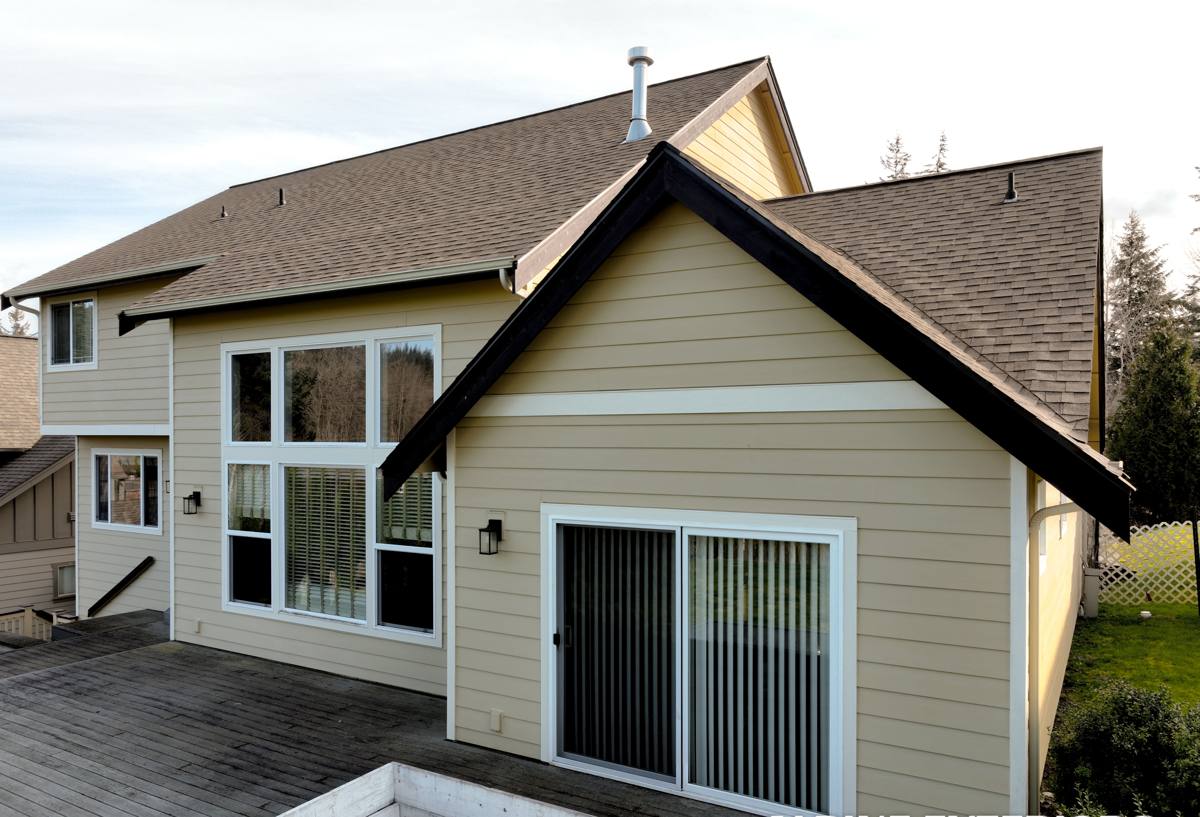
The Climate Sumas Windows Actually Have to Handle
Whatcom County's broader marine climate reaches inland up the valley even though Sumas itself sits well back from saltwater — the moist, salt-tinged air that moves off the Salish Sea doesn't stop at the coastline, and over years it contributes to corrosion on hardware and fasteners the same way it does closer to the water, just more gradually. That's one piece of a bigger picture that matters more directly for a flat, low-lying property like most of the Sumas Prairie.
Driving Rain on Flat, Low-Lying Ground
Storms coming through this part of the county tend to push rain sideways into walls and window openings rather than letting it fall straight down and run off. On higher ground that moisture sheds and drains quickly. On the flat valley floor around Sumas, water sits longer against the base of a wall and around window sills before it has anywhere to go, which raises the stakes on getting sill pans, flashing laps, and sealant details right the first time.
A Long Moss and Mildew Season
Sustained regional dampness and mild temperatures add up to a moss and mildew season that runs most of the year on shaded and north-facing walls. Around windows specifically, it tends to show up first as dark staining or soft growth on sills and lower trim — a sign that moisture is sitting against the wood or composite longer than it should, which is exactly the condition that leads to hidden rot behind the trim if it isn't addressed.
Freeze-Thaw Cycling
Sumas sees more frequent hard frosts than the milder, coastal parts of Whatcom County. When water that's already worked its way into a poorly sealed frame or an old, failing seal freezes, it expands — and that expansion accelerates cracking and seal failure faster than a climate that's simply wet but rarely freezes. It's one more reason an older window in this area often fails sooner than the same unit would in a milder spot closer to the water.
Custom Window Situations We Build For in Sumas
- Non-standard replacement sizes — matching an opening in a farmhouse or older outbuilding that predates modern window sizing standards
- Additions and converted outbuildings — new openings that need to sightline correctly with windows on the original structure
- Egress and code-driven openings — bedroom or basement conversions where code sets the minimum size, not convenience
- Larger picture or multi-unit combinations — openings built to take advantage of open farmland views, which by definition aren't stock sizes
- Reinforced units for wind-exposed walls — openings on the sides of a house most exposed to outflow wind events
- Matched replacement sets — full-house projects where every window needs to be the same style and sightline, even if the openings themselves vary slightly
What a Correct Custom Window Job Involves
Field Measurement and Ordering
Custom work starts with an actual field measurement, not a guess based on old plans. We measure the real opening, check for out-of-square or out-of-level conditions — common in older Sumas Prairie farmhouses — and account for the clearance the finished trim and flashing will need. Because custom units are built to order rather than pulled from a shelf, this is also where we set honest expectations on lead time. It's rarely a same-week turnaround, and we'd rather tell you that upfront than surprise you later.
Opening Prep and Structural Check
Larger custom units carry more weight and sometimes need structural support beyond what a standard opening requires. We check that as part of the initial assessment rather than discovering it mid-project. On older Sumas homes, this step is also where we typically find out whether the original framing or flashing needs correction before a new unit goes in — a detail worth knowing before you're committed to a schedule, not after.
Flashing Sequence
This is the step that matters most given what Sumas weather actually does to a wall. Every custom size or shape changes how flashing has to be sequenced — a wider sill needs to slope and shed water outward instead of letting it pool, a taller opening needs head flashing lapped correctly over the housewrap above it, and any opening on a wind-exposed wall needs fastening and sealant details built for real wind load, not just gravity-fed rain. We build the flashing plan around the specific opening, not a generic template pulled from a manufacturer's average-condition install guide.
Trim and Finish Integration
A custom window often sits somewhere visually prominent — a farmhouse's street-facing wall, a new addition meant to blend with the original structure. We plan the trim and finish work before the unit arrives so the result reads as part of the house rather than an obvious retrofit.
A Quick Checklist Before You Order
- Confirm the opening has been field-measured, not estimated from old plans or a rough guess
- Ask what the flashing plan looks like for your specific opening, not a generic answer
- Get a realistic lead time in writing before committing to a schedule
- Ask whether the opening needs structural review, especially for larger or combination units
- Confirm what's covered under warranty — the window unit and the installation labor are usually separate
- Ask how trim and finish will be matched to the rest of the exterior
Our Process, Start to Finish
- On-site assessment — we measure the opening, check square and level, and evaluate any structural, wind-exposure, or flashing concerns specific to the wall
- Honest recommendation — a custom order, a modified stock size, or an opening reframe, explained with the reasoning behind it
- Ordering and lead time — a realistic timeline for the custom unit to arrive, since it's built to order rather than pulled from stock
- Removal and opening prep — the old unit comes out carefully, and any hidden rot or flashing issues get addressed before the new window goes in
- Installation and flashing — the new unit is set, shimmed, and flashed to a sequence built for its size, shape, and wall exposure
- Trim and finish — exterior trim integrated to match the surrounding siding and architecture
Frame Materials for a Sumas Property
Frame material matters more on a custom unit, since a larger or more exposed window has more surface area for moisture, wind, and freeze-thaw cycling to work against. We'll walk through the honest trade-offs for your specific opening rather than defaulting to whatever's easiest to install.
| Frame Material | How It Holds Up in This Climate | Trade-Off to Know |
|---|---|---|
| Vinyl | Good moisture resistance, low maintenance, budget-friendly | Can flex or warp under repeated hard freeze cycles if the product is a lower grade |
| Fiberglass | Dimensionally stable through wide temperature swings, holds paint well | Higher upfront cost than vinyl |
| Wood-clad | Traditional interior look with a protective exterior cladding | Exterior cladding still needs to be detailed and sealed correctly, or moisture finds the seams |
| Aluminum | Strong and slim sightlines, handles wind load well | Conducts cold, so it needs a thermal break for this climate or condensation becomes an issue |
For most Sumas Prairie homes dealing with sustained valley moisture, outflow wind, and real winter freezes, vinyl and fiberglass tend to be the lowest-maintenance long-term choices. Wood-clad units still make sense when matching an older home's original look matters and the exterior cladding is detailed properly — it's a legitimate option, not one we steer people away from, but it does ask more of the installation and the homeowner's upkeep over time.
Why Hire a Crew That Already Works Sumas
Manufacturer installation guides are written for average conditions. A flat valley property near the border with outflow wind exposure and a long wet season doesn't match that average, and a custom-sized or custom-shaped opening adds another layer of complexity on top. A crew that has actually flashed openings, reframed odd-sized rough openings, and dealt with wind-exposed walls specifically in and around Sumas knows which parts of a manufacturer's guidance are worth extra time here and which corners genuinely can't be cut, because we've seen what happens when they are.
That experience shows up in decisions that rarely make it into a sales pitch — how much lap a flashing course needs on a wind-exposed wall, when a sill needs a sloped composite cap instead of relying on caulk, which wall orientations on a given property stay wet the longest after a storm. Those details decide whether a custom window is still sealing tight in fifteen years or showing drafts and soft trim in five.
Ready When You Are
If you're dealing with an odd-sized opening in an older Sumas Prairie farmhouse, planning an addition, or just replacing windows that have been letting in drafts and moisture for a few winters too many, it's worth having someone look at the actual opening before you start pricing units. We offer free, no-pressure estimates for custom window projects in Sumas and the surrounding Lynden area — use the form below to get a time on the schedule.