 Lynden Siding
 New Roofs Built for Sumas, Not a Generic Climate Zone
Sumas sits at the north end of Whatcom County, tucked against the Nooksack Valley floor right at the Canadian border. It's a small community with its own weather quirks, and a roof that would hold up fine forty miles south in a drier part of the state won't always perform the same way here. When we install a new roof in Sumas, we're accounting for the specific combination of steady Pacific rainfall, heavy shade and moss pressure from the surrounding valley vegetation, and the cold outflow winds that funnel down through the Sumas Gap from the Fraser Valley in winter. A correct installation plans for all of it from the decking up, not just the shingle color.
Why "Local" Actually Matters for Roofing
A lot of roofing crews work statewide and treat every job the same. The trouble is that fastening patterns, underlayment choices, and ventilation details that are adequate in a calm inland valley aren't always adequate where wind-driven rain and periodic high-wind events are part of the normal weather pattern. A crew that already works in Sumas knows which details to over-build rather than treat as optional.
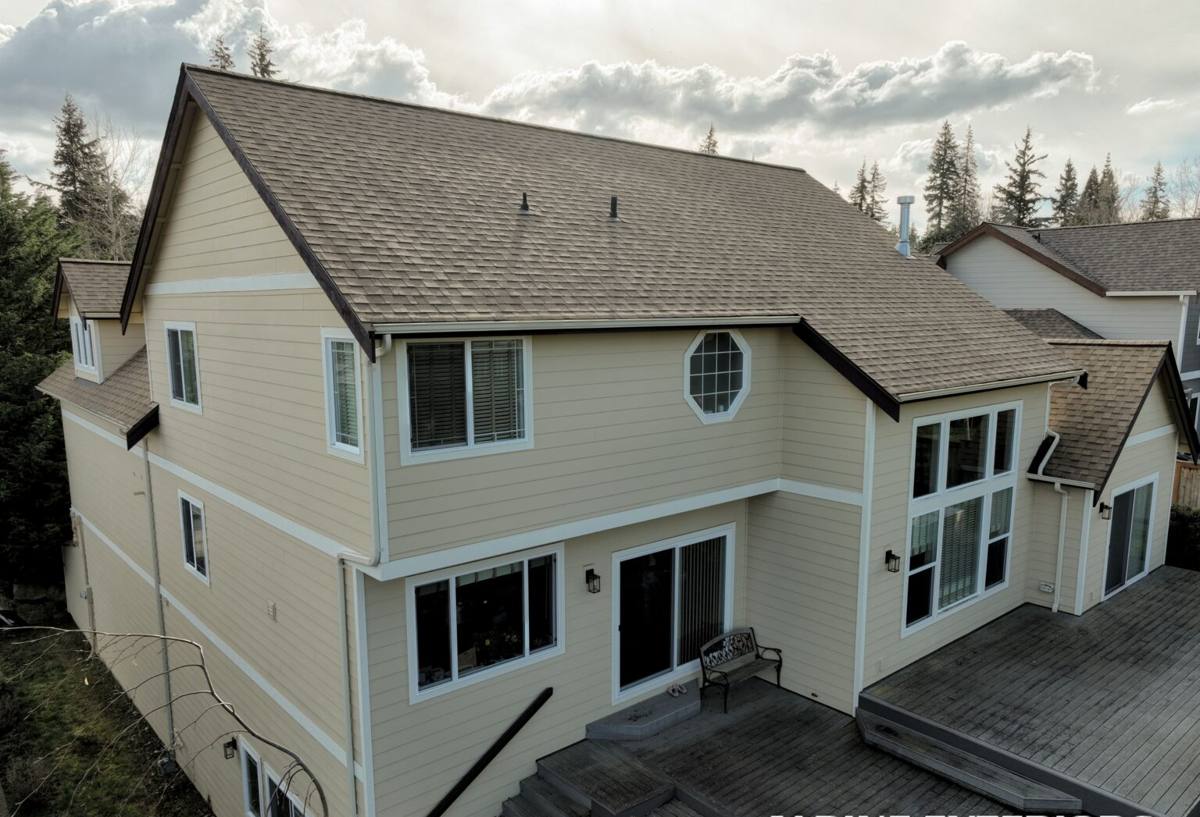
What Sumas Weather Does to a Roof Over Time
Whatcom County gets a steady diet of moisture-laden marine air moving in off the coast, and Sumas catches its share of driving rain on top of a moss season that can run more than half the year in shaded, north-facing sections of a roof. Add in the occasional strong outflow wind event funneling down through the Sumas Gap during winter cold snaps, and you have three separate stresses working on the same roof at once: constant moisture, biological growth, and wind uplift.
- Driving rain finds weak laps, worn flashing, and under-driven fasteners that a calmer climate would never expose.
- Moss and algae hold moisture against the shingle surface, degrade granules faster, and can work under tabs and shakes over time if never removed.
- Wind events test whether shingles were nailed to the manufacturer's high-wind pattern or just the minimum standard pattern.
- Repeated wet-dry cycling is harder on a roof than constant dampness alone — it's what eventually loosens fasteners and opens seams.
None of this means a roof in Sumas needs to be exotic or overbuilt for its own sake. It means the ordinary steps — fastening, flashing, ventilation, underlayment — have to be done correctly and not skipped, because this climate doesn't forgive shortcuts the way a milder one might.
Signs a Sumas Home Needs Replacement, Not Another Repair
Roof repairs make sense for isolated damage. A full replacement makes sense once the roofing system as a whole is past the point where patching is cost-effective. Common signs we see on homes in this area include:
- Granule loss heavy enough that you can see bare, shiny patches on multiple slopes
- Shingles that are cupping, curling, or cracking, especially on sun-and-shade transition areas
- Moss buildup thick enough that it's lifting shingle edges rather than just sitting on the surface
- Soft or spongy decking felt underfoot in the attic, or daylight visible through the roof deck
- Repeated leaks around the same valley, chimney, or vent boot despite prior repairs
- A roof that's already at or past its material's expected service life, regardless of appearance
If a roof is showing one or two of these in isolation, a repair is often the right call. When several show up together, patching one area usually just means the next failure shows up somewhere else within a season or two.
What a Correct New Roof Installation Actually Involves
A new roof is more than shingles nailed over the old ones. Every layer underneath does specific work, and skipping or downgrading any of them is where premature failures come from in a climate like this one.
| Component | What It Does | Why It Matters Here |
|---|---|---|
| Deck inspection & repair | Confirms solid, dry plywood or plank sheathing under the old roofing | Soft or delaminated decking won't hold fasteners through a wind event |
| Ice & water shield | Self-adhering membrane at eaves, valleys, and penetrations | Backs up the roof where wind-driven rain and ice damming are most likely |
| Synthetic underlayment | Water-resistant layer across the full deck | Second line of defense during driving rain before shingles are the only barrier |
| Metal flashing | Directs water at valleys, walls, chimneys, and roof-to-wall transitions | Most leaks trace back to flashing, not the field shingles |
| Ventilation (intake & exhaust) | Moves air through the attic space | Reduces trapped moisture that feeds moss, mold, and premature decking rot |
| Fastening pattern | Correct nail count and placement per manufacturer spec | Determines actual wind resistance, not just the shingle's rated number |
Roofing Material Options for a Whatcom County Home
Most Sumas homeowners choose between architectural asphalt shingles and metal roofing, with a smaller number considering cedar or specialty products. Each has real trade-offs worth understanding before you decide.
| Material | Typical Lifespan | Moss & Moisture Behavior | Trade-offs |
|---|---|---|---|
| Architectural asphalt shingle | 25–35 years | Susceptible to moss without upkeep; good drainage when installed correctly | Best cost-to-performance balance for most homes; wide color range |
| Standing seam metal | 40–60 years | Sheds moss and debris well due to smooth, low-friction surface | Higher upfront cost; requires installers experienced with metal detailing |
| Cedar shake | 20–30 years with upkeep | Most vulnerable to moisture retention and moss without regular maintenance | Traditional appearance, but the highest ongoing maintenance burden in this climate |
| Synthetic/composite shake | 30–50 years | Resists moisture absorption better than natural wood | Mid-to-high cost; appearance and installation quality vary by manufacturer |
We'll walk through which option fits your roof's pitch, your budget, and how much shade the roof sits under, since shade exposure is one of the biggest drivers of long-term moss pressure regardless of material.
Our New Roof Installation Process
- On-site inspection and honest assessment — we look at the current roof, attic ventilation, and decking condition before recommending replacement over repair.
- Written estimate — clear scope, material options, and pricing with no surprise add-ons buried in fine print.
- Tear-off and deck inspection — old roofing is fully removed so the decking can be checked and any damaged sections replaced, not covered over.
- Underlayment and flashing installation — ice and water shield, synthetic underlayment, and new metal flashing at every transition point.
- Roofing material installation — installed to manufacturer fastening specifications, not just standard minimums.
- Ventilation check — intake and exhaust venting confirmed or upgraded so the attic can actually dry out between rain events.
- Final walkthrough and cleanup — site cleared of debris and nails, and the completed roof reviewed with you before we consider the job done.
Cost Factors for a New Roof in Sumas
Roofing costs vary based on several factors, and we'd rather explain them upfront than give a number that doesn't hold up once we're on the roof.
| Factor | Why It Affects Cost |
|---|---|
| Roof size and number of stories | More square footage and steeper access both add labor time |
| Roof pitch and complexity | Multiple valleys, dormers, and roof lines take longer to flash correctly |
| Decking condition | Rotten or soft sections found during tear-off require replacement before new roofing goes on |
| Material choice | Asphalt, metal, and specialty products carry different material and labor costs |
| Ventilation upgrades | Adding or correcting intake/exhaust venting is a smaller cost during a full replacement than after |
We give real, project-specific numbers after seeing the roof — not a phone-quote guess that changes once the tear-off starts.
Ventilation and Moss Management: The Part Homeowners Often Skip
A new roof is a good opportunity to fix ventilation problems that have been quietly shortening the life of every roof this house has had. Poor attic airflow traps moisture, which feeds moss growth and can rot decking from underneath even while the shingles above look fine.
- Confirm balanced intake (soffit) and exhaust (ridge or roof vents) — one without the other doesn't work
- Trim back overhanging branches where practical to reduce shade and debris buildup
- Keep gutters clear so water isn't backing up under the eave edge
- Have moss treated gently, not power-washed, which can strip granules and shorten shingle life
- Schedule a roof check after major wind events, not just once a year
Why Hire a Crew That Already Works in Sumas
Roofing done right in this part of Whatcom County means understanding that this isn't a one-size-fits-all climate zone. A crew that regularly works Sumas roofs knows to plan flashing and fastening around the outflow wind pattern, knows which shaded rooflines will fight moss year-round, and doesn't need to guess at how the Nooksack Valley's rain patterns behave differently than a drier part of the county. That local familiarity shows up in fewer callbacks and a roof that's actually built for the conditions it will face, not just the conditions on a spec sheet.
If your roof in Sumas is showing its age or you're planning ahead rather than waiting for a leak, we're happy to take a look and give you a straightforward, no-pressure estimate using the form below.