 Lynden Siding
 Why Siding Repair Looks Different Out Here
Sumas sits right up against the Canadian border in the lowlands north of Lynden, in a stretch of Whatcom County where the Fraser Valley funnels down through the gap in the foothills. That geography matters more than most homeowners realize. Houses here don't just deal with typical Pacific Northwest rain — they sit in a corridor that channels wind, pushes moisture sideways into wall assemblies, and holds onto damp, shaded conditions longer than open, sunnier parts of the county. Add in the long stretch of gray months where nothing fully dries out, and siding here works harder than siding thirty miles inland.
When we get called out for a repair near Sumas, it's rarely just cosmetic. Something in the system — the caulking, the flashing, the material itself, or the way it was originally installed — has let moisture or wind get somewhere it shouldn't. A repair that only addresses what's visible on the surface tends to fail again within a year or two. A repair that addresses the cause holds.
What's Actually Behind Most Siding Damage We See
Wind-Driven Rain and Moisture Intrusion
Rain that falls straight down is easy for siding to shed. Rain that's being pushed sideways by wind is a different problem — it finds gaps at seams, around trim, and behind poorly lapped panels, then works its way behind the siding where it can sit against sheathing and framing. In the Sumas Gap area, wind-driven rain is more of a regular occurrence than in more sheltered parts of Whatcom County, which is why we pay close attention to lap gaps, caulking, and flashing details whenever we're diagnosing a repair here.
Moss, Algae, and a Long Wet Season
North-facing walls, areas shaded by trees or fences, and any spot that stays damp longer than it should are prone to moss and algae growth. On its own, surface growth is mostly cosmetic — but moss holds moisture against the siding surface for extended periods, and over years that constant dampness accelerates wear at seams, fastener points, and butt joints, especially on materials that aren't built to handle sustained moisture contact.
Wind Exposure and Physical Damage
Because of its position in the gap between the Cascades and the Fraser Valley, the Sumas area sees stronger, more frequent wind events than many nearby communities. Wind doesn't just drive rain — it flexes panels, stresses fasteners, and can crack or dislodge siding that wasn't fastened to spec in the first place. Loose or popped panels we find during repairs are very often a fastening issue that's been slowly working its way loose for years before it finally became visible.
Sun, Temperature Swings, and Material Fatigue
South- and west-facing walls get the opposite problem — direct sun exposure that dries and stresses siding surfaces, especially painted or primed materials that weren't engineered for repeated wet-to-dry cycling. Over time, that cycling is what causes paint failure, warping, and cracking on lower-grade or improperly finished products.
Signs Your Siding Needs Repair, Not Just a Wash
Some damage is obvious. Some hides in plain sight for years. Here's what we tell Sumas and Lynden homeowners to watch for:
- Soft or spongy spots when you press on the siding, especially near the bottom courses or around windows and doors
- Visible gaps, cracks, or separation at panel seams and corner trim
- Peeling, bubbling, or chalky paint that keeps coming back after repainting
- Dark streaking, persistent moss, or algae that returns quickly after cleaning
- Panels that flex, rattle in the wind, or have visibly popped fasteners
- Musty smells or visible staining on interior walls near exterior siding
- Warping, bowing, or swelling, particularly on lower walls and near ground contact
- Discoloration around windows, vents, or anywhere two materials meet
Any one of these on its own might be minor. Several together, especially clustered in one area, usually points to a moisture problem that's been developing for a while.
What a Correct Siding Repair Actually Involves
A lot of "siding repair" in this industry amounts to caulking over a crack or nailing a loose panel back down. That buys a little time, but it doesn't fix anything if there's moisture already behind the wall. A repair worth paying for starts with figuring out why the damage happened in the first place.
That means checking the water-resistive barrier and flashing behind the damaged section, not just the siding itself. It means looking at how the original installation handled clearances — ground contact, deck ledger connections, and anywhere two building materials meet — because those transition points are where most rot starts. It means confirming that fastening patterns meet manufacturer spec, since under- or over-driven fasteners are a common source of the cracking and popping we see on repair calls. And it means matching replacement material properly, both structurally and in appearance, so the repair doesn't stand out as an obvious patch.
Skipping any of those steps is how you end up paying for the same repair twice.
Repair or Replace? How We Help You Decide
Not every damaged section needs a full re-side, and not every problem can be solved with a patch. We walk every job through the same basic decision points before recommending either direction:
| Factor | Leans Toward Repair | Leans Toward Replacement |
|---|---|---|
| Extent of damage | Isolated to one or two wall sections | Spread across multiple elevations |
| Underlying structure | Sheathing and framing are sound | Rot has reached structural framing |
| Age of existing siding | Newer material, good remaining life | Nearing or past expected service life |
| Cause of failure | One-off event (impact, flashing gap) | Systemic issue (poor original install, wrong material for climate) |
| Typical cost range | A few hundred to a couple thousand dollars for isolated repairs | Full re-side pricing, scoped after inspection |
We'll tell you honestly which category your home falls into. If a targeted repair will hold up, that's what we'll recommend — a full re-side isn't the right answer just because it's a bigger job.
Why We Repair and Replace Only With James Hardie Fiber Cement
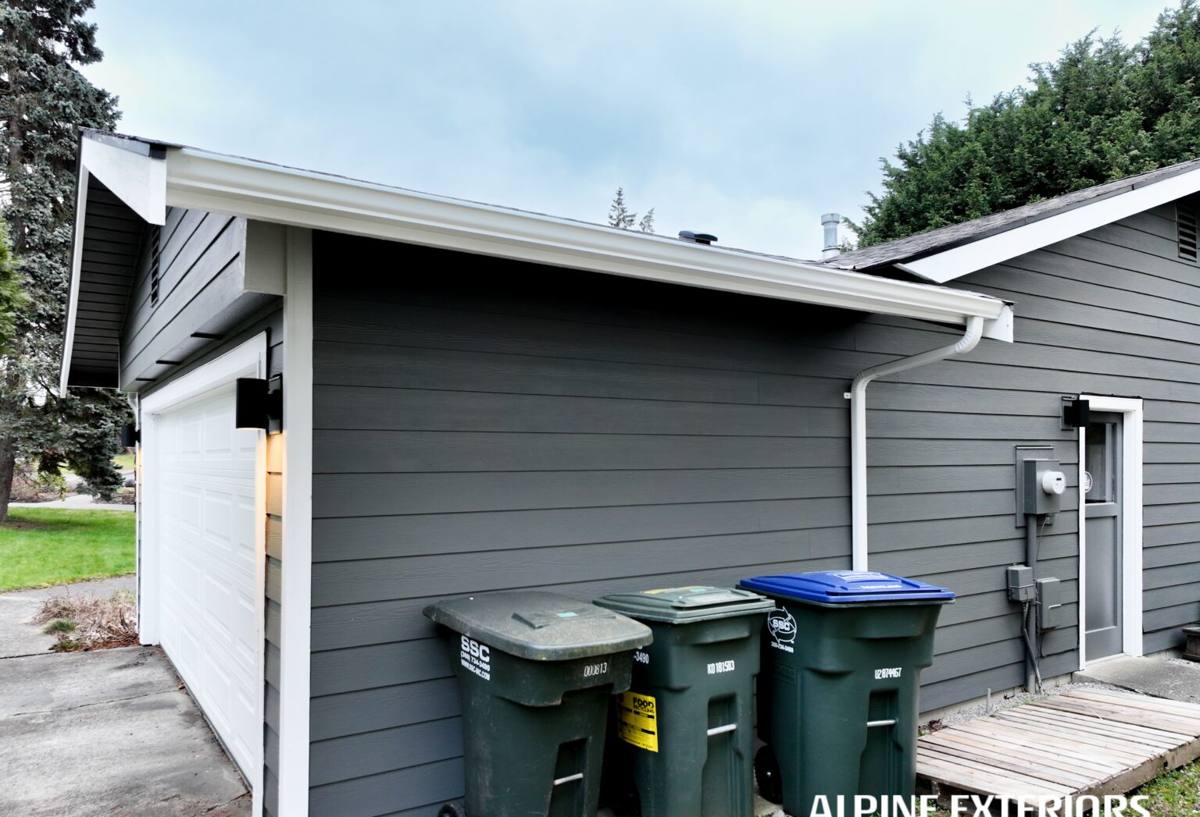
We standardized this company on James Hardie fiber cement siding, and that shapes how we approach repairs too — not just new installs. We don't install or repair-in vinyl, LP SmartSide, Cemplank, Allura, primed spruce, or cedar, and there's a practical reason that matters specifically for repair work in a place like Sumas.
When you're patching a wall, the replacement material has to hold up exactly like what's already there, in the same wind and moisture conditions that damaged the original section. James Hardie's fiber cement is non-combustible, engineered to resist moisture absorption and swelling far better than wood-based products, and available in HZ product lines specifically formulated for the Pacific Northwest's wet climate. Its factory-applied ColorPlus finish also means we can color-match a repaired section far more consistently than we could with field-painted materials, so a patched wall doesn't end up with a visibly different sheen or shade a year later.
It also carries a strong transferable warranty when installed to spec — something that matters if you ever sell the home. We won't tell you a different product is a disaster; most have legitimate uses. We simply won't put our name on a repair or installation using a material we don't think holds up to what this climate does to a house.
Our Repair Process
- Inspection. We look at the damaged area and its surroundings — not just the spot you called about — to catch related issues before they become separate service calls.
- Diagnosis. We identify the actual cause: moisture path, flashing failure, fastening issue, or material fatigue.
- Scope and estimate. You get a clear, written explanation of what needs to happen and why, with repair and replacement options laid out honestly if both are viable.
- Repair. We address the underlying issue first — flashing, barrier, or fastening — then install matched James Hardie material to finish the section.
- Cleanup and check. We walk the finished area with you before we consider the job done.
Why Hiring a Crew That Already Works This Area Matters
Siding repair isn't one-size-fits-all across Whatcom County. A crew that mostly works drier, more sheltered neighborhoods can miss the specific wind and moisture patterns that show up around Sumas and the Fraser Valley gap. We work this area regularly, which means we already know to check the details that tend to fail here first — lap gaps facing prevailing wind, north-side moss buildup, and fastening on exposed elevations — instead of treating every repair as a generic checklist. That local familiarity is part of what keeps a repair from becoming a recurring problem.
If you're seeing damage, staining, or persistent moss on your siding, we're happy to take a look and give you a straight answer — repair or replace, and why. Reach out for a free, no-pressure estimate using the form below.