 Lynden Siding
 Roofing for Abbotsford, BC's Wet, Mossy Climate
Abbotsford sits in the Fraser Valley just north of the Whatcom County line, and it gets more rain than most of the surrounding Lower Mainland. The valley funnels moist air off the Strait of Georgia and Puget Sound, and when that air hits the foothills it drops a lot of water on local roofs for months at a stretch. Add long stretches of overcast, low-drying-potential weather and you get a climate that's genuinely hard on asphalt shingles if the roof underneath wasn't built for it.
Three things drive most of the roofing problems we see on Abbotsford homes: driving rain that gets pushed sideways under poorly lapped shingles or worn flashing, salt-tinged coastal air that accelerates corrosion on exposed metal and fasteners, and a moss season that can run eight or nine months out of the year on shaded, north-facing slopes. None of these are exotic problems. They're just steady, cumulative wear, and a roof that's installed correctly handles them for decades. One that's installed with shortcuts starts leaking or shingling over with moss within a handful of years.
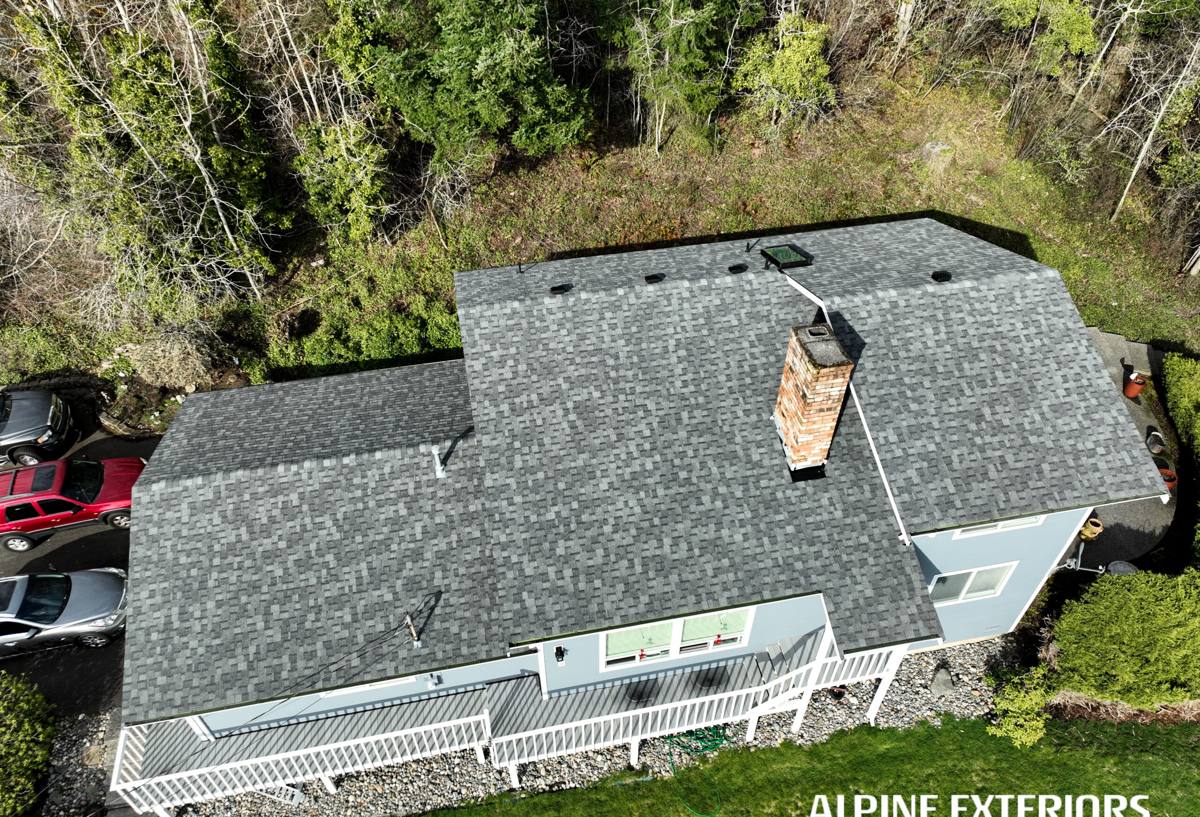
What a Correct Asphalt Shingle Job Actually Involves
Asphalt shingles are a mature, well-understood product, but the roof's performance has almost nothing to do with the shingle brand and almost everything to do with what happens underneath it. On a re-roof or new install, that means:
- Full tear-off to the deck on re-roofs, not a shingle-over-shingle layer, so we can actually inspect the sheathing
- Sheathing repair or replacement anywhere the deck has soft spots, delamination, or rot from a prior leak
- Ice-and-water shield or a comparable self-adhered membrane at eaves, valleys, and around every penetration — the areas where wind-driven rain is most likely to work its way backward under the shingle courses
- A synthetic or felt underlayment across the full field, lapped correctly, not just stapled down loosely
- New flashing at every wall intersection, chimney, and skylight — reused flashing is one of the most common causes of "mystery" leaks on older Fraser Valley homes
- Balanced intake and exhaust ventilation so the attic can actually dry out between rain events
- Proper nailing pattern and placement per the manufacturer's spec, not just "close enough," since this is what most warranty claims actually hinge on
Skip any one of these steps and the shingles themselves — even premium ones — will underperform. This is the part of the job that doesn't show up in a photo but determines whether the roof is still tight in year fifteen.
Our Process for Abbotsford, BC Jobs
We run the same disciplined process on every roof, adjusted for the specific house:
1. On-Site Inspection and Honest Assessment
We walk the roof (or use a drone where pitch or access makes that impractical), check the attic from inside where we can get to it, and tell you plainly whether you're looking at a repair, a partial re-roof, or a full replacement. We don't upsell a full tear-off when a targeted repair will genuinely hold.
2. A Written Scope and Straight Numbers
You get a scope that spells out tear-off, deck repair allowances, underlayment type, flashing work, ventilation changes, and the shingle line — before any work starts, not discovered mid-project.
3. Tear-Off, Deck Inspection, and Repair
Old material comes off down to bare deck. We photograph any deck damage before repairing it so you can see exactly what was found and what was replaced.
4. Underlayment, Flashing, and Ventilation First
This is the layer that actually keeps water out. We install it to spec before a single shingle goes down.
5. Shingle Installation to Manufacturer Spec
Correct exposure, correct nail placement, correct starter course and ridge detail — the details that determine both weather performance and warranty validity.
6. Final Walkthrough
We walk the finished roof and the yard with you, confirm the gutters and downspouts are clear of debris, and answer any questions about maintenance before we leave.
Choosing a Shingle for Fraser Valley Conditions
Most manufacturers offer three general tiers of laminated asphalt shingle. The right choice for an Abbotsford home usually comes down to how much wind and moss exposure the roof gets and how long you plan to own the house.
| Shingle Class | Typical Wind Rating | Algae/Moss Resistance | Best Fit |
|---|---|---|---|
| Standard 3-tab | Lower wind rating, lighter weight | Minimal built-in resistance | Budget-conscious re-roofs on simpler, less exposed rooflines |
| Architectural / laminated | Higher wind rating, heavier mat | Often includes algae-resistant granules | Most Abbotsford homes — the standard choice for durability and appearance |
| Premium / designer laminate | Highest wind rating in the shingle category | Enhanced algae-resistant granules, thicker profile | Steep-slope, highly visible, or heavily shaded roofs where moss pressure is worst |
We don't push a specific brand as "the only option." What we do insist on is matching the shingle's wind and algae-resistance rating to how exposed the roof actually is, and installing it exactly to that manufacturer's spec — because that's what keeps the warranty enforceable if something ever does go wrong.
Moss, Algae, and Ventilation: The Long Game
Moss doesn't cause damage by itself so much as it holds moisture against the shingle surface far longer than the shingle was designed to tolerate. Over a few wet seasons, that constant dampness lifts shingle edges, degrades the granule surface, and works its way into fastener holes. North-facing slopes and roofs shaded by mature trees are the most common places we see it take hold in this area.
Two things control how fast moss comes back after a cleaning: sunlight exposure (which you generally can't change) and attic ventilation (which you usually can). A roof with balanced intake at the eaves and exhaust at the ridge dries out faster after every rain, which slows moss regrowth and also extends shingle life by keeping the underside of the deck from staying damp. If your current roof has no ridge vent, or the soffit vents are painted shut or blocked with insulation, that's often a bigger factor in moss problems than the shingle itself.
Routine moss treatment (a gentle, roof-safe application rather than aggressive pressure washing, which can strip granules) and keeping gutters clear so water isn't backing up under the eave line are the two lowest-cost things a homeowner can do between roofing jobs.
Signs an Abbotsford Roof Needs Attention
Most roof failures give warning signs well before there's an active leak inside the house. Worth checking a few times a year, especially after a windstorm:
- Granules collecting in gutters or at the base of downspouts
- Shingle edges that look curled, cupped, or lifted rather than lying flat
- Visible moss or dark streaking concentrated on shaded or north-facing slopes
- Daylight, water staining, or musty smell in the attic, especially near valleys or chimneys
- Flashing that looks rusted, loose, or separated from the wall or chimney it seals
- Sagging or soft-feeling areas anywhere on the roof plane
- Missing shingles or exposed nail heads after a wind event
Any one of these on its own doesn't necessarily mean a full replacement — but it does mean the roof is worth a professional look before the next heavy rain season.
Why It Matters That the Crew Already Works Abbotsford, BC
We're based on the Whatcom County side, a short drive south of the border, and Abbotsford has been part of our regular service area for years. That matters for a few practical reasons. We already understand which slopes in this part of the Fraser Valley tend to hold moss the longest, how the local wind patterns off the valley affect flashing and shingle wind ratings, and what deck conditions are common in homes of different ages in the area. We're not learning the regional climate on your roof — we've already accounted for it in how we scope and install every job here.
It also means we're not disappearing after the invoice clears. If a warranty question or a storm-related issue comes up two or five years down the line, we're still a short drive away and still doing roofs in your neighborhood.
What Drives the Cost of a Roofing Project
Every roof is different, but the same handful of factors move the price up or down on most jobs:
| Factor | Why It Matters |
|---|---|
| Roof size and pitch | Steeper roofs take longer and require more safety setup and material overage |
| Number of layers to remove | Tear-off of multiple old layers adds labor and disposal cost |
| Deck condition | Rotted or delaminated sheathing found during tear-off adds repair cost, usually quoted as a per-sheet allowance |
| Roof complexity | Valleys, dormers, skylights, and multiple penetrations all add flashing labor |
| Shingle tier selected | Standard, architectural, and premium lines carry different material costs and wind/algae ratings |
| Ventilation upgrades | Adding or correcting ridge and soffit ventilation is inexpensive during a re-roof, far costlier after |
We walk through each of these on-site so the number you get reflects your actual roof, not a generic per-square estimate.
Get a Free, No-Pressure Estimate
If your Abbotsford, BC home is due for a roof inspection, a moss and ventilation check, or a full asphalt shingle replacement, we're glad to take a look and give you a straight answer — no pressure, no inflated scare tactics. Use the form below to request a free estimate and we'll get back to you to schedule a time that works.