 Lynden Siding
 Siding Built for Acme's Wet Side of Whatcom County
Acme sits in the wooded, low-lying stretch of Whatcom County that gets the full brunt of what Pacific Northwest weather can do to a house. Marine air pushes up the valley carrying salt and moisture, storms roll through with driving, sideways rain rather than gentle showers, and the tree cover that makes these lots so appealing also means long stretches of shade where moisture never quite dries out. Put those three things together — salt-tinged air, driving rain, and a moss season that can run most of the year — and you get a climate that is genuinely hard on exterior siding.
Most siding materials are engineered for an "average" American climate. Acme isn't average. A siding choice that holds up fine in a dry inland state can fail here in a fraction of the time, not because the product is defective, but because it was never built for this much sustained moisture exposure. That's the lens we bring to every fiber cement job in this area: what does this specific wall, on this specific lot, in this specific climate, actually need to hold up for the next several decades?
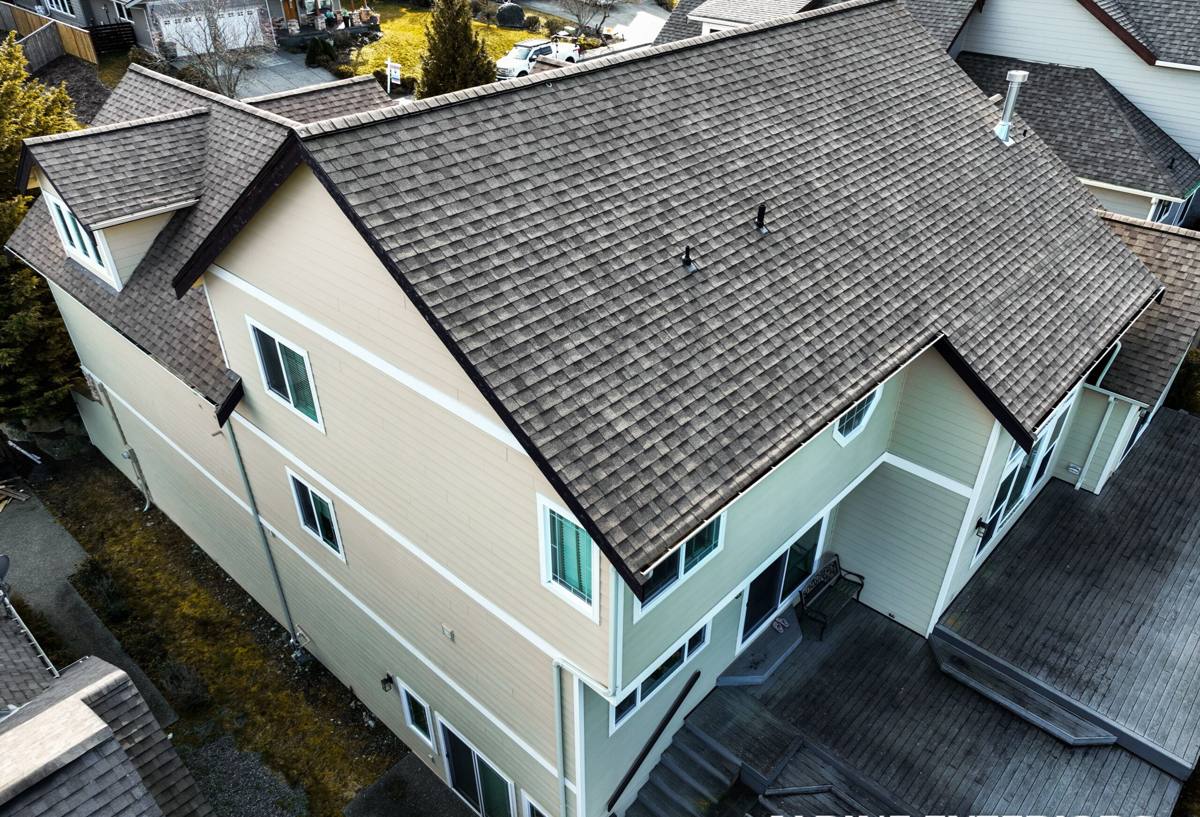
What Chronic Moisture Does to the Wrong Siding
Before talking about what works, it's worth being honest about what doesn't hold up well under Acme's conditions. Wood-based products — including engineered wood siding — rely on paint and caulking to keep water out of the substrate. In a climate with this much rainfall and shade, those seals get tested constantly, and any gap at a cut edge, nail hole, or joint becomes an entry point for moisture. Once water gets behind the cladding, it doesn't dry out quickly in a shaded, humid environment, and that's when swelling, softening, and rot show up.
Vinyl siding has a different weak point: it expands and contracts with temperature swings, and over enough years of that movement combined with UV exposure and moss/algae buildup in shaded areas, panels can warp, fade, or pull away from fastening points. It also isn't a fire-resistant material, which matters more each year as Pacific Northwest summers bring longer wildfire-smoke seasons.
None of this means every non-fiber-cement product is doomed on day one. It means these products ask more of the maintenance schedule and the installation quality than a material engineered specifically for wet, shaded, moisture-heavy climates. That's the trade-off homeowners deserve to understand before they choose — not after a decade of upkeep.
Why Fiber Cement Is the Right Fit for Acme Homes
Fiber cement siding is a composite of cement, sand, and cellulose fiber, pressed and cured into planks and panels. Unlike wood, it doesn't absorb water the way organic material does, so it doesn't swell, cup, or rot the way an unsealed edge on a wood-based product can. It's also non-combustible, which is a meaningful difference in a region where summer wildfire smoke and ember exposure are now a normal seasonal reality, not a rare event.
We install James Hardie exclusively, and the reason comes down to how the product is engineered and finished, not just the raw material.
HZ5 Climate Engineering
James Hardie manufactures different formulations for different climate zones — a product built for the humid Southeast is not the same formulation used in the drier Southwest. The HZ5 line is engineered for the Pacific Northwest's freeze-thaw cycles and prolonged wet weather, which is the exact combination Acme deals with for a good part of the year. That climate-specific engineering is part of why we don't treat "fiber cement" as one generic category — the formulation matters as much as the material.
ColorPlus Finish
Hardie's ColorPlus finish is baked onto the board at the factory under controlled conditions, rather than field-painted on site. That matters in a climate like this because factory-cured finishes resist fading, chipping, and moisture intrusion at the surface far better than paint applied outdoors in variable humidity. It also means far fewer caulking and repainting cycles over the life of the siding — a real advantage when a property sits in near-constant shade and dampness for months at a stretch.
What a Correct Fiber Cement Installation Actually Involves
Fiber cement siding only performs as well as the installation behind it. This is true of any siding, but it matters more here because Acme's climate gives installation mistakes nowhere to hide — a shortcut that might go unnoticed for years in a dry climate shows up in one or two wet seasons here. A correct install includes:
- A drainage gap (rain screen) between the siding and the weather-resistive barrier, so any moisture that does get past the cladding has somewhere to drain and dry instead of sitting against the wall sheathing
- Properly integrated flashing at every window, door, and roof intersection — the majority of siding leaks trace back to flashing details, not the siding material itself
- Fasteners driven to Hardie's specified depth and pattern; over-driven nails crack the board's fiber structure and create entry points for water, and under-driven fasteners leave panels loose
- Correct clearance from grade, roof lines, decks, and patios — Hardie specifies minimum gaps precisely because ground-level moisture and splash-back are common failure points
- Sealant only at the joints Hardie's installation instructions call for, using a sealant rated for the application — not a blanket caulk-everything approach that traps moisture instead of releasing it
- Primed and painted cut edges wherever a board is field-cut, so the factory finish's protection isn't compromised at every trim and corner
Skipping any one of these doesn't necessarily cause an immediate problem — that's what makes bad installs so common industry-wide. The damage shows up years later, after the crew that cut corners is long gone.
Fiber Cement vs. Other Siding Options in Acme's Climate
Every siding material involves trade-offs. The table below reflects how each option generally performs under Acme's combination of driving rain, salt-laden air, and heavy shade — assuming a competent installation in each case, since a poor install can undermine any product.
| Material | Moisture Resistance | Fire Resistance | Ongoing Maintenance | Typical Lifespan (to spec) |
|---|---|---|---|---|
| James Hardie Fiber Cement | High — doesn't absorb or swell | Non-combustible | Low — factory finish, occasional wash | 30-50+ years |
| Vinyl | Moderate — can warp/crack over time | Combustible | Low, but panels aren't repairable individually | 20-30 years |
| Wood or Cedar | Low — absorbs moisture without diligent sealing | Combustible | High — regular painting/sealing | 15-30 years, highly upkeep-dependent |
| LP SmartSide (engineered wood) | Moderate — relies on paint seal integrity | Combustible | Moderate — edge sealing and paint upkeep | 20-30 years, installation-sensitive |
This isn't about declaring other materials unusable — it's why, as a matter of professional standard, we've chosen to install only the product line best suited to this specific climate rather than offer several options with very different long-term outcomes.
Our Process for Acme Projects
Every job starts with an on-site assessment, not a generic quote. We look at sun and shade exposure on each side of the home — a heavily shaded, tree-lined lot needs different attention to ventilation and drainage detailing than a more open one — and we check the condition of the existing wall sheathing once old siding comes off, since that's often where hidden moisture damage from a prior installation shows up.
- Assessment and measurement, including a look at drainage patterns, existing moisture issues, and sun/shade exposure by wall
- Removal of old siding and inspection of the sheathing underneath, with repairs made before anything new goes on
- Installation of a weather-resistive barrier and rain screen furring to create the drainage gap fiber cement performs best with
- Installation of James Hardie planks or panels to manufacturer specification for the HZ5 climate zone, including flashing, fastening, and clearances
- Sealing and trim work per Hardie's published details — not a generalized caulking approach
- A final walkthrough with the homeowner before we consider the job complete
We don't skip the sheathing inspection step to save time. In a climate this wet, siding installed over compromised sheathing just hides a problem instead of solving it.
Keeping Acme Siding Looking Right Through the Wet Season
James Hardie siding installed correctly needs far less upkeep than wood or engineered wood, but "far less" doesn't mean zero. A little seasonal attention goes a long way in a moss-prone, high-moisture area like this:
- Rinse moss and algae buildup gently — a garden hose or low-pressure wash, not a pressure washer aimed directly at seams and joints
- Check caulking at trim, window returns, and joints once a year, since sealant is the first line of defense and the first thing to wear out
- Keep gutters and downspouts clear so water doesn't sheet down the wall face during heavy rain events
- Trim back branches and vegetation close to the house to let sun and air reach shaded wall sections, which slows moss growth at the source
- Touch up paint promptly on any field-cut edge that's showing raw material, since that's the one spot the factory finish doesn't protect
- Walk the exterior after major storms and note any impact damage, loose trim, or displaced flashing early, while it's a small fix
Why Hiring a Crew That Already Works in Acme Matters
A siding installation manual reads the same everywhere, but the judgment calls on a real job don't. Knowing which walls on a shaded, wooded Acme lot need extra drainage attention, how the valley's rain patterns tend to hit a home, and how to work efficiently around the access challenges of wooded, rural Whatcom County properties all come from having done this work in this specific area — not from installing siding somewhere with a completely different climate and then applying the same playbook here.
A crew unfamiliar with the region might install siding that technically meets code and still underperforms in Acme's conditions because the finer details — drainage gap sizing, flashing sequencing at wooded, shaded corners, fastener choices for a marine climate — weren't tuned to what this specific area actually throws at a house year-round.
Get a Free Estimate for Your Acme Home
If your current siding is showing moss buildup, soft spots, cracked caulking, or you're planning ahead for a replacement, we're happy to take a look and walk you through what a correct James Hardie installation would involve for your specific property. The estimate is free, there's no pressure, and you'll get a straight answer about what your home actually needs.