 Lynden Siding
 Bellingham's Climate Is Hard on Siding, and James Hardie Is Built for It
Bellingham sits close enough to the water that its climate shows up in three specific, predictable ways on every exterior: salt-tinged marine air that moves through year-round, driving rain that hits walls sideways rather than falling straight down, and a moss season that can run for most of the calendar year on shaded or north-facing walls. That combination doesn't just make siding look tired faster — it actively works on the material, the fasteners, and the finish in ways a drier inland climate never would. This page is specifically about installing James Hardie fiber cement siding on homes in and around Bellingham, part of the broader Lynden service area we work throughout Whatcom County.
We install James Hardie exclusively. Not as one option among several, but as the one siding system we've settled on after years of installs, inspections, and repair calls in exactly this kind of weather. This page covers what Bellingham homes specifically need from a siding system, what a correct James Hardie install actually involves, and why the crew doing the work matters as much as the product itself.
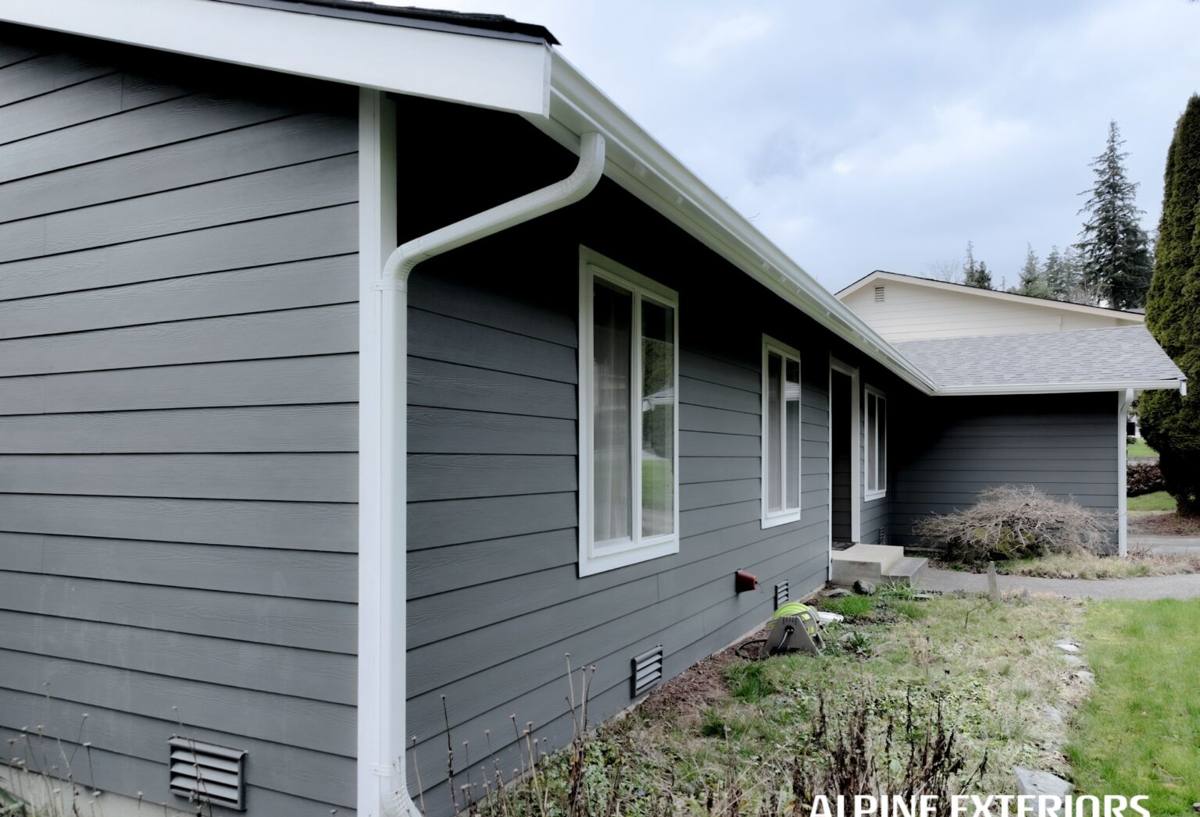
What Salt Air, Driving Rain, and Moss Actually Do to a Wall
Salt-Tinged Marine Air
Bellingham's proximity to the bay and the Salish Sea means a steady, low-level exposure to salt-carrying air, not just on stormy days. Over years, that exposure accelerates corrosion in fasteners, flashing, and lower-grade trim, and it degrades weaker finishes faster than an inland climate would. It's a slow kind of damage — the kind that's easy to ignore because nothing looks wrong in year one or two, and then it does.
Driving Rain, Not Just Rainfall
Wind off the water pushes rain sideways into lap joints, trim seams, and wall penetrations at an angle that a simple "how many inches of rain fall here" number doesn't capture. A siding system, house wrap, and flashing detail that would hold up fine somewhere calmer and drier can still let water in here specifically because the water isn't just falling on the wall, it's being driven into it.
A Long Moss Season
Mild year-round temperatures, tree cover, and near-constant dampness add up to extended moss and mildew growth on shaded and north-facing walls. Any siding material that holds moisture against its surface, or that has even slight porosity, becomes a growth surface over time — and it tends to show up first in the places nobody checks often: behind shrubs, under eaves, on the side of the house that never sees direct sun.
Why We Install James Hardie and Nothing Else
We don't offer a menu of siding brands. On every home we side, including in Bellingham, we install James Hardie fiber cement, and the reasoning comes from what we've consistently seen on tear-offs and repair calls in this specific climate, not from a supplier relationship.
- Non-combustible core: Fiber cement doesn't feed a fire the way wood-based siding products can.
- Factory-applied ColorPlus finish: The color coat cures under controlled factory conditions, not on a jobsite at the mercy of Bellingham's weather, so it resists fading and moisture intrusion far longer than field-applied paint.
- Climate-engineered HZ product line: Hardie's HZ5 formulation is built for regions with heavy sustained moisture and freeze-thaw cycling, which describes coastal Whatcom County better than a generic national spec does.
- Dimensional stability: Fiber cement doesn't swell, cup, or warp the way engineered wood products can after repeated wet-season moisture cycles.
- A strong, transferable warranty: Backed by Hardie, provided the install follows spec — which is where a lot of siding problems actually originate, not in the material itself.
We don't install LP SmartSide, vinyl siding, Cemplank, Allura, primed spruce, or cedar. Those are legitimate products, and other contractors install them well. LP SmartSide is engineered wood with a resin-treated strand core; it does fine in drier climates but is more sensitive to moisture at cut edges and fastener penetrations than fiber cement is in a marine environment like this one. Vinyl is affordable and low-maintenance in a general sense, but it can warp under sun exposure, crack in a cold snap, and trap moisture behind the panel if the house wrap and flashing aren't handled carefully — an easy thing to get wrong and hard to spot from the outside. Cedar and primed spruce are genuinely attractive natural materials, but they need ongoing painting or sealing to keep water out, and in a climate this wet that maintenance schedule tends to slip, which shortens the material's real lifespan. We made the call that standing behind one system we trust completely serves Bellingham homeowners better than offering a cheaper option that quietly shifts maintenance risk onto them later.
What a Correct James Hardie Install Involves
The board itself is only part of the equation. A lot of the siding failures we get called out to inspect trace back to installation shortcuts, not the product. On a Bellingham home, a correct install includes:
Water Management Behind the Siding
A weather-resistive barrier installed with proper lapping and sealed penetrations, rainscreen or furring where the wall assembly calls for it, and flashing at every window, door, and roofline transition. In a climate with wind-driven rain, the siding itself is really the second line of defense — the drainage plane behind it is what determines whether water that does get past the surface has somewhere to go.
Correct Fastening
Hardie specifies fastener type, placement, and penetration depth for a reason — over-driven or under-driven nails, wrong fastener material, or missing the framing can all create early failure points, and in salt-exposed air the wrong fastener corrodes faster than it should.
Proper Clearances and Gaps
Siding needs the specified clearance from grade, roof lines, decks, and other transitions so it isn't sitting in standing water or trapping moisture against untreated cut edges. This is one of the most common corners cut on rushed jobs, and it's usually invisible until moisture damage shows up years later.
Caulking and Joint Treatment
Cut ends and joints need to be sealed per Hardie's specification, not just caulked wherever looks tidy. Skipping this at butt joints and trim transitions is a common source of hidden moisture intrusion.
| Install Element | Why It Matters in Bellingham |
|---|---|
| Weather-resistive barrier & rainscreen | Manages the water that gets past the siding surface during wind-driven rain events |
| Fastener type & placement | Salt-tinged air accelerates corrosion on the wrong fastener choice or a poorly driven nail |
| Clearances at grade & roofline | Prevents standing moisture and cut-edge exposure during the long wet season |
| Joint sealing at cuts and butt joints | Closes the entry points moss and mildew exploit on shaded, damp walls |
| HZ5 product selection | Matches the board formulation to freeze-thaw and sustained moisture cycling in this region |
Our Process for a Bellingham Siding Project
Every project starts with a walk-through of the specific home, not a generic quote off a price sheet. We look at wall orientation, existing moisture damage, current siding condition, and how the house is currently handling water at grade, roofline, and window transitions. From there:
- On-site inspection and honest assessment of what's driving the need for new siding — cosmetic, moisture damage, or both.
- A detailed estimate that separates material, labor, and any additional water-management work the wall assembly needs.
- Tear-off of old siding and inspection of the sheathing underneath for hidden rot or moisture damage before anything new goes up.
- Correct installation of the weather-resistive barrier, flashing, and rainscreen where called for.
- Installation of James Hardie HZ5 siding to manufacturer spec, including fastening, clearances, and joint sealing.
- Final walk-through with the homeowner before we consider the job done.
That sheathing inspection in step three matters more here than it would somewhere drier. Bellingham's moisture load means hidden rot behind old siding isn't rare, and finding it before new siding goes up is a lot cheaper than finding it during a warranty call five years from now.
Why Local Experience on This Specific Climate Matters
James Hardie siding is installed all over the country, but the details that make it perform well shift depending on what climate it's going into. A crew that mostly works drier regions may not think hard about rainscreen gaps, fastener corrosion resistance, or the specific clearances that matter when a wall stays damp for months at a stretch. We work this stretch of Whatcom County regularly, which means we're not guessing at how Bellingham's salt air, driving rain, and moss season interact with a siding install — we've seen it on tear-offs, repair calls, and our own completed projects long enough to know where the failure points actually show up.
That local pattern recognition is also why we standardized on one product rather than offering a menu. A crew that installs five different siding systems is spreading its expertise five ways. We put all of that expertise into installing James Hardie correctly, every time, in this specific climate.
Signs Bellingham Homeowners Should Watch For
- Soft or spongy spots when pressing on siding near the bottom courses or window sills
- Visible moss or dark streaking on north-facing or shaded wall sections
- Peeling or bubbling paint on existing wood or engineered wood siding
- Warping, cupping, or gaps opening up between siding boards or panels
- Staining or discoloration around window and door trim, a common sign of flashing failure
- Visible corrosion or rust streaking near fasteners or metal trim pieces
Any one of these on its own isn't necessarily an emergency, but they're worth a professional look before the underlying wall assembly is affected, especially heading into another wet season.
What Cost Factors Look Like on a Bellingham Project
| Factor | How It Affects the Project |
|---|---|
| Home size and wall complexity | More corners, gables, and dormers mean more cutting, flashing, and labor time |
| Current siding condition | Hidden rot found during tear-off adds sheathing repair before new siding can go on |
| Product line and profile | Lap, panel, and shingle profiles carry different material and labor costs |
| Water management upgrades | Adding or improving rainscreen and flashing detail where the existing wall assembly is lacking |
| Access and site conditions | Steep lots, mature landscaping, or tight setbacks affect staging and labor time |
We give a firm, itemized estimate after the on-site inspection rather than a rough number over the phone, since the condition behind the old siding is often the biggest variable on a Bellingham home.
Ready When You Are
If your Bellingham home's siding is showing wear, moss, or moisture damage, or you're planning ahead for a re-side rather than reacting to a problem, we're happy to come take a look. We'll give you an honest read on what we see and a free, no-pressure estimate for a James Hardie install done right for this climate.