 Lynden Siding
 Everson's Climate Is Harder on Siding Than Most Homeowners Realize
Everson sits in the Nooksack River valley just outside Lynden, in a part of Whatcom County that takes weather from two directions at once. Marine air drifts in off the Puget Sound and Georgia Strait region, carrying salt and moisture that settles on exterior surfaces mile after mile inland. Add the driving rain that comes through in fall and winter storm systems, plus the shaded, damp conditions along the river bottom that keep moss and algae established most of the year, and you have a climate that is genuinely tough on exterior building materials.
Siding in this area doesn't fail because homeowners neglect it. It fails because it was never engineered for this specific combination of stresses — constant moisture cycling, low winter sun that never fully dries north-facing walls, and organic growth that holds water against the surface long after a storm has passed. That's the starting point for every siding decision we make on a home in Everson: does this product actually hold up here, or does it just hold up in a lab test written for a drier climate.
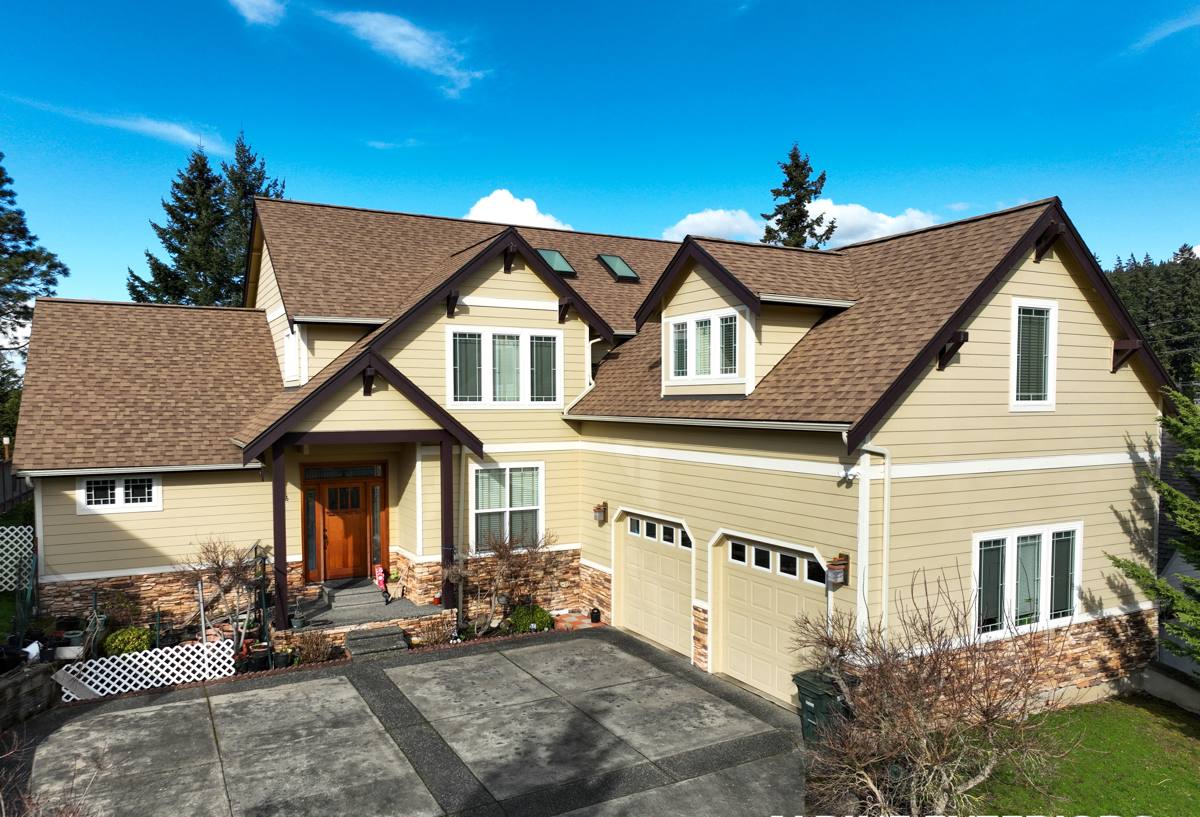
Why We Install Only James Hardie Fiber Cement
Our crew installs one siding system: James Hardie fiber cement. We don't carry vinyl, LP SmartSide, Cemplank, Allura, or wood products like cedar or primed spruce, and that's a deliberate professional standard, not a sales pitch. Each of those alternatives has real strengths — vinyl is inexpensive, wood has genuine character, engineered wood siding installs quickly — but every one of them has a moisture, maintenance, or longevity trade-off that shows up faster in a climate like this one than it would somewhere drier.
Fiber cement is cement, sand, and cellulose fiber pressed and cured into a dense, stable board. It doesn't absorb water the way wood-based products can, it doesn't expand and contract with humidity the way vinyl does, and it carries a Class 1(A) non-combustible fire rating that none of the wood-based alternatives can match. For a home that sits through a genuinely wet Pacific Northwest winter every single year, that stability is the difference between siding that looks the same in year fifteen and siding that needs attention by year seven.
The HZ5 Product Line Built for This Region
James Hardie engineers its siding by climate zone, and homes in Whatcom County fall in the HZ5 category — the line built for regions with sustained moisture, freeze-thaw cycling, and humidity rather than extreme heat. HZ5 boards are formulated with a moisture-resistant composition suited to exactly the conditions Everson sees: extended damp periods, moss-friendly shade, and windborne rain that hits siding at an angle rather than falling straight down.
What a Correct Installation Actually Involves
James Hardie siding performs the way it's rated to perform only when it's installed to the manufacturer's specification. A rushed or generic install — the kind that treats fiber cement like it's interchangeable with vinyl — is where most of the failures we get called out to inspect actually originate. The board itself is rarely the problem; the water management behind it is.
Water Management Comes First
Correct installation starts before a single piece of siding goes up: a weather-resistant barrier, properly lapped and taped, with flashing integrated at every window, door, and roofline penetration so water is directed out and away from the wall assembly rather than trapped behind it. In a climate with Everson's rainfall pattern, this layer matters more than the visible siding itself.
Clearances and Fastening
Hardie's specification calls for minimum clearances from grade, roof lines, decks, and horizontal surfaces so the bottom edge of the siding never sits in standing water or constant splash-back. Fasteners need to land in the right zone of the board at the right depth — over-driven or misplaced nails crack the board's protective edge and create a point where moisture can start working in. Every seam, corner, and joint needs to be caulked or capped per spec, not just butted together and left.
Factory-Applied ColorPlus Finish
We install Hardie's ColorPlus finish, which is baked on at the factory rather than sprayed on site. It resists fading and holds its color far longer than field-applied paint, and because it's cured under controlled conditions, it doesn't have the pinholing or thin spots that can happen when paint is applied outdoors in variable humidity — a real risk on a job site in this region.
How Hardie Compares to the Alternatives
Homeowners in Everson often ask us to walk through the honest trade-offs between siding materials before committing to a full replacement. Here's how the common options actually compare when judged against this specific climate, not a national average.
| Factor | James Hardie Fiber Cement | Vinyl | LP SmartSide | Cedar |
|---|---|---|---|---|
| Moisture resistance | Engineered for wet climates (HZ5) | Doesn't rot, but can trap moisture behind it if installed poorly | Wood-based; vulnerable at cut edges and seams if not sealed | Absorbs moisture; needs consistent sealing |
| Moss / algae resistance | Dense surface resists organic growth | Can host algae in shaded, damp spots | Susceptible in shaded, damp conditions | Prone to moss and mildew without upkeep |
| Fire rating | Non-combustible, Class 1(A) | Combustible | Combustible (wood-based) | Combustible |
| Maintenance burden | Low; occasional wash and caulk check | Low, but cracks and fades over time | Moderate; edge sealing and repainting cycles | High; regular refinishing required |
| Typical service life (correctly installed) | 30+ years | 20-30 years, appearance often shorter | 15-25 years | Varies widely with maintenance |
| Warranty structure | Long-term, transferable manufacturer warranty | Varies by manufacturer, often prorated | Manufacturer-specific, moisture-related exclusions common | Rarely warrantied as a system |
None of these products are "bad" in an absolute sense. But when we weigh them specifically against Everson's rain and moss exposure, fiber cement is consistently the material that needs the least intervention over time — which is why it's the only thing we put our name behind installing.
Our Process on an Everson Project
Every job starts with an in-person inspection of the existing siding and the wall assembly behind it, not just a measurement for a quote. We're looking for soft spots, existing moisture damage, and any trim or flashing details that need correcting before new siding goes on — covering a moisture problem with new material just delays the discovery, it doesn't solve it.
- On-site inspection and moisture check of existing siding, trim, and sheathing
- Written estimate detailing the Hardie product line, profile, and color options for the home
- Removal of old siding and repair of any damaged sheathing or framing found underneath
- Installation of weather-resistant barrier and flashing at all penetrations
- Hardie siding installed to manufacturer clearance and fastening specifications
- Final walk-through covering caulking, trim details, and care going forward
Signs Your Siding May Already Be Failing
Because moisture damage often develops behind the siding before it's visible on the surface, it helps to know what to look for during a normal walk around the house:
- Soft or spongy spots when you press on the siding, especially near the bottom courses
- Persistent moss, algae, or black streaking that returns soon after cleaning
- Paint that's peeling, bubbling, or chalking heavily, particularly on north-facing walls
- Visible gaps, cracking, or warping at seams and corners
- A musty smell in rooms along an exterior wall, which can indicate moisture intrusion
- Siding that feels noticeably cooler or damp to the touch compared to the rest of the wall
Any one of these on its own isn't necessarily an emergency, but a home showing two or three of these signs together is worth a professional inspection before the damage spreads to the framing.
Why Hiring a Crew That Already Works Everson Matters
Siding installation isn't just about the product — it's about understanding how a specific piece of ground behaves. A crew that regularly works homes in and around Everson already knows which wall orientations take the worst weather, where moss tends to establish first, and how the river valley's damp, shaded microclimate differs from a drier lot just a few miles away in Lynden proper. That local pattern recognition shapes real decisions on site: where to add extra flashing attention, which details need extra caulk redundancy, and which corners of a house need the most scrutiny during the pre-install inspection.
It also means accountability doesn't end when the crew packs up. A local contractor is reachable for warranty questions, follow-up caulking, or a maintenance check years down the road — not a name on an invoice from a company that worked the area once and moved on.
Caring for Your Siding After Installation
James Hardie siding is low-maintenance, not zero-maintenance. A rinse with a garden hose once or twice a year removes the pollen, dust, and early moss spores before they take hold, especially on shaded or north-facing walls. Check caulking at trim joints and penetrations annually, since caulk is the one component that wears out well before the siding does. Keep gutters clear and grade sloped away from the foundation so water isn't sitting against the bottom courses through the winter — that single habit prevents more long-term damage than almost anything else a homeowner can do.
If your Everson home is due for new siding, or you're just not sure whether what's on the walls now is holding up the way it should, we're glad to take a look. Request a free, no-pressure estimate using the form below and we'll walk the property with you and give you a straight answer.