 Lynden Siding
 Why Maple Falls Needs Siding Built for This Climate
Maple Falls sits in the forested foothill country of Whatcom County, tucked along the Nooksack River drainage on the way up toward Mt. Baker. That setting is beautiful, and it's also hard on a house. Big timber and second-growth forest keep most lots in deep shade for a good part of the day, which means siding here dries slower after every rain than siding on an open lot in town. Add in a wet season that can run half the year, occasional wind-driven storms that push damp, salt-tinged marine air up the river valleys from the Sound, and winter cold snaps that funnel down out of the mountains, and you've got a climate that punishes any siding product that isn't built to shed water and resist rot.
The result, if the wrong product goes up or the right product goes up wrong, is predictable: paint that fails early, wood that softens and rots behind trim, seams that trap moisture, and siding that never quite dries out before the next rain hits it.
Why Shade and Moss Are the Real Enemy Here
Moss and algae don't attack siding directly, but they hold moisture against it, and constant moisture is what actually causes damage over time. Shaded, tree-lined lots like the ones common around Maple Falls are exactly the conditions moss loves. The siding material matters here — some products give moss and algae something to grow on and into; others don't. So does the installation: proper clearance from the ground, from decks, and from planting beds gives a wall a fighting chance to dry between storms.
Why We Only Install James Hardie Fiber Cement
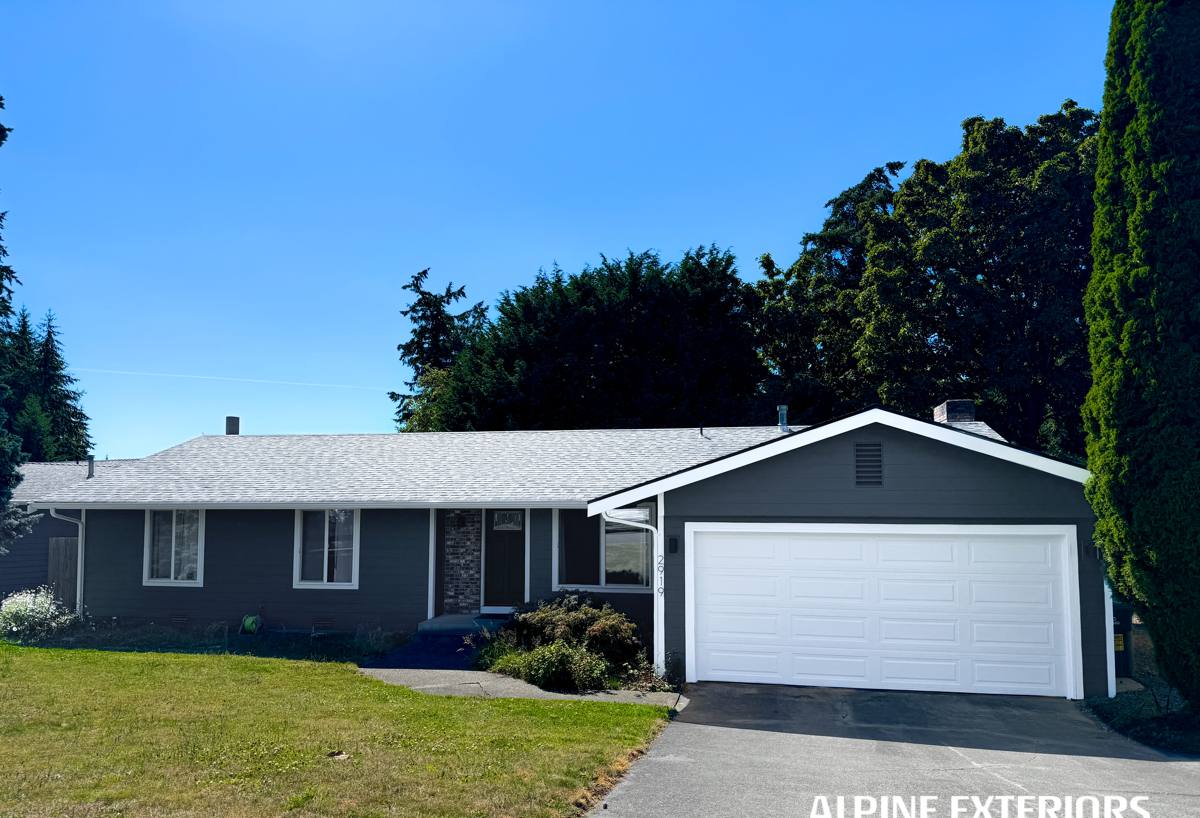
We don't install vinyl, LP SmartSide, Cemplank, Allura, or primed wood siding. That's not a marketing angle — it's a standard we've held to because of what we see on houses in exactly this kind of climate. James Hardie fiber cement is made from cement, sand, and cellulose fiber. It doesn't rot, it doesn't feed moss and mold the way wood-based products can, and it's engineered in region-specific formulations — Hardie's HZ5 line is built for the wetter, milder climate zones that include the Pacific Northwest, with a different moisture and freeze-thaw profile than the products made for hotter, drier regions.
Hardie's ColorPlus finish is baked on at the factory in multiple coats under controlled conditions, not brushed or sprayed on site. That matters in a climate like this one, where field-applied paint has less time to properly cure between rain events and tends to fail sooner as a result.
The Wildfire Angle Homeowners Don't Always Think About
Maple Falls backs up to a lot of standing timber, and like most of the forested foothills in Whatcom County, it isn't immune to wildfire smoke and ember exposure during dry summer stretches. Fiber cement is non-combustible. That's not a reason by itself to pick a siding product, but it's a real, material difference between Hardie and vinyl or wood-based siding, and it's one more reason we're comfortable standing behind it as the only product we put on a home.
A Warranty That Actually Follows the House
Hardie backs its siding with a long product warranty and a separate finish warranty on ColorPlus color, and both are transferable if you sell the home. That's worth something in a market where buyers and inspectors are paying closer attention to exterior condition and maintenance history than they used to.
What a Correct Fiber Cement Installation Actually Involves
Fiber cement is only as good as the installation underneath it. This is where a lot of siding jobs — on any product — go wrong, and it's especially unforgiving in a climate that gives siding fewer chances to dry out.
Flashing and Water Management
Every window, door, and roof-to-wall intersection needs proper flashing and a correctly lapped weather-resistive barrier underneath the siding. Kickout flashing where a roofline meets a wall is one of the most commonly skipped details in the trade, and it's one of the most damaging to skip — water that should divert into a gutter instead runs straight down behind the siding. On a shaded, high-rainfall lot, that mistake shows up as rot years before it would on a drier, sunnier site.
Fastening, Clearances, and Sealant
Hardie specifies fastener type, spacing, and pattern, and those specs exist for a reason — get them wrong and you risk cracking, popped fasteners, or a voided warranty. Ground clearance matters too: siding installed too close to grade, a deck, or a planting bed stays damp longer and invites moss and rot at the bottom courses, which is exactly the failure point we see most often on older homes in wooded settings like this one. Factory-cut edges need to be sealed with the correct primer before installation, and sealant should go only where Hardie's details call for it — over-caulking a wall can trap moisture in just as easily as skipping it can let water in.
How Siding Options Compare for a Climate Like This
We get asked why we don't offer alternatives. Here's the honest comparison, based on how these products actually perform in a wet, shaded, forested climate like Maple Falls sees — not on price alone.
| Factor | James Hardie Fiber Cement | Vinyl | LP SmartSide (engineered wood) | Cedar / Primed Wood |
|---|---|---|---|---|
| Moisture & rot resistance | Excellent — cement-based, doesn't absorb and swell | Won't rot, but can trap moisture behind panels | Good if sealed edges hold; vulnerable once compromised | Requires diligent maintenance to avoid rot |
| Moss & algae resistance | Doesn't feed organic growth; washes clean | Resists growth but can still host it in shaded areas | Wood fiber base is more susceptible | Most susceptible of the group |
| Combustibility | Non-combustible | Melts/burns, can contribute fuel load | Combustible (wood-based) | Combustible |
| Finish durability | Factory-baked ColorPlus, long finish warranty | Color molded in but fades and chalks over time | Field-applied or factory paint, needs upkeep | Needs repainting/restaining on a regular cycle |
| Typical lifespan installed to spec | Decades, often 30+ years | 20–30 years, but fades and can warp | 15–25 years, dependent on maintenance | Highly variable, maintenance-dependent |
None of these products are junk — vinyl and engineered wood both have legitimate uses. We just don't think they hold up to the standard we want to put our name behind on homes in this climate, which is why fiber cement is the only thing we install.
Our Process, Start to Finish
- On-site assessment of the existing siding, sheathing condition, and any moisture damage already present, with particular attention to shaded and ground-level areas.
- Product and color selection from Hardie's plank, shingle, and panel lines and ColorPlus color palette.
- Permitting through the appropriate jurisdiction — unincorporated Whatcom County or the City of Lynden, depending on the property.
- Tear-off of old siding, repair of any compromised sheathing found underneath, and installation of a correctly lapped weather-resistive barrier.
- Installation of flashing, trim, and siding to Hardie's fastening and clearance specifications.
- Final walkthrough and cleanup, with a look at drainage and clearance around the finished job before we call it done.
Why Local Experience in Maple Falls Matters
A siding crew that hasn't worked in this specific setting will underestimate a few things: tree-covered lots that stay damp longer, gravel and long-driveway access that changes how a job gets staged, and the fact that a wall facing the prevailing storm direction usually needs more attention to flashing and clearance than the walls that stay drier. None of this is exotic knowledge, but it's the difference between a crew that's guessing and one that's done this exact kind of job, on this exact kind of lot, before. We work throughout Whatcom County, including Lynden and the surrounding rural areas, and we bring that same standard — Hardie only, installed to spec — to every job regardless of how far off the main road it sits.
Keeping Your New Siding Looking Right
Fiber cement is low-maintenance compared to wood, but "low-maintenance" doesn't mean "no maintenance," especially on a shaded lot. A little regular attention goes a long way:
- Rinse the siding down at least once a year — a garden hose and soft brush is usually enough; skip the pressure washer, which can force water behind panels and joints.
- Keep gutters and downspouts clear so water isn't overflowing onto the wall below.
- Trim back trees, shrubs, and vines so they aren't holding moisture against the siding or blocking airflow.
- Check caulking annually around windows, doors, and penetrations, and have any gaps resealed before winter.
- Watch north-facing and heavily shaded walls first — that's where moss and algae will show up earliest if they're going to.
- Touch up any chips or scratches promptly so bare edges aren't exposed to moisture.
Ready for Siding That's Built for Maple Falls?
If you're weighing your options for a siding replacement in Maple Falls or anywhere else around Lynden and Whatcom County, we're happy to take a look at your home, talk through what we're seeing, and give you a straight answer — no pressure, no upsell. Request a free estimate using the form below and we'll get back to you to schedule a time to come take a look.