 Lynden Siding
 Aldergrove Sits in a Tough Spot for Roofs
Aldergrove, part of the Township of Langley, sits close enough to Boundary Bay and the Georgia Strait that salt-laden air reaches roofs here more than most homeowners realize. Add Whatcom County's share of the same weather system just across the line in Lynden, and you get a stretch of the Pacific Northwest where roofs take a specific kind of beating: near-constant damp, long stretches of low sun angle that keep north-facing slopes wet for days after a storm, and a moss season that can run from October through April in a wet year. None of this is exotic weather, but it is relentless, and a roof installed without that in mind will show it within a few winters — not with a dramatic failure, but with slow moss creep, soft spots at the eaves, and granule loss that shortens the shingle's working life well before its rated warranty runs out.
A correct install in this climate isn't about upgrading to something exotic. It's about getting the ordinary details right — ventilation, underlayment, flashing, and material choice — because in a marine climate those details do more work than they would in a dry region.
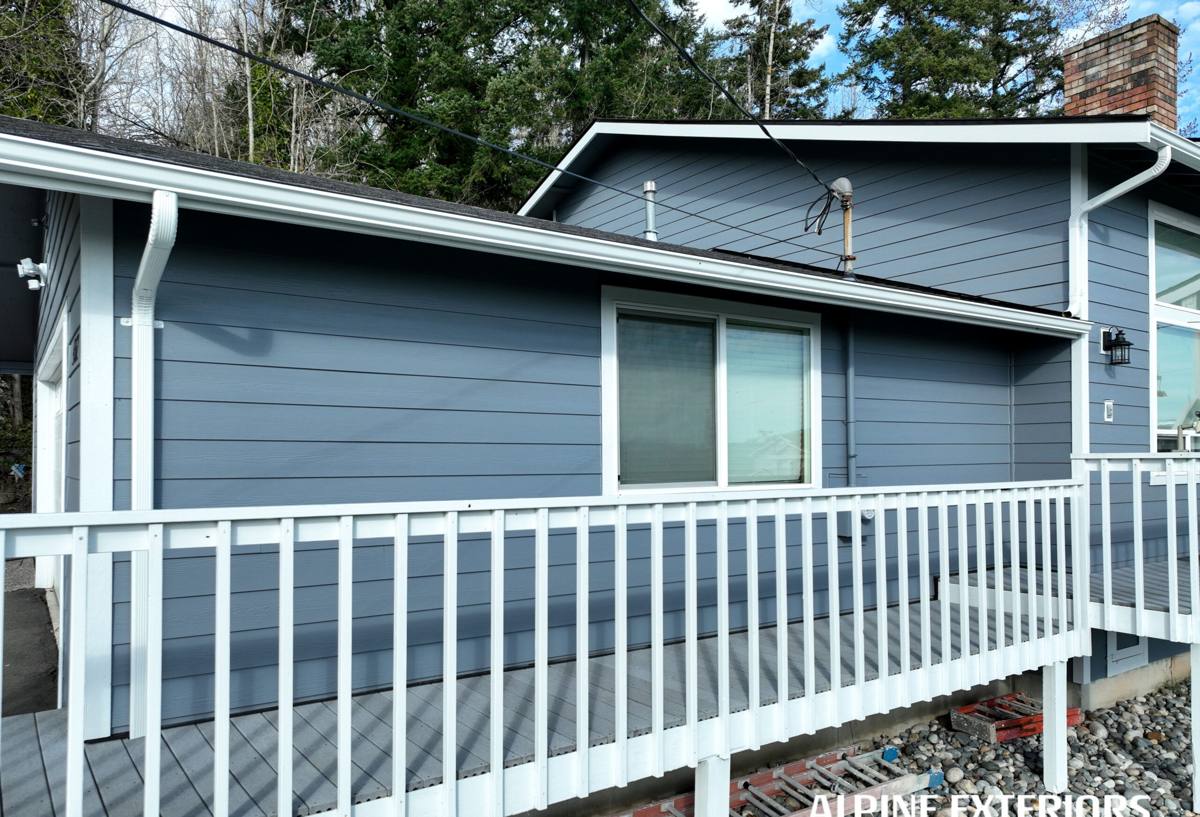
What Driving Rain and Salt Air Actually Do to a Roof
Driving rain
Wind-driven rain off the Strait doesn't just fall straight down — it gets pushed sideways and upward under shingle tabs, around chimney flashing, and into any gap in a ridge or valley. A roof built for a drier climate, with minimal underlayment or shortcuts at the valleys, will eventually let that water find a seam. The fix isn't a thicker shingle; it's a underlayment and flashing system built to shed water that's moving sideways, not just down.
Salt air and moisture
Salt air accelerates corrosion on exposed metal — nails, flashing, ridge vents, and fasteners. It also keeps roof surfaces damp longer, which is exactly the condition moss and algae need to take hold. Over years, that combination corrodes cheaper fasteners and feeds the organic growth that eats into shingle granules.
Moss season
Moss doesn't just sit on top of a roof — its rhizoids work into shingle granules and butt seams, holding moisture against the roof deck long after the rain stops. Left unchecked over a few seasons, it lifts shingle edges and accelerates wear in exactly the spots most exposed to wind-driven rain: eaves, valleys, and north-facing slopes that don't get enough sun to dry out between storms.
What a Correct New Roof Installation Involves
A full re-roof is more than swapping old shingles for new ones. Done right, it includes:
- Complete tear-off to bare deck — never install over existing layers, which traps moisture and hides deck damage
- Deck inspection and repair — soft, rotted, or delaminated sheathing gets replaced, not covered
- Ice and water shield at eaves, valleys, and penetrations — the areas most exposed to wind-driven rain and ice damming
- Synthetic underlayment across the full deck, not just felt paper, for a stronger secondary water barrier
- Balanced intake and exhaust ventilation, sized to the attic, not just a ridge vent added as an afterthought
- New flashing at all chimneys, walls, skylights, and roof-to-wall transitions — old flashing gets replaced, not reused
- Corrosion-resistant fasteners appropriate for a marine climate
- Final cleanup with a magnetic nail sweep and gutter check
Skipping any one of these doesn't usually cause an immediate problem — it causes a problem in year four or five, which is exactly why cutting corners on a re-roof is hard for a homeowner to catch at the time of installation.
Choosing a Roofing Material for This Climate
There's no single "best" roofing material for Aldergrove — the right choice depends on the home's roof pitch, budget, and how much moss and moisture resistance the owner wants to prioritize. Here's how the common options actually compare in a wet, moss-prone marine climate:
| Material | Moisture & moss behavior | Typical lifespan here | Trade-offs |
|---|---|---|---|
| Architectural asphalt shingle | Good with algae-resistant (copper/zinc) granules; without them, moss risk is higher | 20-30 years | Best value; needs periodic moss removal on shaded slopes |
| Standing seam metal | Sheds water fast, very moss-resistant on steep slopes | 40-50+ years | Higher upfront cost; requires correct fastener and underlayment detailing to avoid condensation issues |
| Cedar shake | Attractive but holds moisture; needs regular treatment and cleaning | 20-25 years with maintenance | Higher maintenance burden in this climate; insurance and fire-rating considerations vary |
| Synthetic/composite shingle | Low moisture absorption, good moss resistance | 30-50 years | Cost sits between asphalt and metal; product quality varies by manufacturer |
For most Aldergrove homes, an architectural asphalt shingle with algae-resistant granules is the practical middle ground — it costs less upfront and handles this climate well as long as ventilation and moss maintenance aren't neglected. Metal earns its higher price on steep-pitch homes where long-term moss resistance and lifespan matter more than upfront cost.
Cost factors worth understanding
| Factor | Why it moves the price |
|---|---|
| Roof pitch and access | Steep or hard-to-access roofs take longer and require more safety equipment |
| Deck condition | Rotted sheathing found during tear-off adds material and labor |
| Layers being removed | Tearing off two or three layers of old roofing costs more than one |
| Material choice | Asphalt, metal, and composite carry different material and labor costs |
| Ventilation upgrades | Adding proper intake/exhaust venting where none existed is extra work, but pays off in moss and moisture control |
We won't quote a number without seeing the roof — pitch, layer count, and deck condition swing the price too much for a broad range to be honest. What we can say is that a correct install, with full tear-off and proper ventilation, costs more upfront than a bare-minimum overlay job, and earns that difference back in the years it adds to the roof's life.
Ventilation: The Detail Most Roofs Get Wrong
Attic ventilation is the single most under-addressed factor in moss and moisture problems on roofs in this region. A roof with too little intake ventilation traps warm, moist air against the underside of the deck, which condenses, keeps the sheathing damp, and creates ideal conditions for moss and mold — even under a brand-new roof. The fix is simple in principle: balanced intake at the soffits and exhaust at the ridge, sized to the attic's square footage. It's often skipped because it takes more thought than just replacing shingles, but it's one of the cheapest ways to add years to a roof's life in a climate like this one.
Our Installation Process
We keep the process straightforward and communicate what we're finding along the way, since deck condition often isn't visible until tear-off is underway.
- On-site inspection and honest assessment of current roof condition, ventilation, and any visible problem areas
- Written estimate covering material options, scope, and what's included
- Scheduling around weather windows — we don't install shingles in active rain, and we plan around this region's wetter months where possible
- Full tear-off, deck inspection, and any necessary sheathing repair, with photos of anything replaced
- Underlayment, ice and water shield, ventilation, and flashing installed to spec
- Final roofing material installed per manufacturer requirements to keep warranty coverage intact
- Cleanup, magnetic nail sweep, and a final walk-through
Signs a repair won't cut it anymore
- Granules collecting heavily in gutters or at downspouts
- Moss established across multiple slopes, not just isolated patches
- Soft spots or visible sagging when walking the roof deck
- Daylight visible through the roof deck from inside the attic
- Repeated leaks in different locations after previous patch repairs
- Shingles curling, cracking, or losing their seal at the tabs
If you're only seeing one or two of these, a repair may still make sense. If several apply at once, that's usually a sign the roof system as a whole is past the point where patching is the economical choice.
Why a Lynden-Based Crew That Already Works Aldergrove Matters
Aldergrove sits close enough to Lynden that a crew based here can reach it without treating the job as a special trip — but working across the border does add real logistics that a purely local or purely cross-border contractor might not have sorted out: coordinating material delivery and crew scheduling around border crossing times, understanding that Aldergrove falls under Township of Langley permitting rather than a Washington jurisdiction, and knowing that homes here face the same Georgia Strait weather pattern that shapes roofing decisions on the Whatcom County side. A crew that's done this specific cross-border work before isn't guessing at any of that on your job.
We'd rather be upfront that homeowners should confirm any permit requirements directly with the Township of Langley for their specific project — regulations and thresholds can change, and we always work within whatever is currently required rather than relying on outdated assumptions.
Maintaining a New Roof in This Climate
A correctly installed roof still benefits from basic upkeep in a climate this wet:
- Clear gutters and downspouts at least twice a year so water doesn't back up under the roof edge
- Have moss treated or gently removed before it establishes on shaded, north-facing slopes
- Trim back overhanging branches that keep sections of roof shaded and slow to dry
- Have flashing and seals checked after any major windstorm
None of this is complicated, but skipping it is how a well-installed roof still ends up with avoidable moss and moisture problems years down the road.
If your Aldergrove home needs a new roof, or you're not sure whether a repair will still hold, we're happy to take a look and give you a straight answer — no pressure, no upsell. Use the form below to request a free estimate.