 Lynden Siding
 Siding Repair Built for Kendall's Climate
Kendall sits east of Lynden in a stretch of Whatcom County where larger, tree-lined lots and open rural acreage are far more common than the tighter in-town setting you'd find closer to downtown Lynden. That mix of shade, tree cover, and open exposure means siding damage on a Kendall home doesn't always show up the same way it would a few miles away. A wall tucked behind a stand of trees stays damp long after a wide-open, sun-exposed wall has dried out, and the two can be on the same house.
The underlying pressures are consistent across this part of the county, though: marine air moving inland carries enough salt to work on fasteners and trim hardware over time, wind-driven rain gets pushed sideways into wall assemblies instead of falling straight down, and a long, damp moss season settles into shaded siding and stays there for months. Siding repair in Kendall has to account for all three, not just patch whatever's visibly cracked or missing and call it done.
This page covers siding repair specifically — what actually causes repair-level damage on a Kendall home, what a correct repair job involves, when repair is the right call versus when it isn't, and how our process works from first look to final walkthrough.
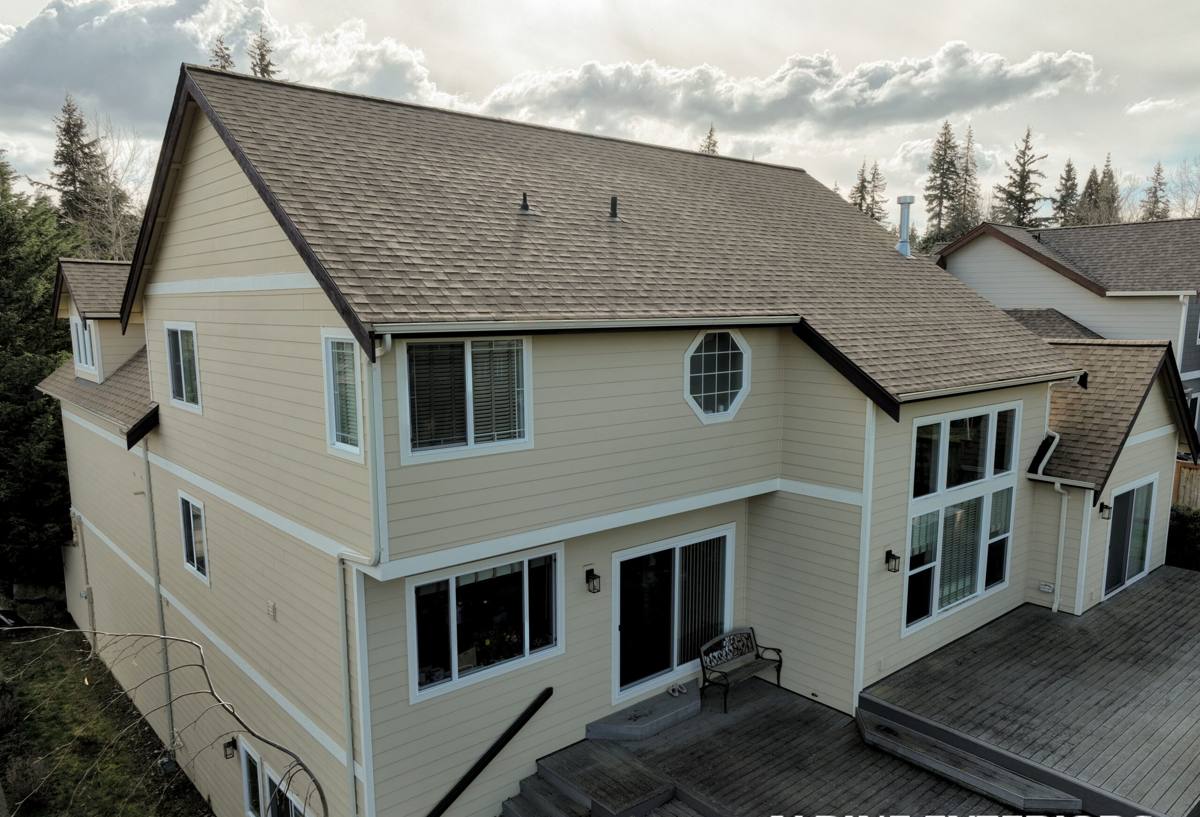
What Kendall's Climate Does to Siding Over Time
Salt Air, Even Out Here
Kendall is inland enough that people sometimes assume salt exposure isn't a real factor. It still is, just at a slower pace than a shoreline property would see. Marine air moves across this whole part of Whatcom County, and over years it accelerates corrosion on fasteners, flashing, and lower-grade trim hardware. A repair that reuses corroded fasteners or skips corrosion-resistant hardware is a repair that fails again sooner than it should.
Driving Rain
Rain through fall and winter rarely falls straight down here. Wind pushes it sideways into wall assemblies, trim joints, and anywhere a seam or penetration gives it an opening. That sideways load is often what turns a small crack or gap into a moisture problem behind the siding, well before the damage is visible from the outside.
A Long Moss Season
Kendall's mix of tree cover and larger, less densely built lots means shaded walls can stay damp for most of the year. Moss and mildew take hold on any siding surface that holds moisture against the substrate instead of shedding it, and that growth accelerates deterioration at seams, laps, and fastener points — exactly where repair work needs to focus.
Repair or Replacement? Making the Right Call
Not every damaged section of siding needs to become a full replacement job, and not every repair request should end with a patch. The honest answer depends on how isolated the damage is, how old the existing siding is, and whether matching material is realistically available.
| Situation | What Usually Makes Sense |
|---|---|
| Isolated impact damage — a cracked or dented panel, storm damage to a small section | Targeted repair, replacing the affected panels only |
| Failed caulking or sealant at trim and joints, with siding itself still sound | Resealing and refastening, often without panel replacement |
| Discontinued or hard-to-match siding color and profile | Repair with the closest available match, or a conversation about partial vs. full replacement |
| Widespread moss, soft spots, or moisture damage across multiple walls | Full replacement is usually more cost-effective than repeated repairs |
| Siding older than 20-25 years with no replacement history | Worth a full assessment before investing further in repairs alone |
We'll tell you honestly which category a given repair falls into. A contractor who only ever recommends full replacement, or who patches everything regardless of extent, isn't giving you the full picture either way.
Matching Repairs to Existing Siding
If the existing siding on a Kendall home is James Hardie, repair is usually straightforward — the product line is well documented and current, and matching color and profile is realistic. If the home has vinyl, engineered wood, cedar, or an older or discontinued product, matching gets harder the older the siding is, and color fade over years in this climate makes an exact match unlikely even when the same product is technically still available. We'll always tell you upfront how close a match is realistic, rather than promising a seamless result we can't actually deliver.
What a Correct Siding Repair Actually Involves
Assessment Beyond the Visible Damage
A correct repair starts by checking what's happening behind the visible crack or gap, not just patching the surface. Water that's found its way behind siding once often leaves a trail — softened sheathing, staining, or trapped moisture — that a surface-level patch will simply seal back over.
Sheathing and Substrate Check
Anywhere siding is removed for repair, we check the sheathing underneath for rot or soft spots before anything goes back on. Covering damaged sheathing with a fresh repair just hides a problem that keeps getting worse behind the wall.
Flashing and Weather Barrier Detail
A surprising number of repair calls trace back to a flashing or weather barrier failure rather than a defect in the siding itself. If water is getting behind the cladding at a window, trim board, or wall penetration, replacing the siding panel without fixing the flashing underneath just resets the clock on the same failure.
Fastening and Sealing to Spec
Repairs get fastened and sealed to the same standard as new installation — corrosion-resistant fasteners, correct spacing, and sealant at the joints most exposed to wind-driven rain. A repair that cuts corners here tends to need a second repair within a few years.
Common Siding Repair Issues on Kendall Homes
- Cracked, split, or missing panels after storm damage or impact
- Soft or spongy siding near ground level or around window and door trim, usually signaling trapped moisture
- Moss or dark staining that returns quickly after cleaning on shaded, tree-covered walls
- Failed caulking at trim joints, corners, and penetrations, letting wind-driven rain behind the siding
- Rust staining running down from corroded fasteners or trim hardware
- Warping or buckling on older wood-based or engineered wood siding
- Gaps or separation at panel seams following seasonal expansion and contraction
Repair Cost Factors
| Factor | What It Affects |
|---|---|
| Extent of damage | A few isolated panels vs. a wider pattern across multiple walls |
| Material match availability | Whether existing siding can be closely matched or requires a compromise |
| Hidden sheathing damage | Whether repair scope grows once old siding comes off |
| Access and wall height | Staging and labor time on taller or harder-to-reach sections |
| Flashing or weather barrier work | Whether the underlying cause of the damage also needs correcting |
A repair estimate that only quotes panel replacement, with no mention of what's underneath, is usually an incomplete picture. Ask what happens if sheathing damage turns up once the old siding is off.
How Our Process Works
- In-person assessment: We look at the damage directly, including what's happening at the sheathing where practical, not just the visible surface.
- Honest repair-or-replace recommendation: You get our real read on whether a targeted repair makes sense or whether the extent of damage points toward replacement.
- Written estimate: A clear, itemized quote covering material match, fastening, flashing correction where needed, and cleanup.
- Repair work: Damaged panels and trim are replaced, sheathing issues are addressed if found, and flashing or sealant details are corrected at the root cause, not just resealed over.
- Final walkthrough: We review the completed repair with you and point out anything worth watching going forward.
Why Hiring a Crew That Already Works in Kendall Matters
A crew that regularly works siding jobs in and around Kendall has already seen which wall orientations on these larger, tree-covered lots stay wet longest, how salt-laden air works on fasteners further inland than people expect, and what a wind-driven rain failure actually looks like once you open a wall up. That's the kind of practical knowledge that shows up in whether a repair actually holds or needs a callback in two years.
It also matters for straightforward accountability. If a repair doesn't hold up the way it should, it helps to be calling a crew that's still working in the area, not tracking down a contractor who bid the job once and moved on.
A Practical Checklist Before Hiring for Siding Repair
- Do they check for hidden sheathing damage before closing the repair back up?
- Does the estimate address flashing or weather barrier issues, not just the visible siding damage?
- Are they honest about how close a material match is realistic, given your existing siding's age?
- Do they carry current WA contractor licensing, liability insurance, and workers' compensation?
- Can they point to recent, real repair work in or near Kendall?
- Will they tell you plainly if a repair isn't the right call and replacement makes more sense?
If you have damaged, aging, or failing siding on a Kendall property and want a straightforward look at what it actually needs, we're glad to come take a look. Use the form below to request a free, no-pressure estimate.