 Lynden Siding
 What Bellingham's Climate Does to Siding
Bellingham sits close enough to salt water and open exposure that homes here take on a different kind of weathering than siding just a few miles inland in Lynden proper. The combination of salt-laden air, driving wind-blown rain, and a moss season that can stretch from October through April puts steady, compounding stress on exterior walls. It's rarely one dramatic event that ruins siding in this part of Whatcom County — it's years of small, repeated exposure that most homeowners never see happening until the damage is already behind the wall.
Salt air is corrosive to fasteners, trim flashing, and any siding material that isn't engineered to resist moisture intrusion at the seams. Driving rain doesn't just fall straight down here — wind pushes it sideways into lap joints, butt seams, and anywhere caulking has started to fail. And moss doesn't just grow on roofs. It colonizes north-facing and shaded siding walls, holding moisture against the surface for months at a time and giving rot a head start wherever the substrate underneath isn't sealed correctly.
A siding replacement in Bellingham has to be evaluated against all three of these stressors at once, not just picked for looks or price.
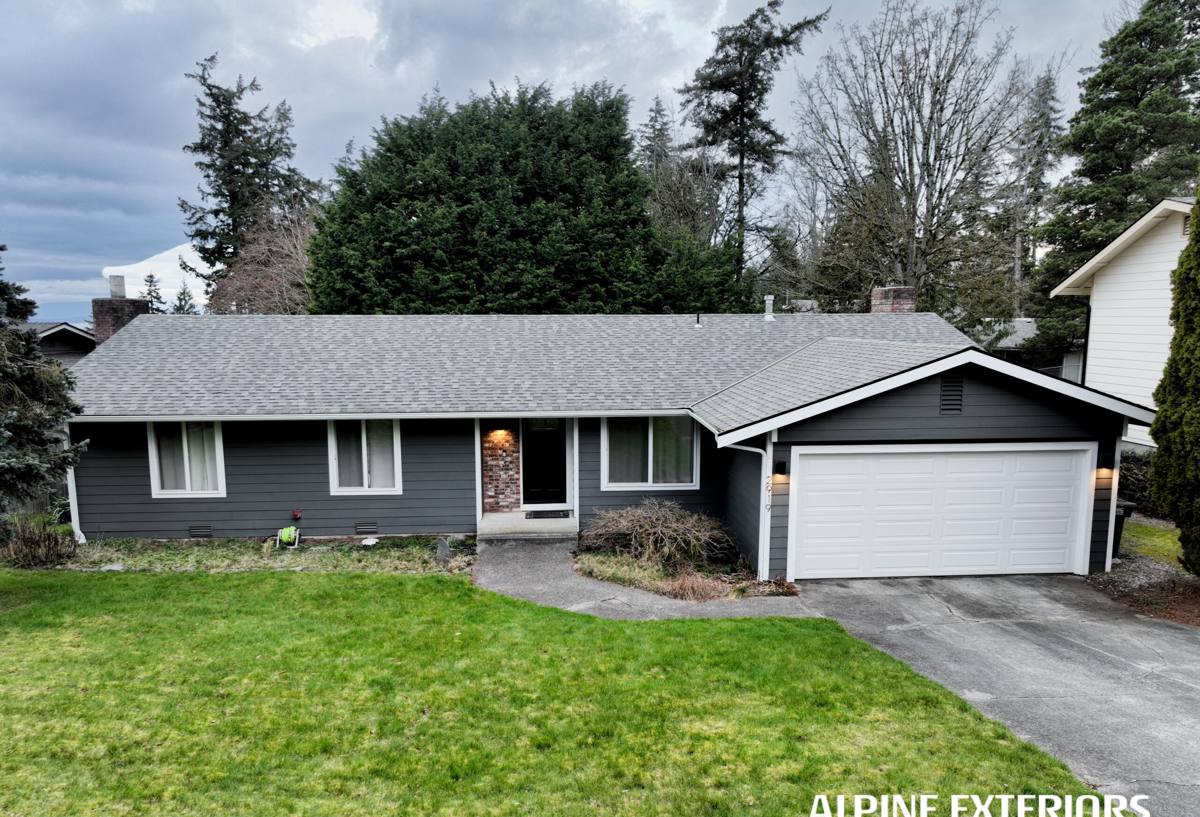
Signs a Bellingham Home Needs Siding Replacement, Not Just Repair
Not every siding problem calls for a full replacement. But there's a point where patching stops making sense and a full re-side becomes the more honest, more cost-effective answer. Homeowners in this area should watch for:
- Soft or spongy spots when you press on the siding, especially near the bottom courses and around window trim
- Visible moss or dark algae streaking that keeps coming back within a season or two of cleaning
- Paint that's bubbling, peeling, or failing faster than a normal repaint cycle would suggest
- Gaps opening at seams, corners, or where siding meets trim, letting wind-driven rain track behind the material
- Warping, cupping, or visible delamination on panel or lap products
- Rising energy bills paired with drafts, which often points to a compromised weather barrier behind failing siding
If you're seeing two or more of these at once, that's usually a sign the underlying moisture barrier and sheathing are already involved, not just the visible siding surface. At that point, spot repairs are a delay, not a fix.
Why Repairs Often Fail on Homes Near the Coast
Repair-only approaches struggle here because the damage usually isn't confined to the panel you can see. Once salt-laden moisture has worked behind a seam and into the sheathing, patching the visible siding without addressing what's underneath just re-covers the problem. We've found that a proper assessment before any repair decision — checking moisture readings behind suspect areas rather than guessing from the surface — is the only honest way to know whether repair or replacement is the right call.
What a Correct Siding Replacement Involves
A siding replacement is not just removing old material and nailing up new panels. Done correctly, especially in a climate that sees this much wind-driven rain, it's a system-level job. Here's what that system looks like:
- Full tear-off and inspection. Old siding comes off entirely so the sheathing and framing underneath can be inspected for rot, moisture staining, or insect damage. Anything compromised gets repaired or replaced before new material goes up — covering a soft spot with new siding just hides the problem for a few more years.
- Correct weather-resistive barrier installation. A properly lapped and sealed house wrap or building paper, installed shingle-style so water sheds outward and down, is the single most important layer against driving rain. This is where a lot of lower-quality installs cut corners, and it's invisible once siding goes back on.
- Flashing at every penetration. Windows, doors, hose bibs, vents, and any other wall penetration need properly integrated flashing that directs water back out, not behind the barrier. This is one of the most common failure points we find when we tear off older siding.
- Rainscreen or drainage gap where appropriate. Giving water a path to drain and air a path to dry behind the siding matters more in a wet, moss-prone climate than in a dry one. It reduces the moisture load the siding and sheathing have to deal with over the life of the product.
- Correct fastening and gapping for the material. Fiber cement, in particular, has specific nailing patterns, gap tolerances, and clearance requirements from grade and roof lines. Installed too tight or fastened incorrectly, even a good product will fail early.
- Sealed, factory-matched finish where possible. Field-painted seams and cut edges are a weak point compared to factory-finished products where the color and sealant are baked in under controlled conditions.
Why We Install Only James Hardie Fiber Cement
We stopped installing vinyl, LP SmartSide, primed spruce, cedar, and other fiber cement brands like Cemplank or Allura as our standard product. That's a deliberate professional decision, not a marketing angle, and it's worth explaining honestly.
Vinyl siding is inexpensive and easy to install, but it expands and contracts significantly with temperature swings, and its seams and J-channels are a common entry point for wind-driven rain when installed in an exposed, gusty environment like this one. Wood-based products — cedar, primed spruce — look good initially but require an ongoing maintenance commitment (repainting, sealing, moss treatment) that most homeowners underestimate, and they're more vulnerable to rot once moisture gets behind a compromised seam. Engineered wood products like LP SmartSide use a resin-treated wood strand core that performs reasonably well but is still an organic substrate, meaning long-term moisture exposure remains a variable to manage rather than a risk that's engineered out.
James Hardie fiber cement is non-combustible, dimensionally stable across our temperature and humidity swings, and doesn't feed mold or rot the way wood-based products can if moisture does find its way behind a panel. Hardie's ColorPlus factory finish bakes color and sealant onto the board under controlled conditions, which holds up better than field-applied paint against the freeze-thaw and rain cycles this area sees. And Hardie's HZ5 product line is specifically engineered for climates like ours — colder, wetter regions where moisture resistance matters more than it would in a dry southern market.
None of this means other products are junk — plenty of homes are sided in vinyl or wood and hold up fine with regular maintenance. It means that for the climate stress Bellingham homes actually face, we believe fiber cement installed to spec is the more defensible long-term choice, and we'd rather stand behind one product line we know inside and out than spread our expertise across several.
Comparing Siding Options for a Bellingham Climate
| Material | Moisture Resistance | Maintenance | Fire Resistance | Typical Lifespan Range |
|---|---|---|---|---|
| James Hardie Fiber Cement | High — engineered HZ5 line for wet climates | Low — factory finish, occasional wash | Non-combustible | Long-term with correct install |
| Vinyl | Moderate — seam and J-channel vulnerable | Low, but prone to cracking/fading | Combustible, can warp near heat | Moderate |
| Cedar / Primed Wood | Low without diligent upkeep | High — repaint/reseal cycle | Combustible | Shorter without maintenance |
| LP SmartSide (Engineered Wood) | Moderate — treated but still organic | Moderate | Combustible | Moderate |
This is a general comparison, not a guarantee for any individual product — actual performance depends heavily on installation quality, maintenance, and site-specific exposure.
Why a Crew That Already Works Bellingham Matters
Siding installation isn't uniform across regions, and a crew that mostly works drier inland areas can miss details that matter here. A contractor familiar with Bellingham and the broader Whatcom County coastal exposure knows to pay closer attention to flashing details around windows facing prevailing wind and rain, to plan installation around the wetter months rather than fighting them, and to recognize early moss and moisture patterns on existing siding that indicate where a wall assembly is already compromised. That local pattern recognition is something you build from doing the work in this specific climate repeatedly, not something you get from a general contractor résumé.
What to Expect From Our Process
We keep the process straightforward and transparent from first visit to final walkthrough:
- An on-site assessment where we look at your current siding condition, check for moisture behind suspect areas, and talk through what full replacement would involve for your home specifically
- A clear, written estimate that spells out the scope — tear-off, sheathing repair if needed, weather barrier, flashing, and the Hardie product line and color you choose
- A tear-off and inspection phase where we show you what we find before covering it back up
- Correct installation following James Hardie's fastening, gapping, and clearance specifications, not shortcuts
- A final walkthrough so you understand what was done and what warranty coverage applies
What Correct Installation Protects
The value of a siding replacement isn't just the new look — it's what it protects underneath. Properly installed siding, weather barrier, and flashing are what keep wind-driven rain and salt-laden moisture out of your framing, insulation, and interior walls. Get that system wrong, even with a premium product, and you're still exposed to the same rot and moisture problems that likely brought you to a replacement in the first place. Get it right, and the siding becomes one part of a durable wall assembly built for the actual conditions Bellingham throws at it, not for a generic climate somewhere else.
James Hardie backs its products with a strong, transferable warranty when installed to their specifications — another reason correct installation isn't optional. A warranty is only as good as the install underneath it.
If your Bellingham home's siding is showing signs of wear from salt air, rain, or moss, we're happy to take a look and give you a straightforward, no-pressure assessment. Fill out the form below to schedule a free estimate.