 Lynden Siding
 Deck Replacement Built for the Nooksack Area
If you own a home in the Nooksack area near Lynden, you already know what a deck goes through here. It's not one big dramatic event that wrecks a deck — it's years of small, quiet damage from rain that never really stops, moss that moves in every fall and doesn't leave until late spring, and the salt-tinged air that drifts in off the water and settles on everything, including your fasteners and flashing. By the time a deck actually fails, it's usually been telling you for a couple of seasons already: soft spots near the house, boards that stay dark and damp longer than the rest, rail posts that wiggle a little more than they used to.
A deck replacement done right for this specific area isn't just "new boards on old frame." It means designing and building for the conditions this part of Whatcom County actually produces, not the generic conditions a deck package assumes. That's the whole focus of this page — what a Nooksack-area deck replacement should involve, what we actually do, and why it matters that the crew doing it already works in this neighborhood.
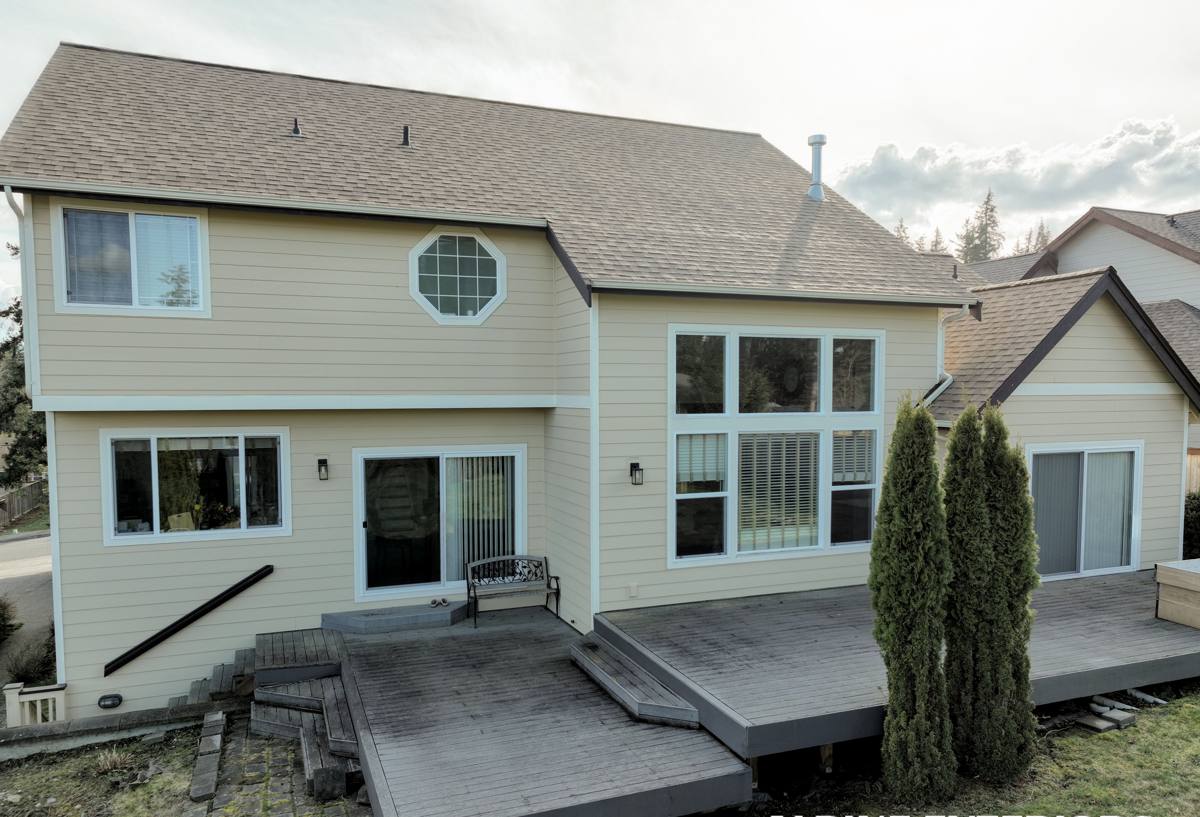
Why Decks Wear Out Faster Here Than the Brochures Suggest
Driving rain and standing moisture
Whatcom County rain doesn't usually fall straight down — wind pushes it sideways into ledger connections, stair stringers, and the gaps between deck boards and framing. Water that gets driven into those tight spaces takes far longer to dry out than water that just falls on a flat surface, which is exactly where rot gets started on an older deck.
Moss season is a long season
Moss needs shade, moisture, and time, and this area supplies all three for a good stretch of the year. On a deck, moss doesn't just look bad — it holds moisture against the wood surface and can make boards slick and slippery underfoot, which is a real safety issue on stairs and near entry doors.
Salt air and hardware
Coastal-influenced air carries fine salt content that speeds up corrosion on fasteners, joist hangers, and any exposed metal connectors. A deck can look structurally fine on the surface while the hardware holding it together is quietly corroding underneath. This is one of the most common things we find on decks we're asked to replace — the decking looks tired, but the real problem is what's underneath it.
Signs a Deck in This Area Needs Replacing, Not Patching
- Boards that feel spongy or give slightly when you step near the house or at stair landings
- Persistent moss or algae staining that comes back within weeks of cleaning
- Rust streaks below joist hangers, fasteners, or ledger bolts
- Rail posts or stair stringers that have any side-to-side movement
- Gaps that have widened or boards that have cupped or crowned noticeably
- A ledger board attachment you can't confirm was properly flashed when it was built
- A deck older than 15–20 years that's never had the framing inspected, only the surface refinished
Any one of these on its own might just mean a repair. Two or three together, especially on an older deck, usually means the framing and connections have reached the point where a full replacement is the more honest recommendation — patching a deck with compromised framing just delays the same conversation a year or two down the road, at more cost.
What a Correct Deck Replacement Involves
A deck replacement isn't just pulling up decking boards and screwing down new ones. Done properly, it's a rebuild of everything moisture actually touches, starting from the house outward.
Ledger and house connection
This is the single most important part of any deck attached to a house, and it's the part most likely to have been under-flashed originally. We check and rebuild the ledger connection with proper flashing that sheds water away from the house structure, since this is where driving rain does the most hidden damage over time.
Framing and hardware
Joists, beams, and posts get evaluated for rot and movement, and all structural hardware gets replaced with fasteners and connectors rated for exterior, corrosion-prone conditions — not standard interior-grade hardware that will start rusting within a couple of wet seasons.
Decking material
Whether you go with wood or composite, the decking surface needs to handle standing moisture and moss growth without cupping, splintering, or staining permanently. We'll walk through the honest trade-offs for your situation rather than pushing one material as a cure-all.
Drainage and airflow underneath
A deck that can't dry out underneath will always struggle here. Proper spacing, grading below the deck, and airflow planning reduce how long moisture sits against the framing after a rain event — which, in this area, is the difference between a deck that lasts and one that doesn't.
Stairs and railings
Stairs take the most direct hit from moss and slickness since they're often shaded and see concentrated foot traffic. Railings and stair connections get rebuilt to current structural standards, not just cosmetically refreshed.
Decking Material Comparison for This Climate
| Material | How It Handles Rain & Moss | Maintenance | Typical Lifespan Here |
|---|---|---|---|
| Pressure-treated wood | Needs regular sealing to resist moisture absorption; prone to moss if not maintained | Annual cleaning and periodic re-sealing | 10–15 years with upkeep |
| Cedar | Naturally moisture-resistant but still needs sealing; can gray and hold moss if neglected | Sealing every 1–2 years, regular cleaning | 15–20 years with upkeep |
| Composite decking | Resists moisture absorption and moss staining much better than wood surfaces | Periodic washing, no sealing needed | 25+ years, varies by product line |
There's no single "right" material for every home — it depends on your budget, how much upkeep you want to do, and the look you're after. What matters more than the brand name is whether the framing underneath is done correctly, because even the best decking material will fail early on a poorly built or badly drained frame.
Our Process for a Nooksack-Area Deck Replacement
- On-site assessment — we look at the existing deck's framing, ledger connection, and hardware condition, not just the surface boards, so you know exactly what's driving the recommendation.
- Honest scope and estimate — you get a clear picture of what needs full replacement versus what could reasonably be repaired, with straightforward pricing.
- Removal and framing rebuild — old decking, hardware, and any compromised framing come out, and the structure gets rebuilt with corrosion-resistant hardware and proper ledger flashing.
- Decking, stairs, and rails — installed to current structural standards, with attention to drainage and airflow underneath.
- Final walkthrough — we go over the finished deck with you, including what maintenance (if any) the material you chose will need going forward.
Why a Crew Already Working in This Area Matters
A deck built for generic conditions and a deck built for Lynden-area conditions can look identical on install day and age completely differently five years later. A crew that already works around Nooksack and greater Lynden has already seen which ledger details fail first in this rainfall pattern, which hardware actually holds up against the salt-influenced air, and which shaded spots on a property turn into moss traps every fall. That's not something you can substitute with a generic deck package bought off a big-box shelf — it comes from working this specific ground, season after season.
It also means someone who understands your property's drainage patterns and sun exposure is the one designing the rebuild, not applying a one-size-fits-all spec sheet to a climate it wasn't written for.
What to Ask Before Hiring Anyone for This Job
- Will you inspect and, if needed, replace the ledger flashing, not just the decking boards?
- What hardware grade do you use for fasteners and connectors, and is it rated for corrosion resistance?
- How do you handle drainage and airflow underneath the deck so it can actually dry out between rain events?
- Do you offer options across wood and composite, and will you walk through the honest maintenance trade-offs of each?
- Can I see the scope of work in writing before anything is torn out?
A contractor who answers these plainly, without dodging the framing and hardware questions, is telling you they actually understand what causes decks to fail in this climate — not just how to install decking boards.
Get a Straightforward Look at Your Deck
If your deck near Nooksack or anywhere around Lynden is showing soft spots, persistent moss, rusting hardware, or just isn't holding up the way it used to, we're happy to take a look and give you an honest read on repair versus replacement — no pressure, no upsell. Use the form below to request a free estimate and we'll get back to you to schedule a time that works.